Mark your calendars! 6 comets to observe in 2026
What's the story
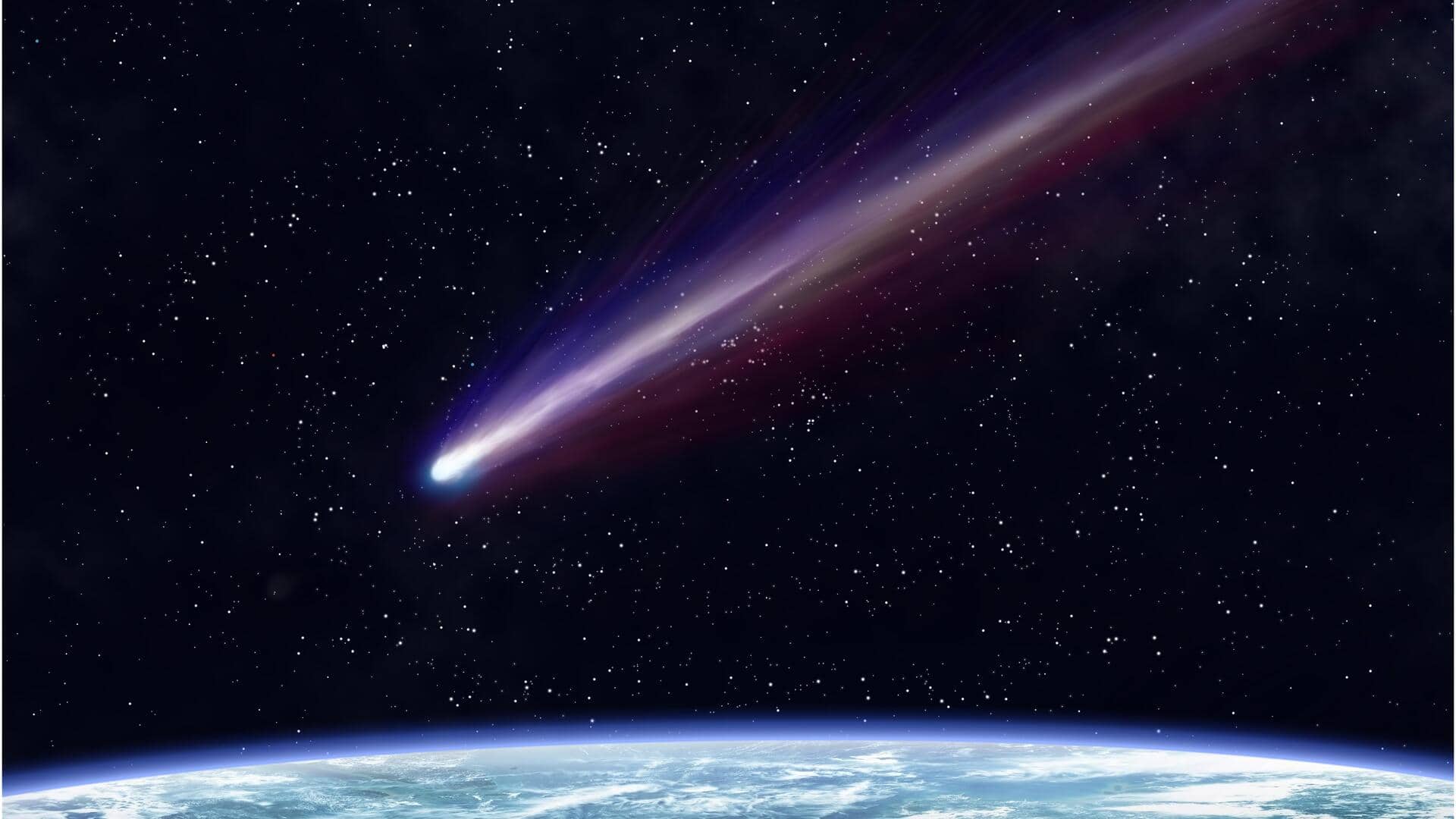
Astronomers are gearing up for a spectacular year of comet sightings in 2026. A number of comets will be visible through binoculars and small telescopes, with some even becoming briefly visible to the naked eye. The visibility of these celestial wonders will vary by location and date, so sky enthusiasts are advised to keep an eye on both hemispheres.
First sighting
Comet 24P/Schaumasse: A January spectacle
The first comet to watch out for is 24P/Schaumasse, which will reach peak brightness around January 8.
This celestial body was discovered in 1911 by Alexandre Schaumasse and has an orbital period of 8.18 years.
Observers from both hemispheres can see it as a fuzzy dot with binoculars, although southern observers will have to wait until about 2:00am to track its path across the sky.
Second sighting
C/2024 E1 Wierzchos: Hyperbolic journey
The second comet to look out for is C/2024 E1 Wierzchos, which will first peak around perihelion on January 20.
Discovered by Polish astronomer Kacper Wierzchos in 2024, this hyperbolic comet is likely to leave the Solar System.
It will initially be visible in the Southern Hemisphere but may fade to magnitude 8 by February 17, when it will be observable in the Northern Hemisphere with binoculars.
Third sighting
88P/Howell: A short-period comet
The third comet to observe is 88P/Howell, which will be visible mainly in the Southern Hemisphere. Its perihelion occurs on March 18, reaching around magnitude 10.
Discovered by Ellen Howell in 1981, this short-period comet orbits the Sun every 5.5 years.
It stays near Capricornus for easy tracking and offers repeated opportunities for observation during favorable returns.
Fourth sighting
C/2025 R3 PanSTARRS: Potentially brightest comet of 2026
The fourth comet to watch out for is C/2025 R3 PanSTARRS, which may become the brightest comet of 2026.
Its perihelion occurs on April 19, with a possible magnitude of 3 under ideal conditions.
Observers in both hemispheres will have a short but potentially spectacular visibility window for this celestial body discovered by the Pan-STARRS survey in 2025.
Fifth sighting
10P/Tempel 2: A Jupiter-family comet
The fifth comet to observe is 10P/Tempel 2, which will emerge in the evening sky after sunset from July onward.
Discovered in 1873 by Wilhelm Tempel, this Jupiter-family comet has a 5.37-year orbital period.
It can be viewed with binoculars or small telescopes for safe viewing around perihelion on August 2-3 when it reaches magnitude 7.0.
Final sighting
3I/Atlas: An interstellar visitor
The last comet to watch out for is 3I/Atlas, an interstellar comet that will continue fading into spring 2026.
It requires telescopes to observe as it dims from magnitude 10.8.
In March, it passes near Jupiter on its interstellar trajectory and won't return, offering a rare chance for observation.
Observers are advised to find dark locations and track the comet's path using apps for the best views.