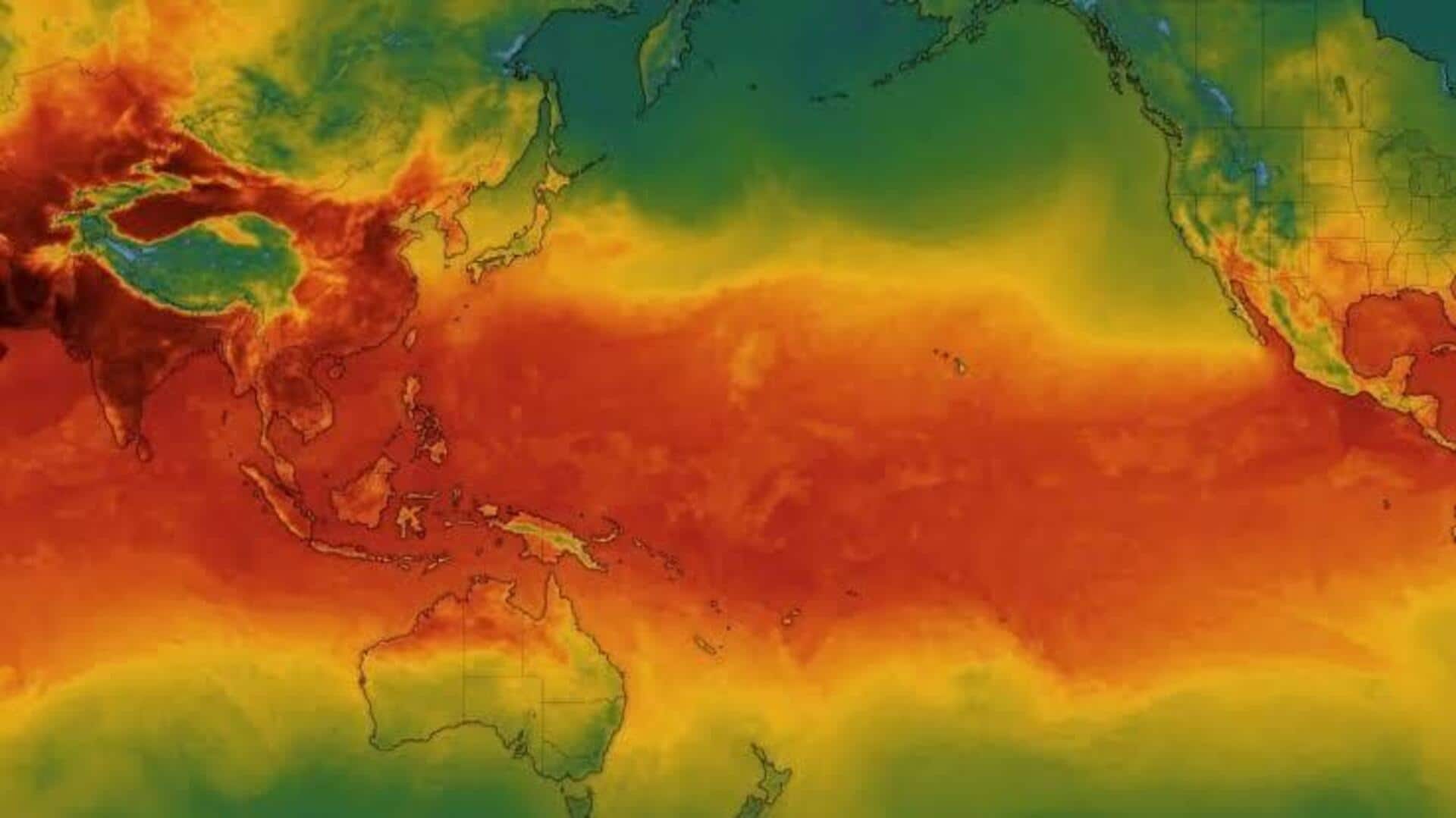
El Nino is now at its strongest in 1,000 years
What's the story
A recent study has found that the El Nino weather phenomenon is now more intense than it has been in the last millennium. The research, led by Julie Cole from the University of Michigan, used fossilized corals from the Galapagos Islands to reconstruct a 1,000-year-long record of ocean surface temperatures. The findings indicate that current El Nino events are unlike anything seen during pre-industrial times.
Coral analysis
How did researchers collect data?
The study focused on corals in the eastern Pacific, where El Nino events are most intense.
These corals grow at a rate of one to two centimeters per year and their calcium carbonate skeletons contain chemical signatures that reflect historical water temperatures.
By analyzing the strontium-to-calcium ratio and different oxygen isotopes in these skeletons, researchers were able to create a temperature record over the life span of each coral colony.
Climate shift
Findings of the study
The study found that temperature variability since 1984 is 36.5% higher than the pre-industrial period from 1000 to 1850 CE, and still 16.2% higher than the period from 1851 to 1982.
Cole explained these figures mean that El Nino events which used to run one or two degrees above normal in the Galapagos now run three or four.
This indicates a significant increase in the intensity of modern El Nino events compared to historical ones.
Human impact
Human activity linked to increased El Nino variability
The study also found a shift in skewness, indicating that warmer events have become stronger. This increased variability is attributed specifically to El Nino.
The researchers used coral records and climate models to show that this increase in ENSO variability is not natural but rather a result of human activity.
Cole said, "We are attributing that to warming, and we know what causes the warming, and it's our use of fossil fuels."