
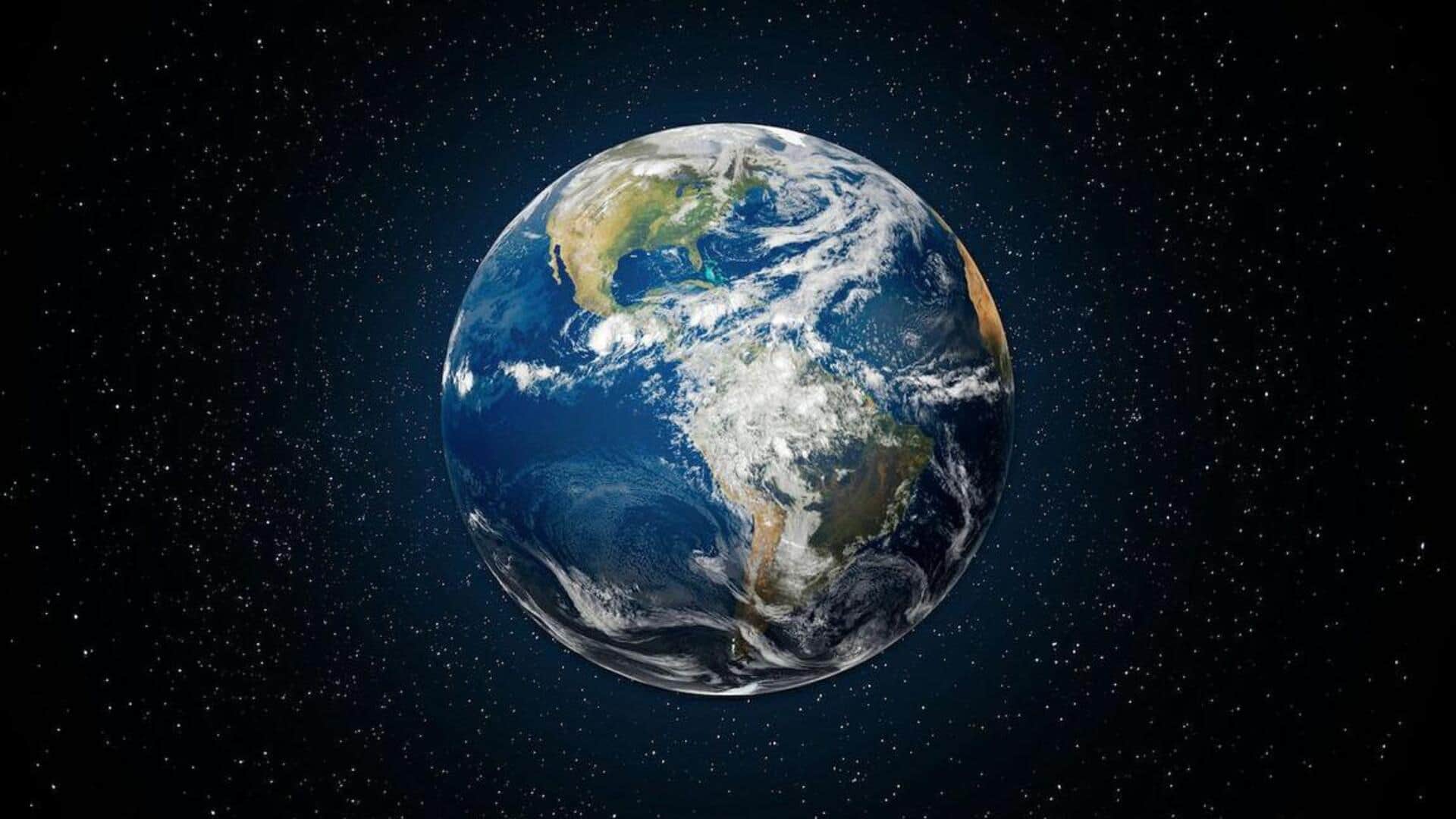
We learned these wild things about Earth in 2025
What's the story
In 2025, scientists made major strides in understanding Earth's history and its inner workings. A rocky outcrop in northern Quebec was identified as the oldest known surviving fragment of Earth's crust, dating back 4.16 billion years. The discovery could provide valuable insights into a little-known chapter of our planet's past. Meanwhile, researchers also discovered a thriving ecosystem nearly 9.6km beneath the ocean surface.
Ancient crust
The Nuvvuagittuq outcrops: Earth's oldest rock?
The exposed remnant of the ancient ocean floor, known as the Nuvvuagittuq outcrops, is believed to be from the Hadean eon. This period started 4.6 billion years ago when Earth was thought to be hot and hell-like. Scientists think this newly dated rock formation may hold signatures of life from that time. However, its acceptance as Earth's oldest rocks remains a matter of scientific debate due to lack of definitive dating methods for such ancient rocks and minerals.
Lightning link
Microlightning and the origins of life
The flickering phenomenon of will-o'-the-wisps has long puzzled scientists. A September study revealed that tiny flashes of lightning ignite microscopic bubbles of methane, creating these eerie flames. The research suggests that microlightning in primordial mist may have sparked the chemical formation of life's building blocks over three billion years ago.
Pole shift
Magnetic north pole's unpredictable journey
The magnetic north pole, unlike its geographic counterpart, is constantly moving due to Earth's magnetic field. Its movement has been erratic over the past few decades. This year, scientists updated the World Magnetic Model to reflect this shift and predict its future course. Since its discovery in 1831, magnetic north has drifted from Canada toward Russia at varying speeds.
Oceanic life
Deep-sea ecosystem discovered
Geochemist Mengran Du's team discovered a new ecosystem of organisms living 5,800 to 9,500 meters below the ocean's surface. These creatures use methane instead of sunlight for survival. The bacteria inside clam and tube worm species in this ecosystem convert organic matter in sediments into carbon dioxide and then into methane, an ability previously unknown to researchers.
Geological secrets
Hidden supercontinents and their influence on Earth's crust
A study in January revealed that remnants of supercontinents buried deep within the mantle are older than previously thought. This finding challenges the idea of a uniformly blended rocky mantle and suggests hidden structures like these ancient tectonic plates could influence activity in both the mantle and Earth's crust. In August, another geological anomaly, a mass of hot rock beneath Appalachian Mountains, was found to have formed about 80 million years ago when Greenland separated from North America.
Core mysteries
Changes in Earth's inner core shape and gold leakage
Finally the innermost layer of Earth, a hot solid ball of metal with a liquid metal outer core, may be changing shape. Scientists study it by observing changes in seismic waves as they pass through the core. In May, a study suggested that at least some gold from Earth's core has escaped to the surface via Hawaiian rock formation. This raises the possibility of more such precious metals reaching Earth's crust in future.