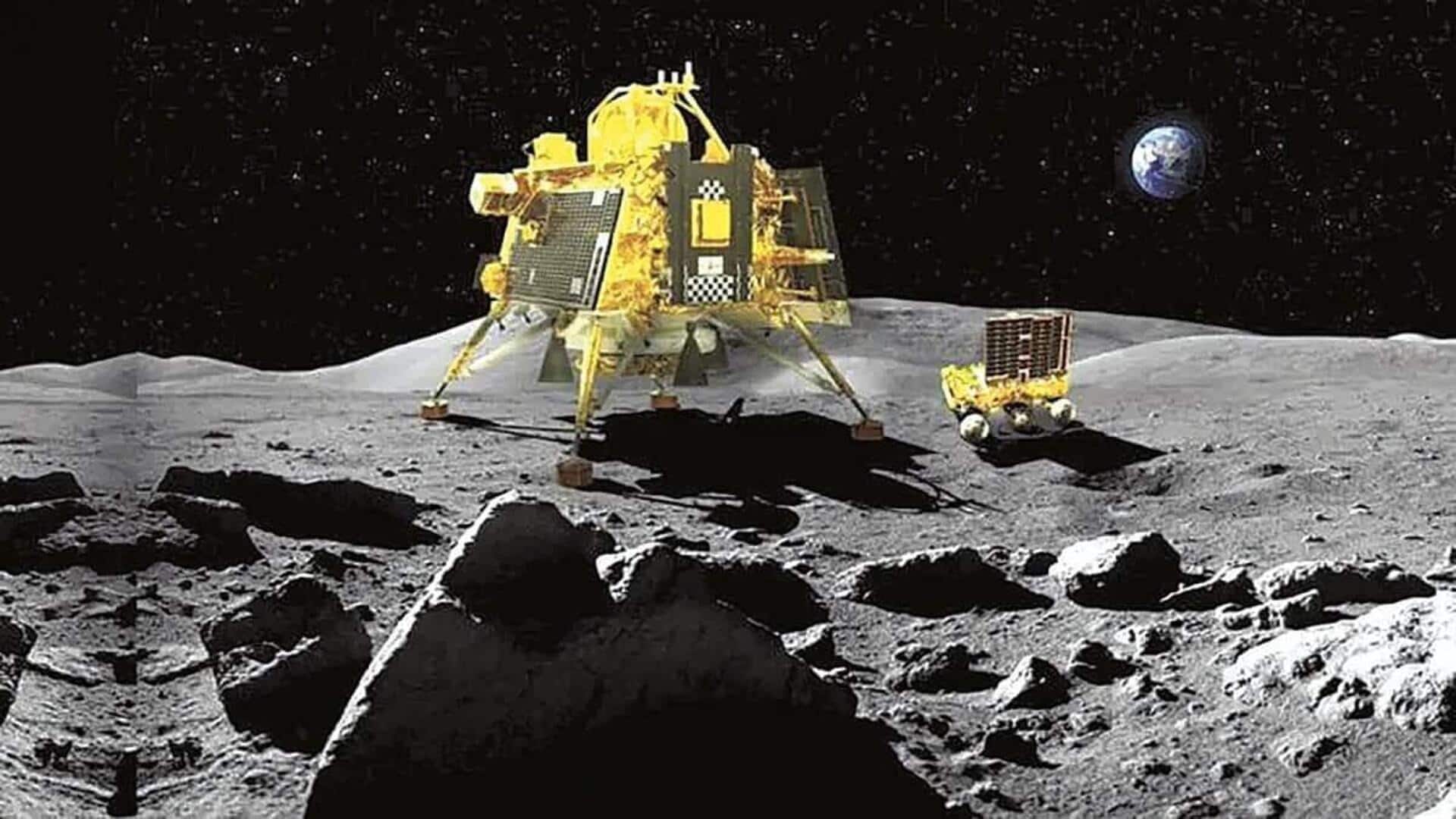
How IIT Kharagpur's new discovery will help Chandrayaan-4 mission
What's the story
A team of researchers from Indian Institute of Technology (IIT) Kharagpur and Physical Research Laboratory, has made a major breakthrough in understanding the Moon's deep interior. Their study focuses on ilmenite-bearing cumulates (IBC). They are a rare class of iron and titanium-rich rocks that are believed to have formed 4.3-4.4 billion years ago during a period when the Moon was covered by a vast ocean of molten rock. The research is all set to boost India's Chandrayaan-4 mission.
Geological insights
Recreating the Moon's interior
As the magma ocean cooled, the dense mineral layers sank deep into the lunar interior, preserving a record of the Moon's early evolution.
To study these ancient materials, the team recreated extreme lunar interior conditions in lab experiments.
They subjected samples to pressures of up to three gigapascals and temperatures exceeding 1,500 degree Celsius.
The high-pressure experiments showed how IBC rocks partially melt and interact with the surrounding mantle, producing magmas similar to titanium-rich basalts seen on the Moon's surface.
Mission preparation
Implications for lunar missions
Professor Sujoy Ghosh, a lead researcher on the paper, emphasized the importance of such work ahead of future sample-return missions.
He said, "These results provide an experimental framework to better understand the origin and evolution of lunar samples."
The study also revealed that different melting conditions produce different types of magma.
At higher temperatures, moderately titanium-rich melts form intermediate-Ti basalts, while at lower temperatures very high titanium melts evolve into more titanium-rich and magnesium-poor compositions before mixing with ascending magmas.
Magma evolution
Understanding volcanic activity
The complex processes revealed by the study ultimately give rise to the high-Ti basalts detected by past missions.
It also sheds light on how magma behaves deep within the Moon.
At lower pressures, these melts can rise to the surface, contributing to volcanic activity.
At higher pressures, certain magmas may sink back into the mantle, indicating a dynamic internal system involving both the upward and downward movement known as mantle overturn.
Exploration impact
Impact on Chandrayaan-4 mission
The findings have direct implications for India's future exploration plans.
With Chandrayaan-4 tipped to bring back samples later this decade, understanding where the titanium-rich materials form and how they evolve shall be critical for selecting landing sites and interpreting returned specimens.
The research will help identify scientifically valuable materials on the lunar surface and guide mission planning, while improving predictions about the Moon's geology based on orbital data collected by spacecraft.