India's Aditya-L1 collaborates with European spacecraft to study solar eruptions
What's the story
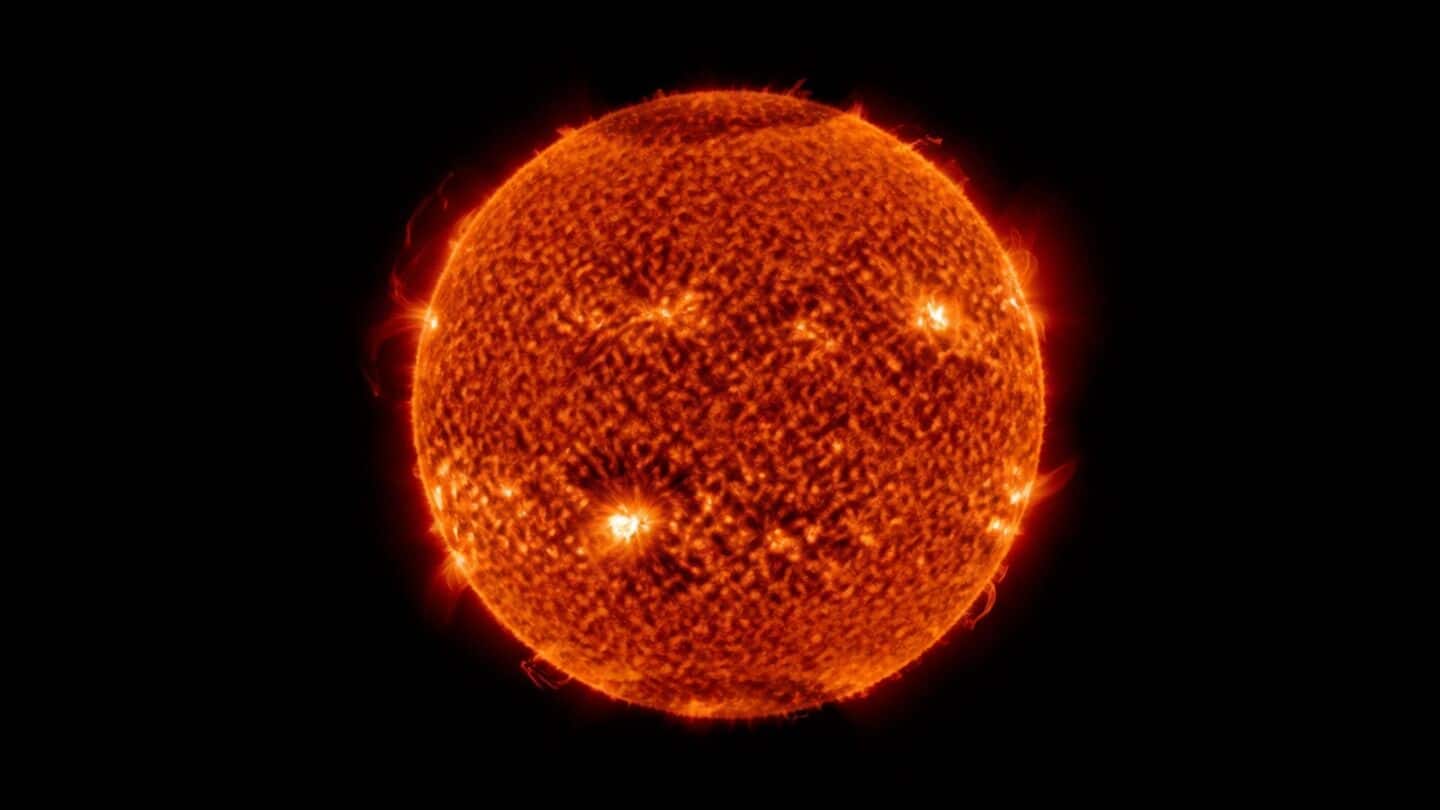
India's first dedicated solar mission, Aditya-L1, has teamed up with Europe's Proba-3 spacecraft to study the early evolution of powerful solar eruptions. The collaboration aims to provide new insights into phenomena that can disrupt satellites, communications, and Earth's space environment. The joint analysis was done by scientists from the Indian Institute of Astrophysics (IIA), Bengaluru. Their work has been published in the journal Astronomy & Astrophysics.
CME significance
CMEs can disrupt satellites, communications
Coronal mass ejections (CMEs) are huge bursts of magnetized plasma released from the Sun into space.
When they head toward Earth, they can trigger geomagnetic storms, disrupt satellites, and interfere with navigation and communication systems.
Understanding how these eruptions develop near the Sun is key to predicting their evolution and potential impact.
However, observing CMEs in the inner corona has been difficult, especially in their early stages.
Mission details
Aditya-L1 and Proba-3 spacecraft
Launched on September 2, 2023, Aditya-L1 entered a halo orbit around the Sun-Earth L1 point on January 6, 2024.
Its Visible Emission Line Coronagraph (VELC) instrument studies the solar corona using spectroscopic observations.
Meanwhile, Proba-3 is the world's first precision formation-flying mission with two spacecraft flying some 150 meters apart to create an artificial solar eclipse.
This allows its Europe's ASPIICS coronagraph to observe the corona between 1.1 and three solar radii.
Observation insights
Key findings from the study
The team identified two CMEs observed simultaneously by both instruments on September 14 and September 16, 2025.
The first traveled at some 645km/s, while the second moved much slower at about 145km/s.
The slower CME showed steeper decline in density with height, indicating stronger early expansion.
In terms of energy distribution, thermal energy accounted for only about 1% of the total in the September 14 event but increased until it became comparable to kinetic energy in the September 16 eruption.
Data consistency
Importance of coordinated observations
The mass and thermal-energy estimates from the two instruments showed good agreement despite different measurement techniques.
This highlights how coordinated observations can provide a more comprehensive understanding of solar eruptions than either spacecraft alone.
The findings could improve scientists' understanding of how CMEs evolve and influence Earth's space environment.