We finally know how climate changes on Mars
What's the story
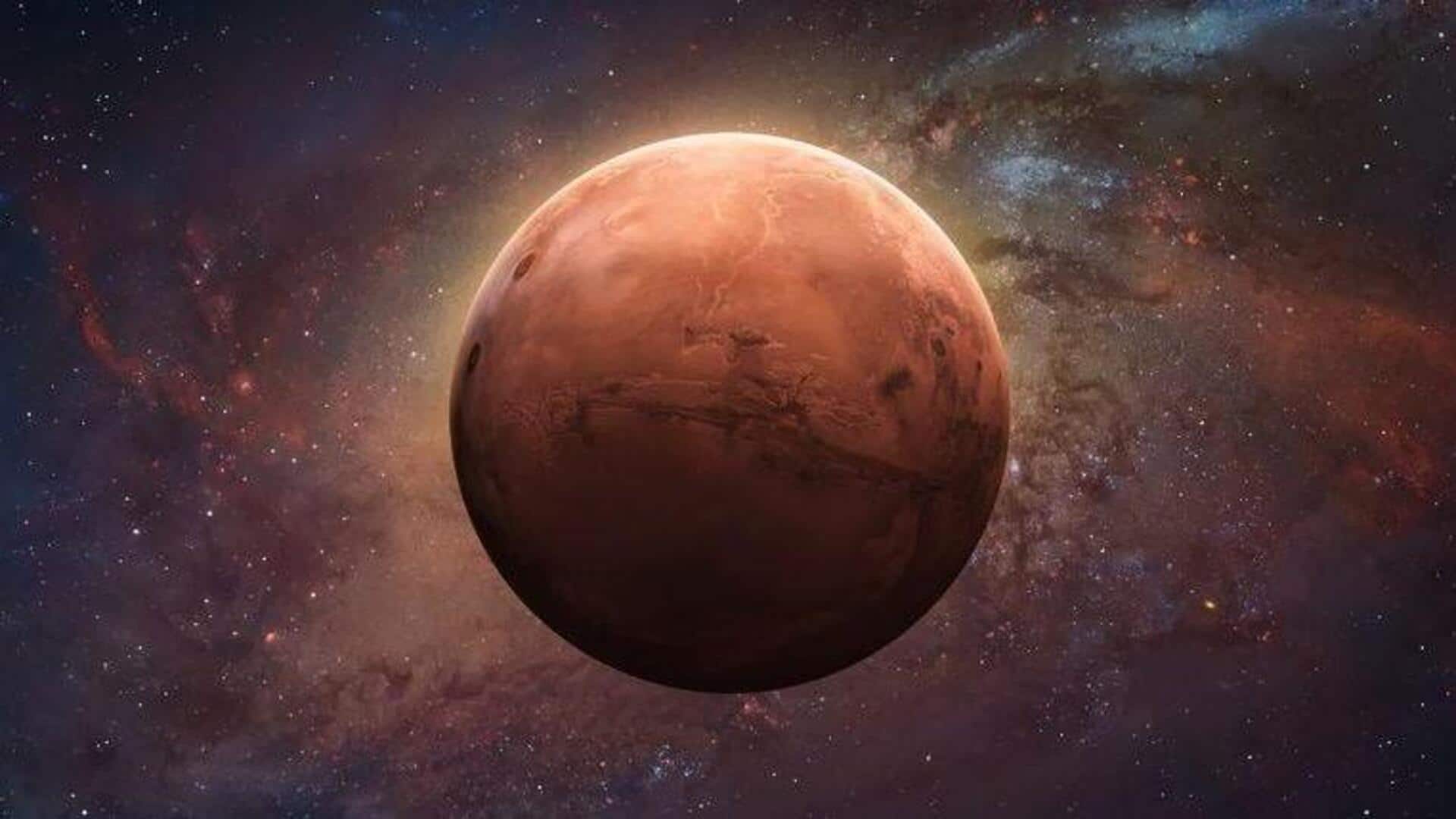
Indian scientists have successfully mapped the temperature variations on Mars, revealing a more complex climate than previously thought. The research, published in the journal Current Science, uses data from the Emirates Mars Mission's Hope spacecraft to study surface temperatures across two of the planet's largest impact basins - Hellas and Argyre. The study provides new insights into how Mars's thin atmosphere circulates and how its vast landscapes influence weather patterns.
Climate dynamics
Extreme temperature fluctuations
The study found extreme temperature fluctuations on the Martian surface, with readings ranging from some -123 degree Celsius to nearly 22 degree Celsius.
The drastic variations are partly due to Mars' thin atmosphere, which can't retain and distribute heat like Earth's.
This causes the Martian surface to warm up quickly in sunlight and cool down just as fast after sunset.
Orbital impact
Southern summer's harshness
Mars has a highly elliptical orbit around the Sun, reaching its closest point during southern summer.
This makes the southern summer particularly harsh, with temperatures in some regions much higher than their northern counterparts.
However, the researchers also observed that Martian temperatures don't just rise and fall with seasons; they also form large-scale patterns resembling waves across the planet's surface.
Atmospheric patterns
Zonal waves and atmospheric circulation
These zonal waves provide an indirect glimpse into Mars's atmospheric circulation, much like ripples on a pond revealing what's beneath.
The researchers found stark contrasts between the Hellas and Argyre basins, with Argyre dominated by a wave-1 pattern, while Hellas showed more complex wave-2 and wave-3 patterns depending on the season.
They believe these temperature patterns are heavily influenced by the immense depth and unique topography of these basins.
Model comparison
Comparison with Mars Climate Database
The researchers also compared their observations with predictions from the Mars Climate Database.
While the model did replicate the observed patterns, it was often much cooler than what was measured by EMIRS.
The findings offer a more comprehensive understanding of Mars's thermal behavior and atmospheric dynamics, which could play an important role in future robotic and crewed missions to the Red Planet.