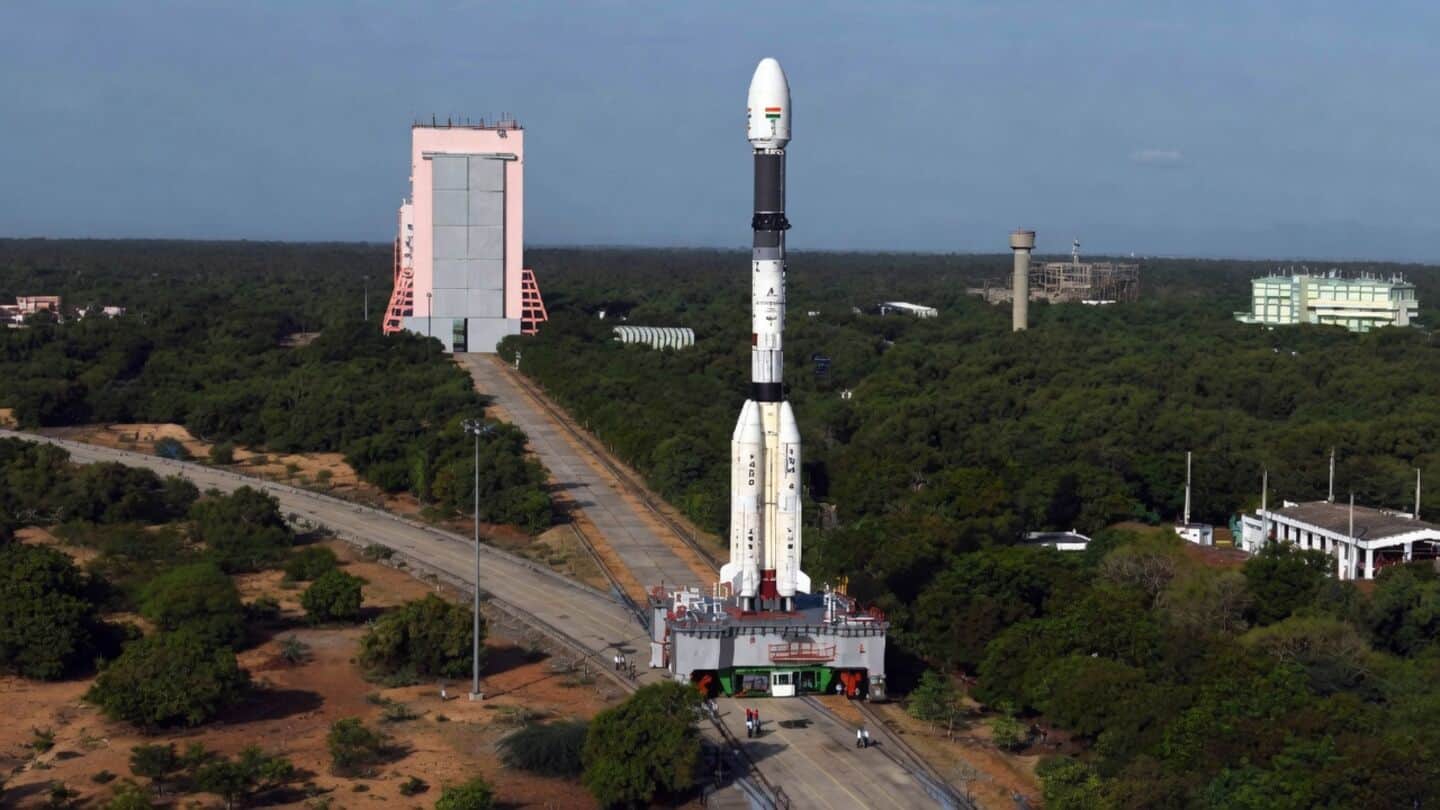
India's first high-altitude imaging satellite launches on September 4
What's the story
The Indian Space Research Organisation (ISRO) is all set to launch its GSLV-F17 rocket with EOS-05, an advanced Earth observation satellite. The mission is scheduled for September 4 at 2:55am IST from the Satish Dhawan Space Centre in Sriharikota, Andhra Pradesh. This will be India's first imaging satellite to operate from a geosynchronous orbit, some 36,000km above Earth.
Mission details
All about the GSLV-F17 rocket
The GSLV-F17 is the 19th flight of India's Geosynchronous Satellite Launch Vehicle (GSLV).
The rocket will carry EOS-05 into a Sub-Geosynchronous Transfer Orbit (Sub-GTO), from where the satellite will move toward its intended orbit.
Standing at 51.7 meters tall and weighing 420.5 tons at liftoff, this three-stage launch vehicle uses the GSLV Mk II configuration with a four-meter-diameter ogive composite payload fairing.
Satellite features
What is EOS-05 and how will it help?
EOS-05 is an advanced Earth observation satellite that will operate from a geosynchronous orbit.
It will be able to observe large areas of the Earth from a much higher orbit than conventional imaging satellites.
Its imaging capability could support monitoring cyclones, floods, cloudbursts, forest fires, among other natural events.
The information can also be useful for disaster management agencies, weather forecasters, agricultural planners, and security agencies especially when quick updates are needed over large areas.
Mission significance
Importance of successful GSLV-F17 mission
The EOS-05 launch is a major test of the GSLV Mk II's reliability and its ability to place an Earth observation satellite into the required orbit.
This mission comes after two consecutive PSLV failures and is being prepared separately from the PSLV program as both vehicles do not share engines or critical propulsion systems.
Mission legacy
EOS-05 is a crucial mission for ISRO
EOS-05 also carries significance as it comes after an earlier attempt to establish a similar capability.
The GSLV-F10 mission carrying EOS-03 failed on August 12, 2021, due to an indigenous cryogenic upper stage problem.
EOS-05 is the successor to that lost mission and marks ISRO's return to the launchpad after recent PSLV setbacks.