Scientists unveil most detailed map of dark matter
What's the story
Scientists have unveiled the most detailed map of dark matter, a mysterious and invisible substance that makes up about five times more of the universe than ordinary matter. The groundbreaking study, published in Nature Astronomy, uses data from the James Webb Space Telescope to show how dark matter's gravity pulled ordinary matter into clumps, forming the first structures in our universe.
Cosmic scaffolding
Dark matter's role in cosmic structure formation
Richard Massey, a physicist at Durham University and co-author of the study, explained that dark matter is "the gravitational scaffolding into which everything else falls and is built into galaxies." He added that this process can be seen happening in the new map. Without dark matter, there wouldn't be enough material to hold galaxies together, resulting in a very different universe than we know today.
Research area
The COSMOS field: A hub for cosmic exploration
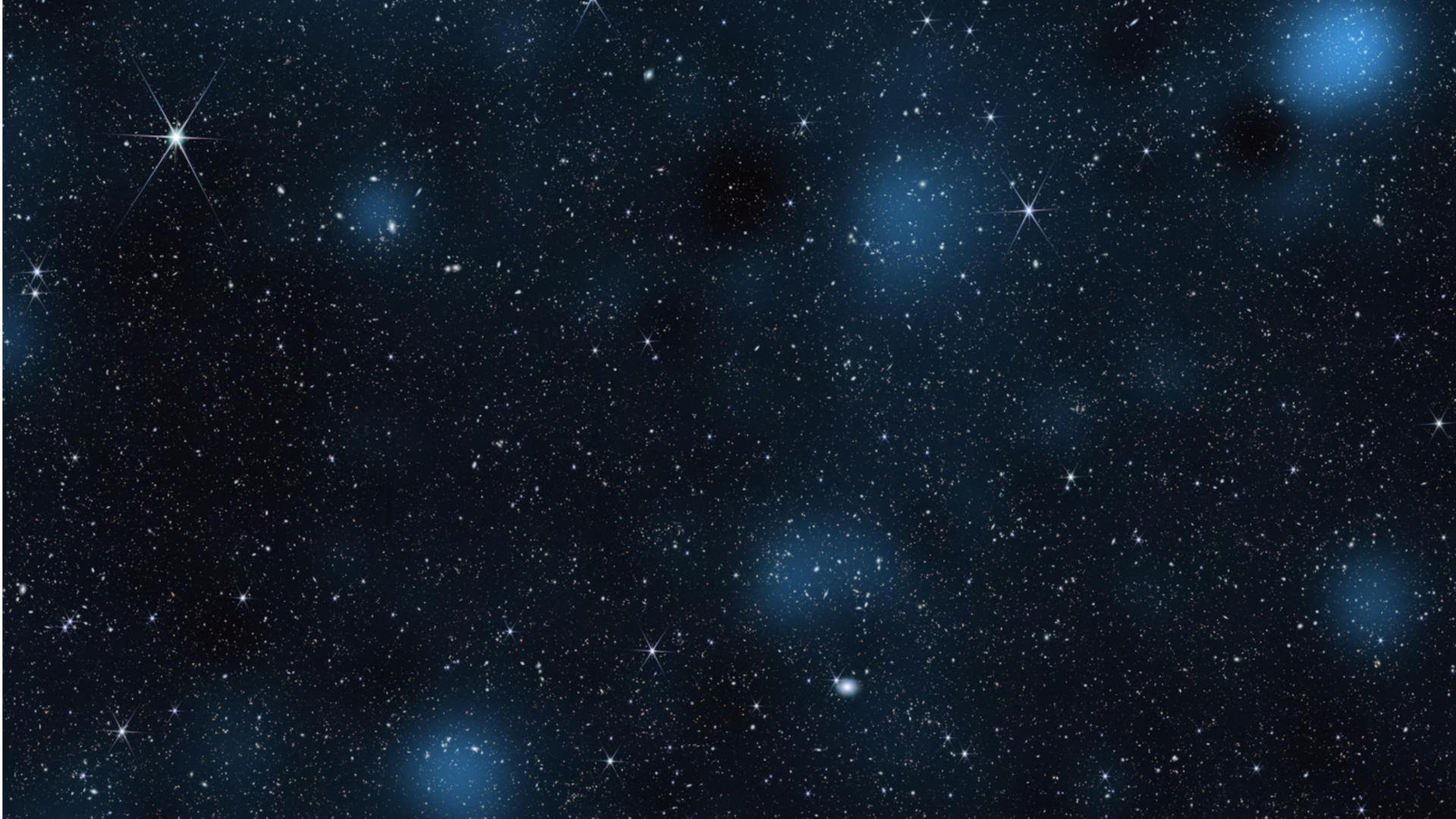
The new dark matter map covers a small part of the COSMOS field, a well-studied region of sky that has been observed by Hubble and other telescopes. The Webb map contains nearly 800,000 galaxies, many previously unknown. Diana Scognamiglio, a cosmologist at NASA's Jet Propulsion Laboratory and lead author of the study, said that with Webb's higher resolution data they can now see structures match each other but with much better details.
Filament discovery
Webb's infrared vision unveils cosmic web
Webb's ability to see infrared light allows it to view galaxies formed billions of years ago in the early universe. This has led scientists to discover structures of dark matter called filaments, forming a "cosmic web" where galaxies are strung along invisible threads. Massey said, "There's galaxies strung out like beads wherever we see dark matter," emphasizing the connection between dark matter and galaxy formation.
Detection method
Gravitational lensing technique reveals dark matter presence
To detect large sources of dark matter in this region, scientists used a technique called gravitational lensing. This involves observing how massive cosmic objects like galaxies or galaxy clusters bend and distort light from more distant sources. In this case, researchers were looking for subtle "weak lensing," where galaxy shapes are slightly distorted due to dark matter's influence on light trajectories.
Next steps
Future studies will build on this dark matter map
Rachel Mandelbaum, a physicist at Carnegie Mellon University who wasn't part of this study, is excited about future research stemming from the map. This could include examining how certain types of galaxies correspond to their dark matter content and mapping out galactic "voids," areas with fewer-than-average galaxies. Such analyzes will help answer fundamental questions about the universe's composition and galaxy evolution.