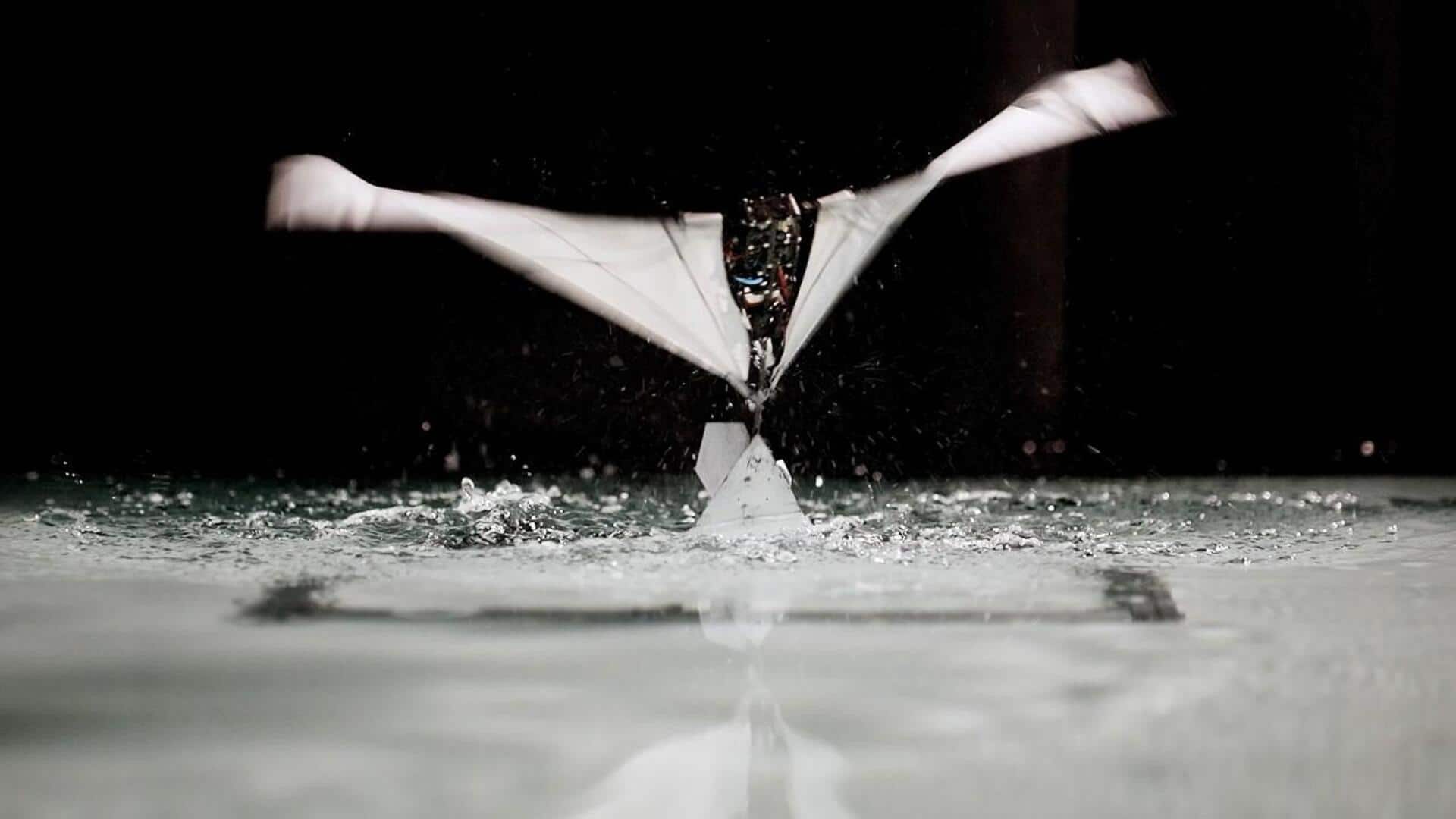
MIT's new robot can both fly and swim
What's the story
The Massachusetts Institute of Technology (MIT) has unveiled a revolutionary new robot that can both fly and swim. The innovative creation, dubbed the Flapping Aerial-Aquatic Vehicle (FAAV), is powered by a battery-operated motor and features nylon wings and a tail coated with water-repellent nanoparticles. The project was led by Raphael Zufferey, an assistant professor of mechanical engineering at MIT.
Nature-inspired engineering
Design of the FAAV
The design of the FAAV was inspired by the wing structures and flight patterns of diving birds such as petrels and puffins.
The team studied these birds' wings and their ability to transition between flying and swimming.
Zufferey emphasized that while there was previous research on diving birds' wings, no one had successfully translated that knowledge into a fully functional robot until now.
Engineering innovation
How does it work?
Unlike diving birds, which have wings that partially fold underwater to reduce drag and generate propulsion, the FAAV has a flexible wing that doesn't fold.
This design allows it to minimize amplitude, the extent of movement during a flap.
The robot can fly at speeds of over 6m/s and swim nearly 1m/s. It can theoretically cover up to 6km in the air or swim up to 2km on a single battery charge.
Testing results
Funding for further development
The FAAV was tested for a year in a water tank in Massachusetts and later at Lake Geneva, Switzerland. The team is now looking for funding to further develop the robot.
Zufferey hopes that this technology could one day be used for oceanography, as it could collect samples from toxic algae blooms or volcano lakes. It could also be fitted with cameras for wildlife monitoring.