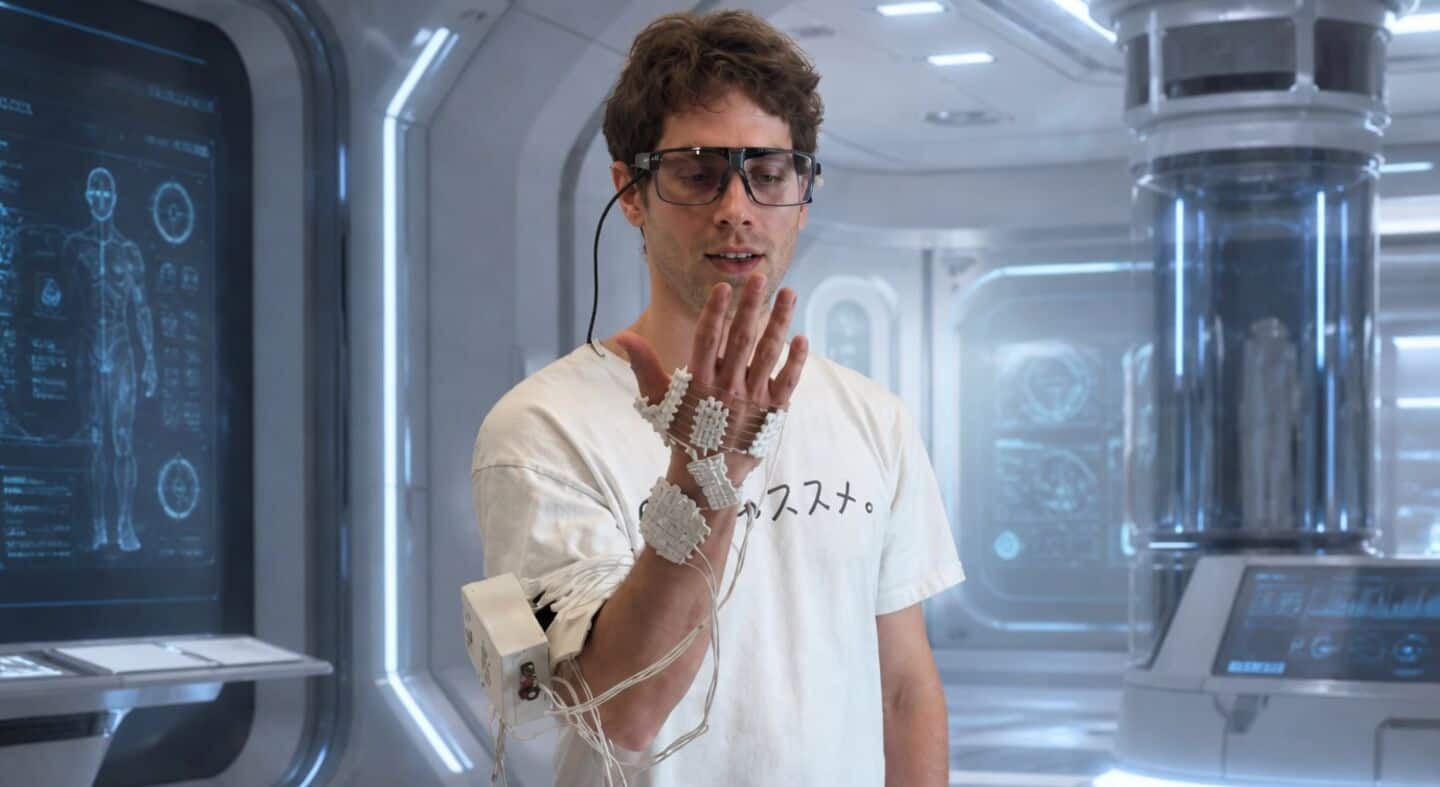
This Claude-powered AI device can move your hand
What's the story
A team of six developers from the Massachusetts Institute of Technology (MIT) has created an innovative AI-powered wearable device. The prototype, called Human Operator, can temporarily move a user's fingers and wrist using electrical muscle stimulation (EMS). The project won the Learn Track at the MIT Hard Mode 2026 hackathon. It was developed by Peter He, Ashley Neall, Valdemar Danry, Daniel Kaijzer, Yutong Wu, and Sean Lewis.
Operational details
How does the human operator work?
Human Operator integrates a head-mounted camera, voice commands, AI, and EMS hardware to turn spoken instructions into actual hand movements.
The system uses a point-of-view camera to capture the user's environment and processes voice commands with a vision-language model connected to Anthropic's Claude API.
Based on its understanding of the command and visual scene, it generates movement instructions sent to an Arduino-controlled relay system that activates a TENS/EMS device.
Research focus
Not a commercial product
The developers of Human Operator have made the project's source code, build instructions, and hardware requirements available for researchers and developers to replicate the prototype.
The device is not intended as a commercial product but an exploration of embodied AI and human augmentation.
It directly manipulates physical movement through muscle stimulation, unlike traditional AI assistants that generate text or images.
Safety measures
Safety considerations are paramount
While the demonstration of Human Operator shows new possibilities for assistive technology, experts stress that systems capable of actuating human movement need significant safeguards.
Reliable calibration, precise timing of stimulation, user-specific settings, and emergency stop mechanisms are critical to prevent unintended muscle contractions.
Sensors like electromyography (EMG) could be used in closed-loop feedback systems to improve safety and accuracy further.
Future prospects
The future of embodied AI
Human Operator demonstrates how large AI models can be integrated with wearable hardware to interact with the physical world.
Such systems could eventually aid rehabilitation, accessibility tools, and assistive technologies.
However, practical deployment would require extensive testing, medical oversight, and regulatory approval.
As researchers continue to explore embodied AI, projects like Human Operator highlight both the potential and challenges of allowing artificial intelligence to directly interact with the human body.