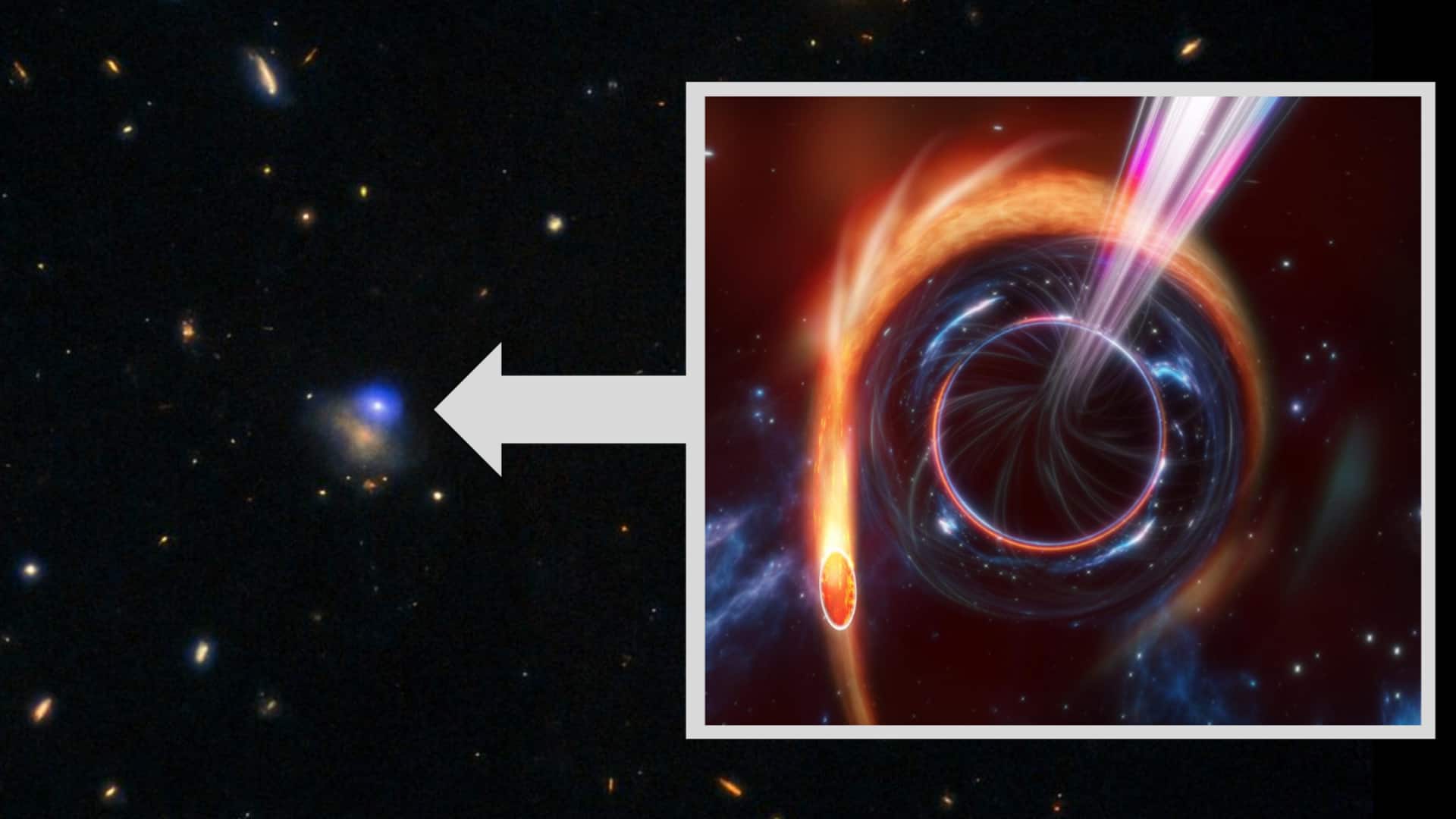
This is how bright blue cosmic blasts take place
What's the story
Astronomers have made a major breakthrough in understanding the origin of powerful blue cosmic explosions. The discovery is based on the observation of a Luminous Fast Blue Optical Transient (LFBOT), AT 2024wpp, first detected in 2024. The team concluded that LFBOTs are caused by extreme Tidal Disruption Events (TDEs), where a black hole up to 100 times more massive than the Sun completely destroys a companion star in days.
Cosmic enigmas
LFBOTs: Bright cosmic phenomena with mysterious origins
LFBOTs are incredibly bright, emitting high-energy light across the electromagnetic spectrum. They can be seen billions of light-years away but only last a few days.
The first LFBOT was detected in 2014, but it wasn't until four years later that astronomers observed one in detail for proper analysis.
Since then, over a dozen such events have been discovered, leaving their origins a mystery for nearly a decade.
Energy comparison
AT 2024wpp's energy output surpasses supernovae
When researchers studied AT 2024wpp, they found it emitted around 100 times more energy than an average supernova. This observation ruled out exploding stars as a possible cause for the event.
To produce this much energy, an exploding star would have to convert some 10% of its mass into energy via Einstein's equation (E=mc^2) over just a few weeks.
Light emissions
Unusual near-infrared light and radio waves detected
The Gemini South observatory also detected an unusual amount of near-infrared light from AT 2024wpp, a phenomenon previously seen only with AT 2018cow.
This event wasn't linked to normal supernovae.
The team also noted that radio waves were produced when material around the black hole was channeled to its poles and accelerated at about 40% the speed of light, creating jets.
Feeding habits
Black hole's long-term feeding and star destruction
The team theorizes that the black hole behind AT 2024wpp had been parasitically feeding on a companion star for a long time. This led to it being completely covered in a spherical shell of material.
However, this shell was too far from the black hole to be consumed by it.
Eventually, the companion star came close enough to be spaghettified by its immense gravitational influence, resulting in new stellar material hitting the matter that had been stolen throughout history.
Stellar involvement
Wolf-Rayet star's role in AT 2024wpp event
The team believes the star destroyed in the event that triggered AT 2024wpp was a highly evolved Wolf-Rayet star, about 10 times more massive than the Sun.
This explains the weak hydrogen emission seen around AT 2024wpp.
Stars like this are thought to be common in actively star-forming galaxies such as the one from which AT 2024wpp originated, located some 1.1 billion light-years away.