NASA's Antarctic balloon campaign complete: What was the goal?
What's the story
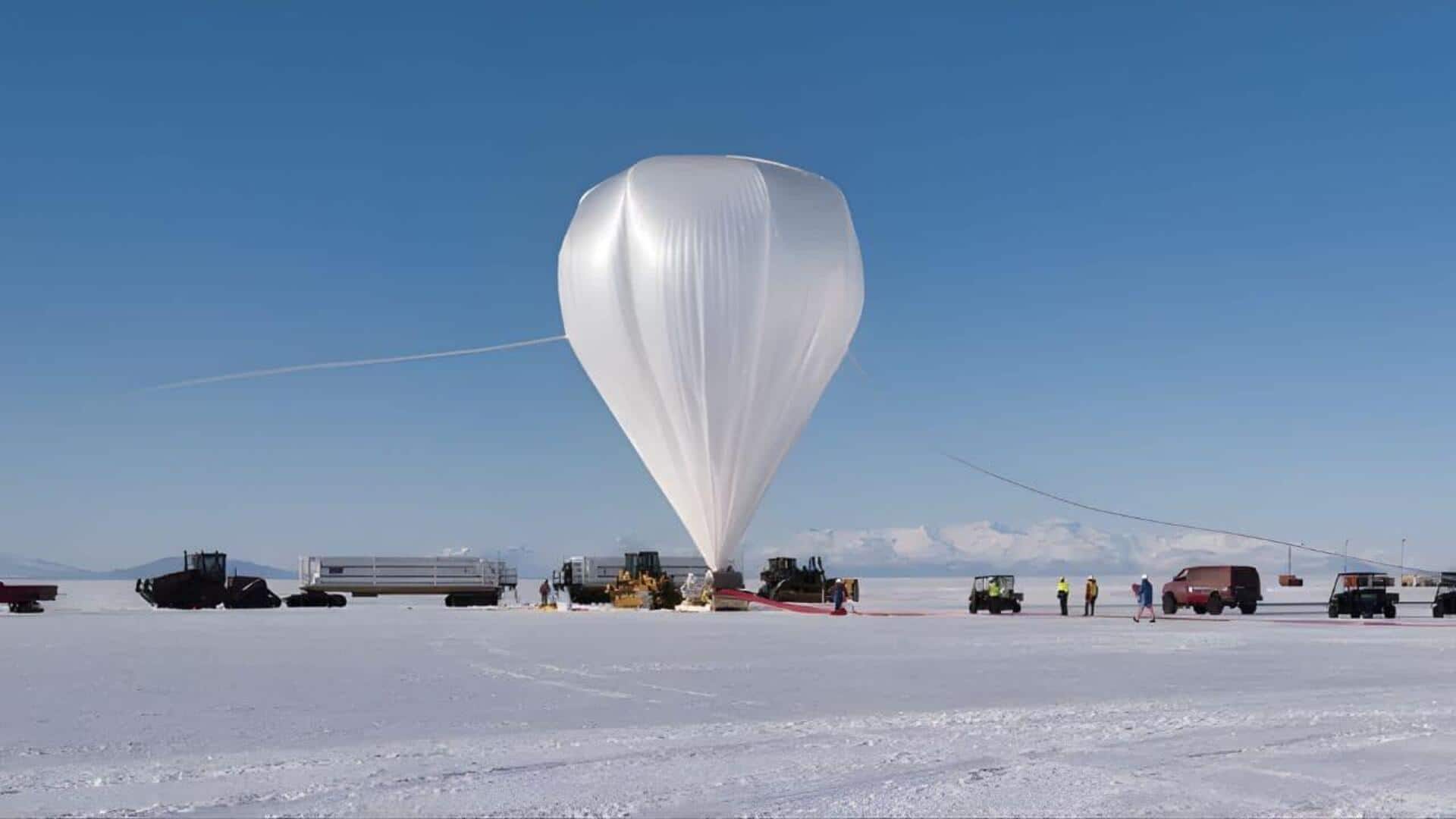
NASA has successfully concluded a scientific balloon campaign over Antarctica, which began in early December. The mission involved launching four high-altitude balloons from a site near McMurdo Station on the Ross Ice Shelf. These balloons were equipped with advanced instruments to study cosmic particles in Earth's atmosphere. The data collected during this campaign will complement findings from satellites and ground-based observatories around the world.
Research tools
Mission objectives and instruments used
The primary goal of the Antarctic balloon campaign was to detect antimatter and high-energy particles. The first major launch took place on December 15 with the General AntiParticle Spectrometer (GAPS).
It was designed to detect rare antimatter particles entering Earth's atmosphere, which could provide valuable clues about dark matter.
The GAPS balloon flew for just over 25 days before returning to the ice on January 9.
Additional missions
Second payload and support balloons
The second major payload, the Payload for Ultrahigh Energy Observations (PUEO), was launched on December 19.
It stayed aloft for over 23 days, landing on January 12. The instrument is designed to detect signals linked to high-energy particles.
Along with these two missions, NASA also launched two smaller balloons using hand on December 21.
These secondary balloons carried radio beacons known as HiCal and remained in flight until December 25.
Ideal environment
Advantages of Antarctic conditions for balloon flights
Antarctica offers stable atmospheric conditions, making it an ideal location for long-duration balloon flights.
The continuous sunlight during summer keeps the balloons afloat for several weeks.
Further, its remote location minimizes human interference and radio signal noise, allowing researchers to track particles and make sensitive measurements without external disturbances.
Budget-friendly
A cost-effective research method
NASA's balloon missions provide cost-effective data that complements satellites and observatories worldwide.
They enable the study of cosmic rays, high-energy particles, and antimatter entering Earth.
The findings from these campaigns could greatly enhance our understanding of particle physics and astrophysical phenomena.
The Antarctic campaign is a perfect example of how scientific balloons can fill the gap between ground-based observatories and orbital missions.