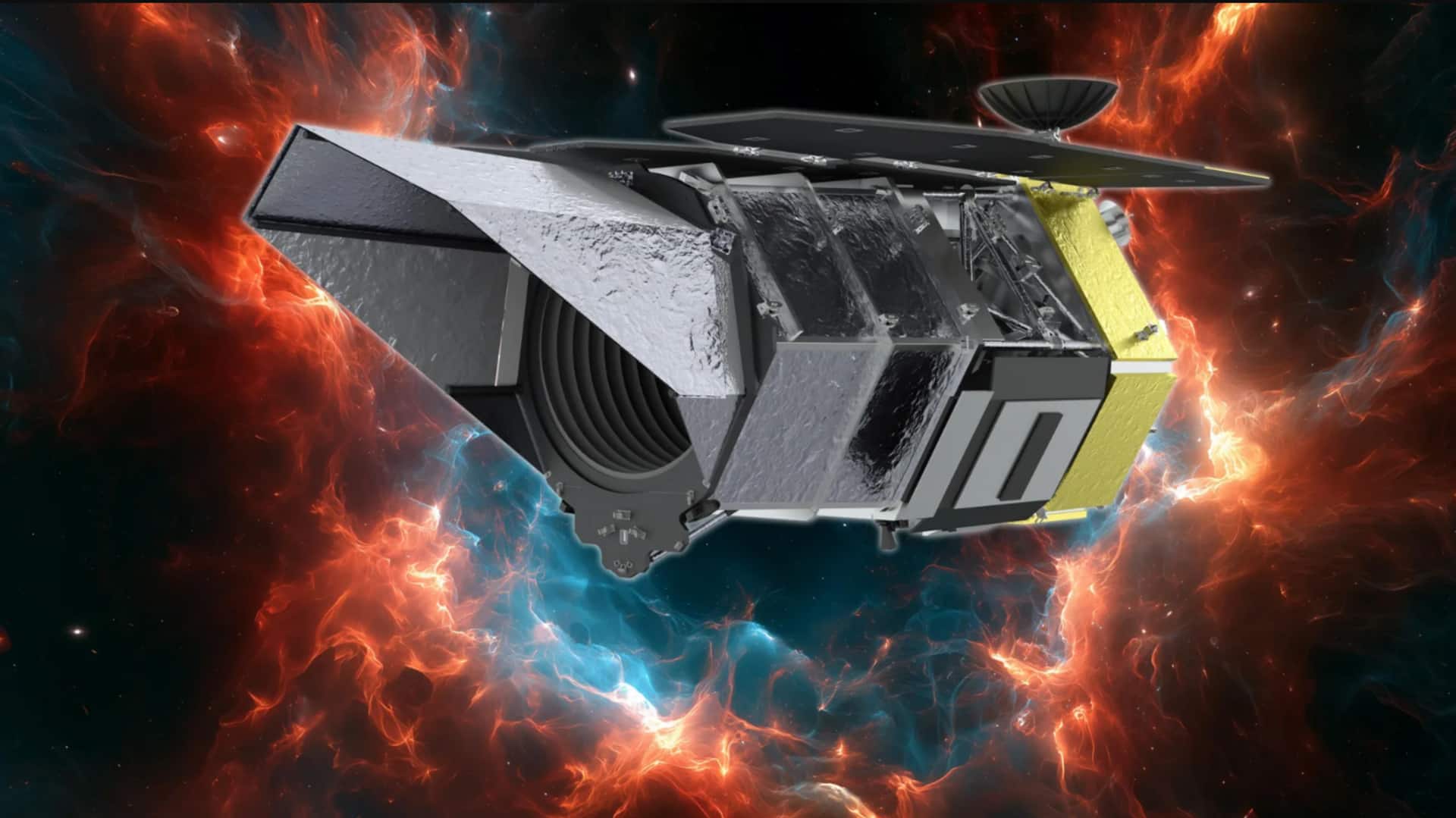
NASA launches $4.3B Roman Space Telescope to hunt exoplanets
What's the story
NASA has successfully launched its latest space telescope, the $4.3 billion Roman Space Telescope, on its way to its observation point. The mission was carried out by SpaceX with a Falcon Heavy rocket from Kennedy Space Center in Florida. The telescope is named after the late Nancy Grace Roman, NASA's first chief astronomer and a pioneer in the field of space science.
Mission objectives
Telescope will reach its observation point in over 3 months
The Roman Space Telescope will take over three months to reach its observation point, located a million miles away from Earth.
Once there, it will survey the universe like never before, revealing hidden parts of the cosmos with unmatched speed.
"It's going to find thousands of supernovae, tens of thousands of planets, billions of galaxies and tens of billions of stars," said NASA science mission director Nicky Fox.
Enhanced observation
Roman's field of view over 100 times wider than Hubble's
The Roman Space Telescope's field of view is over 100 times wider than that of the Hubble Space Telescope.
This means it can capture more data in a single observation, making it an invaluable tool for astronomers.
The telescope will work alongside other space observatories such as the Webb Space Telescope, the European Space Agency's Euclid spacecraft, and the National Science Foundation's Vera C. Rubin Observatory in Chile to unravel some of the universe's biggest mysteries.
Discovery potential
Aim to find new planets around other stars
The Roman Space Telescope will be instrumental in finding new planets around other stars.
Once these exoplanets are discovered, the more powerful Webb Space Telescope will take over to study them in detail.
Senior project scientist Julie McEnery said, "Roman's vast reach will allow us to find the weird, the rare and the unusual."
The telescope is also expected to provide insights into dark matter and dark energy, which make up most of the universe but remain hidden.
Operational advantages
The telescope can be refueled to extend its life
The Roman Space Telescope is designed to be refueled, extending its operational life if a robotic tanker becomes available in the next decade.
It also has a wide-field infrared camera that matches Hubble's sensitivity but is 1,000 times faster.
The telescope's primary mirror is nearly eight feet in diameter and was donated by the National Reconnaissance Office over a decade ago for repurposing.