NASA, SpaceX's Crew-12 mission to launch tomorrow
What's the story
NASA and SpaceX have postponed the launch of their Crew-12 mission to February 13. The delay is mainly due to unfavorable weather conditions along the flight path, including high winds of up to 28 knots in the ascent corridor. This could have made an emergency abort unsafe. The new launch window has been set for February 13 at 3:45pm IST, prioritizing safety over schedule.
Pre-launch preparations
Meet the Crew-12 team
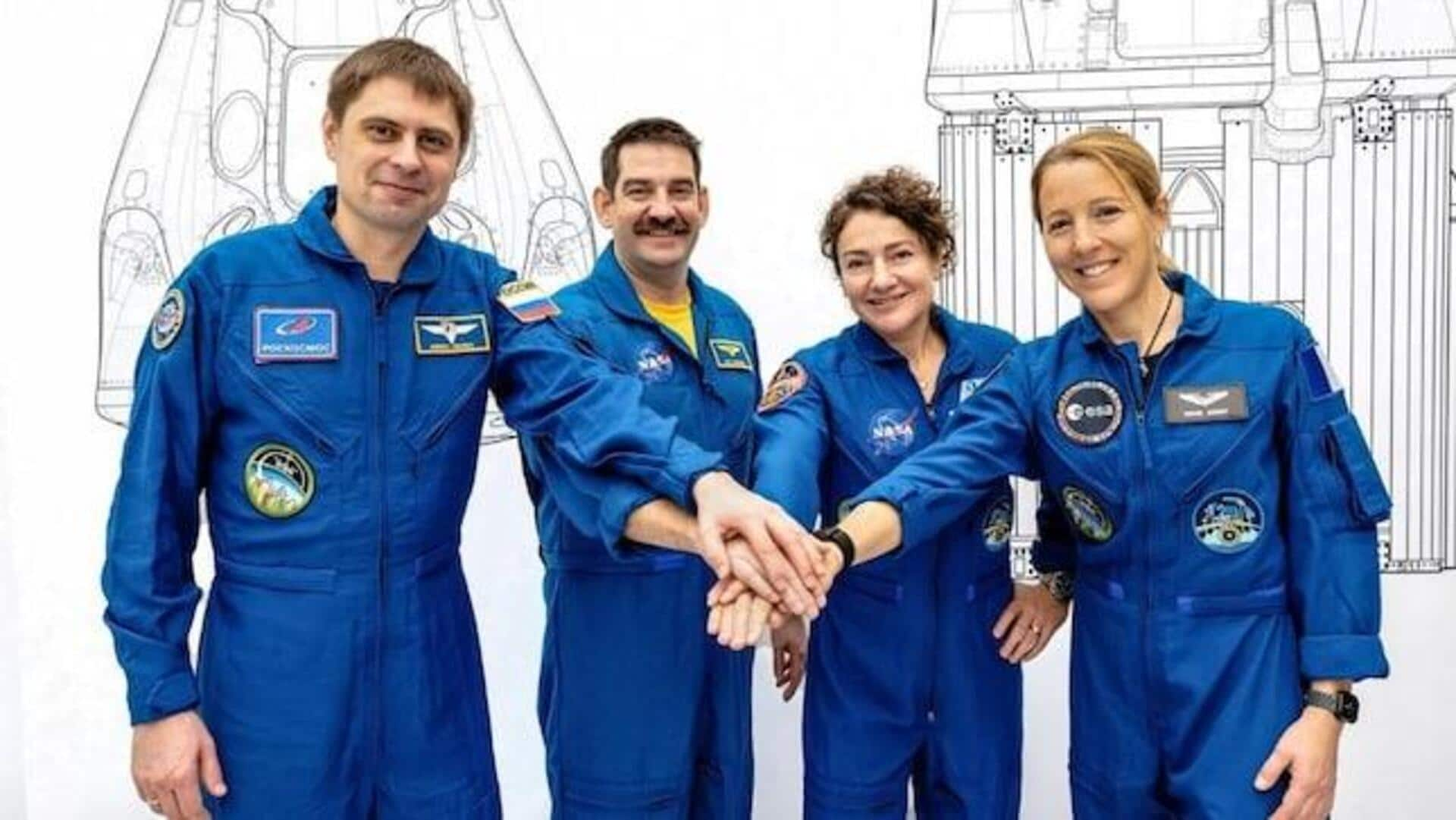
The Crew-12 mission is led by NASA commander Jessica Meir and pilot Jack Hathaway. They are joined by European Space Agency (ESA) specialist Sophie Adenot and cosmonaut Andrey Fedyaev. The four-member team is currently quarantined at the Kennedy Space Center in Florida, living in a biological bubble to avoid bringing any Earthly germs to the International Space Station (ISS).
Scientific objectives
The venous flow study
Once aboard the ISS on their Dragon spacecraft, Freedom, the Crew-12 team will conduct a series of important experiments. One such study is called Venous Flow, which will examine how physical characteristics affect blood flow in microgravity. The astronauts will use ultrasound on their own jugular veins to help doctors find ways to prevent strokes during long Mars trips.
Agricultural advancements
Other important experiments during Crew-12 mission
The Crew-12 mission will also include a study on pneumonia-causing bacteria to improve treatments on Earth. The astronauts will test nitrogen-fixing microbes and automated plant health monitoring to improve food production in space. They will also demonstrate on-demand intravenous fluid generation, a key technology for medical care during deep-space journeys.
Lunar training
Manual piloting study for Moon landing
The Crew-12 mission will also include a Manual Piloting study, where astronauts will use high-tech simulators to practice landing at the Moon's South Pole. This is part of NASA's preparation for future Artemis missions. The team will also test if B-vitamin supplements can protect their eyesight, which often suffers in the weightless environment of space.