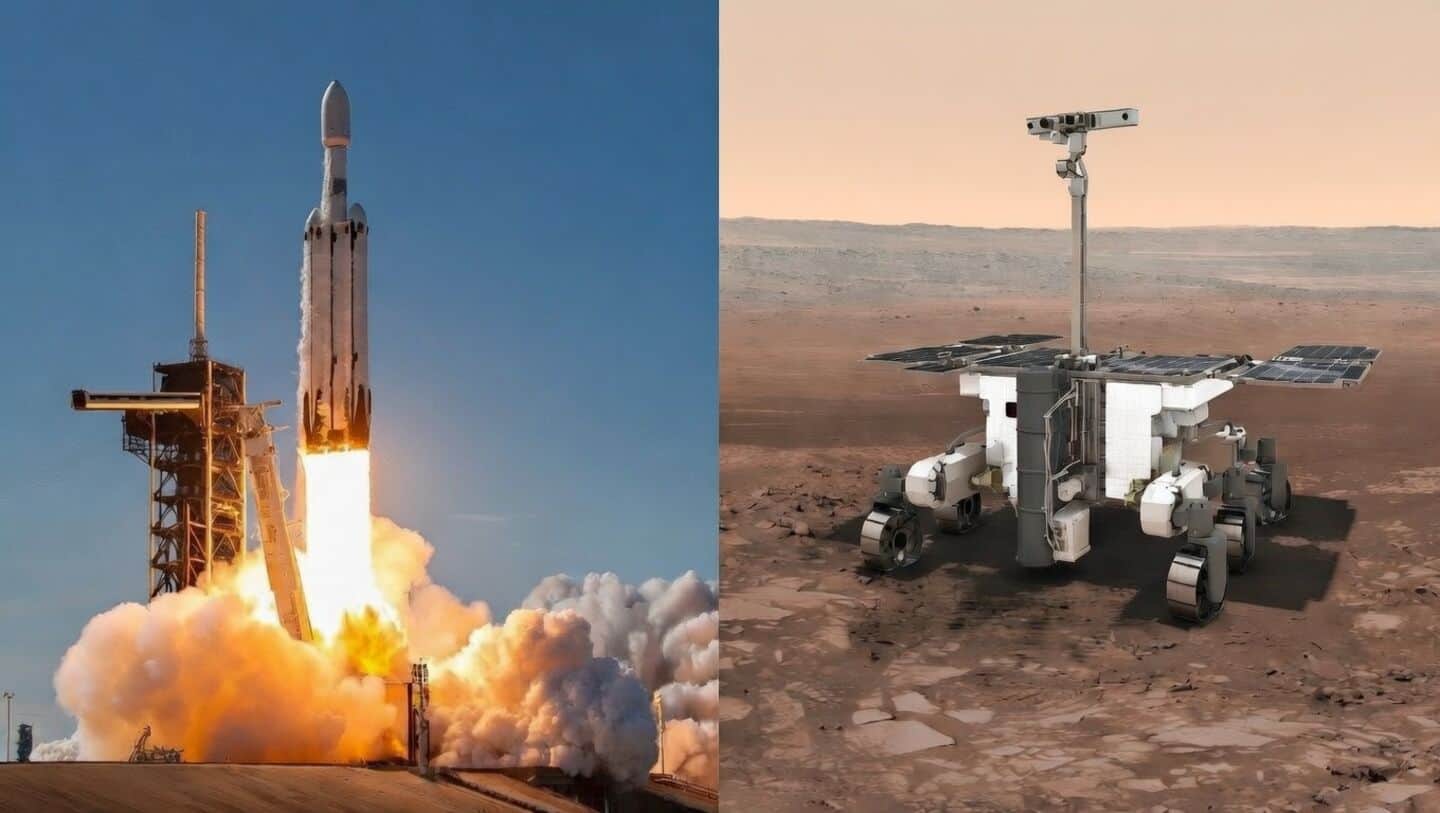
SpaceX to send life-hunting rover to Mars in 2028
What's the story
Elon Musk's SpaceX has been given the green light to launch the Rosalind Franklin rover on a mission to Mars. The ambitious project, which will see the rover travel to the Red Planet aboard a Falcon Heavy rocket, is slated for late 2028. NASA recently approved the implementation phase of this mission, marking a major milestone in one of the most ambitious Mars explorations of this decade.
Collaboration details
NASA's role in the mission
The Rosalind Franklin mission is a joint effort between NASA and the European Space Agency (ESA). Under this collaboration, NASA will provide essential support elements for mission success.
These include launch services, braking engines for the lander platform, and radioisotope heater units to keep the rover's internal systems warm in Mars's extreme cold.
The US space agency will also contribute advanced electronics and a sophisticated mass spectrometer as part of its contribution to this international project.
Exploration goals
Rosalind Franklin rover's groundbreaking approach to Martian exploration
The Rosalind Franklin rover will be different from its predecessors as it plans to drill two meters beneath the Martian surface in search of microbial life.
Scientists think subsurface samples could contain organic material protected from harsh radiation on the surface.
The rover will land at Oxia Planum, a site believed to have once harbored water and clay-rich deposits, furthering our understanding of Mars's past habitability.
Launch details
The Falcon Heavy launch and mission timeline
SpaceX has been chosen by NASA to provide launch services using Falcon Heavy, one of the world's most powerful operational rockets.
The mission will be launched from Launch Complex 39A at Kennedy Space Center, a historic site that has hosted Apollo missions and modern deep-space exploration.
The contract for this mission was awarded under NASA's Launch Services II framework with a target launch window set for late 2028.