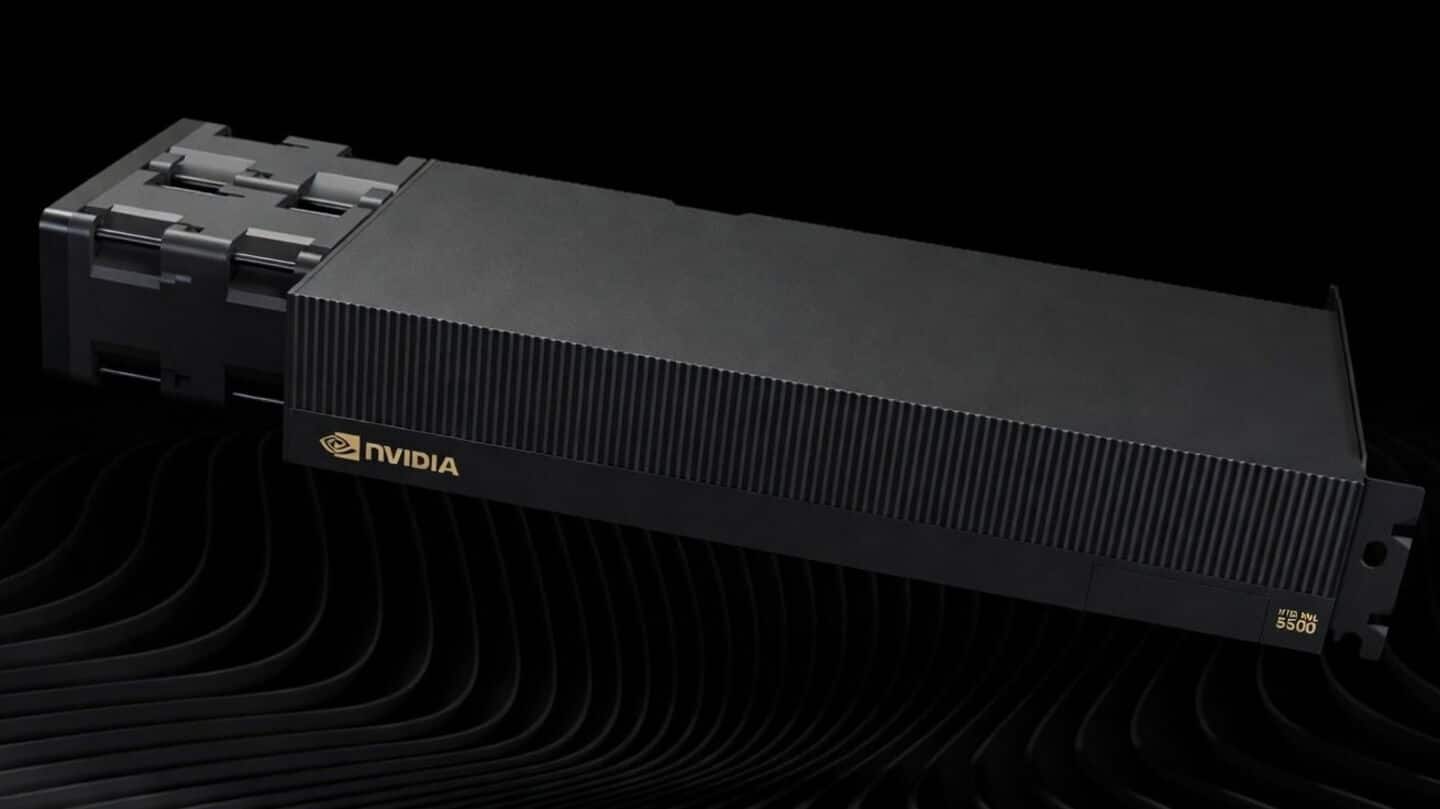
NVIDIA's new GPU can split its power for AI-heavy workloads
What's the story
NVIDIA has unveiled its latest graphics card, the RTX Pro 5500 Blackwell Workstation Edition. The new addition to the Blackwell family comes with a massive 84GB of GDDR7 ECC memory. It is primarily designed for rack-mounted professional workstations and is aimed at companies that need to centralize GPU power and distribute it among teams working on AI models, robotics simulations, rendering, etc.
Product positioning
GPU can handle multiple models at once
The RTX Pro 5500 sits between the 72GB RTX Pro 5000 and the 96GB RTX Pro 6000 in NVIDIA's product range.
The massive memory capacity isn't just for show; it serves a specific purpose.
It enables the GPU to handle larger AI models, longer context windows, or multiple models at once without constant data offloading.
This makes it ideal for local LLM inference, AI agents, computer vision tasks, as well as multimodal generative AI applications.
Technical details
It offers memory bandwidth of 1,398GB/s
The RTX Pro 5500 is powered by NVIDIA's Blackwell architecture and boasts an impressive 21,760 CUDA cores. It also comes with fifth-generation Tensor Cores and fourth-generation RT Cores.
The memory bandwidth is a staggering 1,398GB/s while the maximum power consumption can go up to a whopping 600W.
The card uses a PCIe 5.0 x16 interface and supports up to four DisplayPort 2.1b outputs for connectivity.
Cooling capabilities
MIG allows GPU to be split into 2 separate instances
NVIDIA offers air-cooled and liquid-cooled configurations for the RTX Pro 5500, further emphasizing its design for managed workstation racks.
One of its most interesting features is Multi-Instance GPU (MIG). The RTX Pro 5500 can work as one single 84GB GPU or split itself into two separate instances of 42GB each with their own memory, cache, and compute resources.
This allows two users or workloads to use the same physical accelerator without compromising performance.