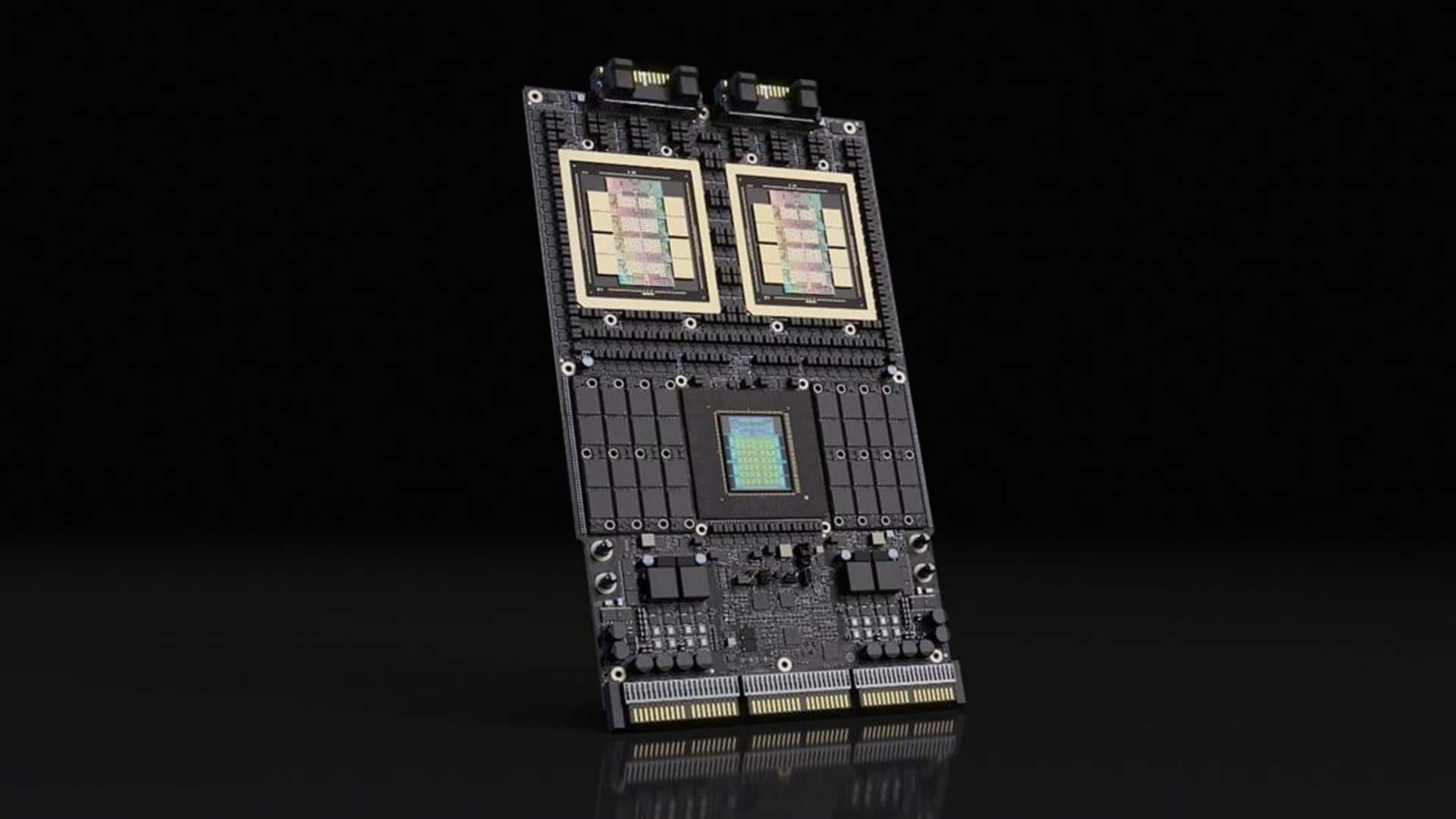
NVIDIA unveils Rubin chip architecture, promises 5x AI performance boost
What's the story
NVIDIA has unveiled its new Rubin computing architecture at CES 2026. The company highlights the state-of-the-art capabilities of this AI hardware, which is expected to significantly advance AI computation. "Vera Rubin is designed to address this fundamental challenge that we have: The amount of computation necessary for AI is skyrocketing," said Jensen Huang, CEO of NVIDIA. He also confirmed that Vera Rubin is already in full production and will ramp up further in the second half of this year.
Technological advancement
Rubin architecture: A leap in NVIDIA's hardware evolution
The Rubin architecture, first announced in 2024, is the latest product of NVIDIA's relentless hardware development cycle.
It will replace the Blackwell architecture and be used by nearly every major cloud provider.
This includes high-profile partnerships with Anthropic, OpenAI, and Amazon Web Services.
The new systems will also power HPE's Blue Lion supercomputer and the upcoming Doudna supercomputer at Lawrence Berkeley National Lab.
System design
Rubin architecture: A multi-chip system for AI
The Rubin architecture, named after astronomer Vera Florence Cooper Rubin, is a multi-chip system. It features six different chips that work together to deliver enhanced performance.
At its core is the Rubin GPU, but it also tackles storage and interconnection bottlenecks with new versions of Bluefield and NVLink systems.
The architecture also includes a new Vera CPU for agentic reasoning tasks.
Memory management
Rubin architecture: A response to growing AI demands
NVIDIA's senior director of AI infrastructure solutions, Dion Harris, explained the new storage system's benefits. He said it addresses the increasing cache-related memory demands of modern AI systems.
"As you start to enable new types of workflows, like agentic AI or long-term tasks, that puts a lot of stress and requirements on your KV cache," Harris told reporters on a call.
Performance boost
Rubin architecture: A significant leap in speed and efficiency
The Rubin architecture also promises a major leap in speed and power efficiency.
NVIDIA's tests show that it will be 3.5 times faster than its predecessor, the Blackwell architecture, on model-training tasks. It will also be five times faster on inference tasks, reaching as high as 50 petaflops.
The new platform will support eight times more inference compute per watt.
Product launch
Rubin chips to debut in DGX SuperPod and modular products
NVIDIA's new Rubin data center products are almost ready for release this year. All six of the new Rubin chips have returned from manufacturing partners and passed some milestone tests.
"The race is on for AI," Huang said during a keynote presentation at CES 2026 in Las Vegas.
The company plans to introduce these chips in DGX SuperPod and as modular products this year, with Microsoft and other major cloud providers deploying them in H2 2026.