OpenAI's Codex Spark can code 15x faster than existing models
What's the story
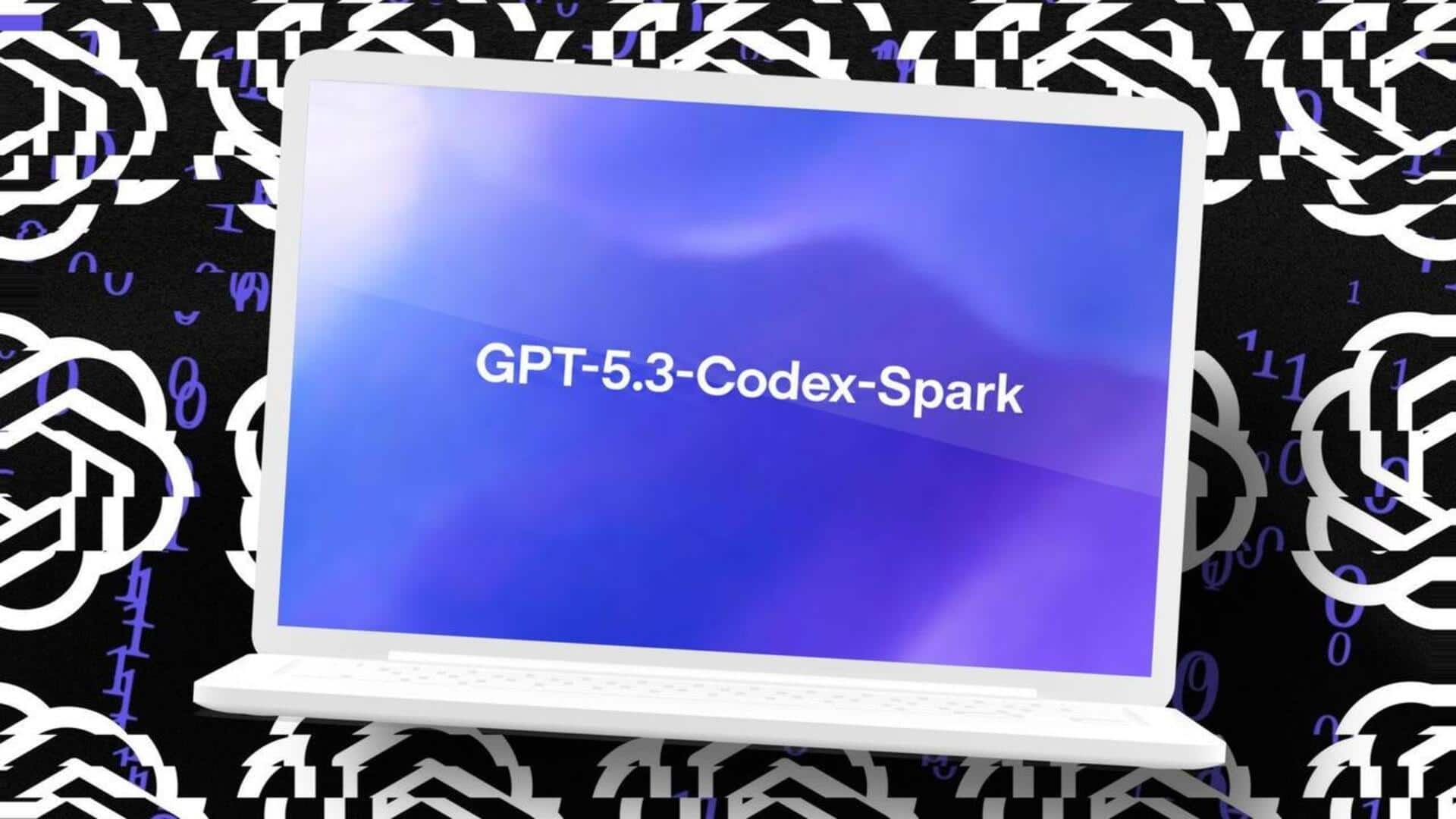
OpenAI has launched a new AI model, GPT-5.3-Codex-Spark, to revolutionize coding. The system is now available as a research preview and promises lightning-fast performance, up to 15 times quicker than conventional AI coding models. Codex Spark is a compact version of GPT-5.3-Codex that can generate over 1,000 tokens per second on low-latency hardware. This means developers can see code changes almost instantly, enabling seamless collaboration with the AI assistant in real time.
Partnership outcome
Codex Spark is a result of OpenAI's collaboration with Cerebras
Codex Spark is the first major result of OpenAI's collaboration with Cerebras, announced in January.
The model runs on Cerebras's Wafer Scale Engine 3, a specialized AI accelerator designed for ultra-fast inference workloads.
This hardware enables Codex Spark to process and respond to developer prompts at near-human speeds, thus supporting real-time collaboration where developers can interrupt or refine the AI's output as it writes code.
Efficiency
Codex Spark performs focused edits instead of complete overhauls
Codex Spark performs small, focused edits instead of overhauling entire codebases, keeping the process efficient and under user control.
It doesn't run tests automatically unless instructed.
Despite its smaller size, the model performs well on software engineering benchmarks, completing coding tasks much faster than larger versions.
The experience mimics pair programming where the AI acts as an instant co-developer.
Features
Codex Spark supports text-only interactions
Codex Spark supports text-only interactions and has a 128k context window, which lets it handle large codebases without any issues.
OpenAI describes it as the first in a new line of ultra-fast Codex models that will evolve toward more complex, multimodal capabilities.
The model is being rolled out to ChatGPT Pro users through the Codex app, CLI, and VS Code extension.
Future developments
Future iterations are expected to support larger models
OpenAI has said that Codex Spark is just the start of a larger effort to develop AI tools that combine real-time collaboration with deeper autonomous problem-solving.
Future iterations are expected to support larger models, extended context windows, and multimodal input, blurring the line between human and machine creativity in software development.
During peak demand periods, users may have to wait or face limited access as OpenAI works to maintain reliability.