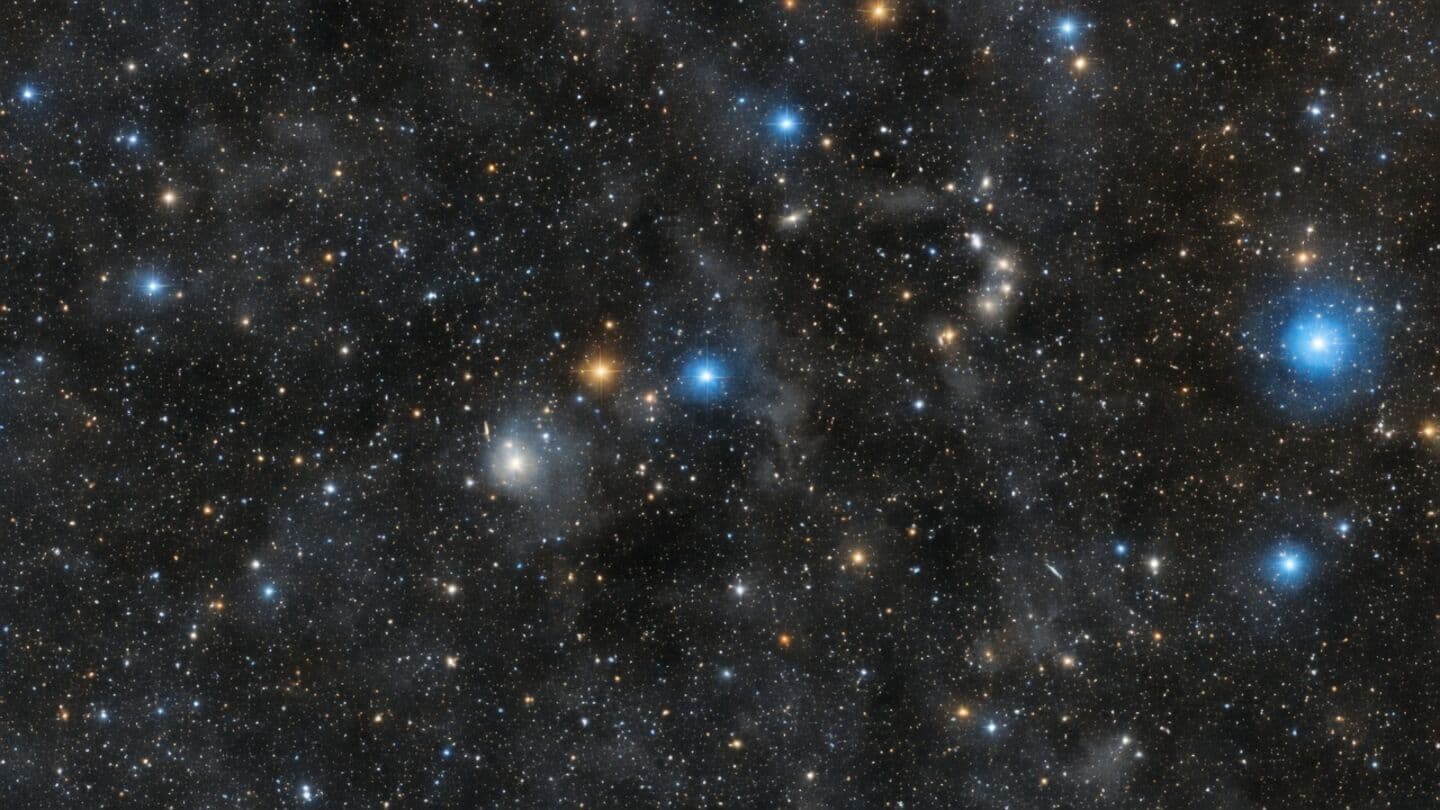
World's largest camera captures 500,000 galaxies in stunning cosmic image
What's the story
The Vera C. Rubin Observatory in Chile has unveiled one of the most detailed views of the cosmos, capturing over 500,000 galaxies and more than 50,000 stars in a single deep image. The stunning picture was created using the observatory's cutting-edge 3.2-gigapixel LSST Camera. This landmark achievement is a major step forward in our understanding of the universe and how galaxies have formed and evolved over billions of years.
Image creation
The breathtaking cosmic view
The breathtaking cosmic view is a composite of hundreds of individual exposures taken by Rubin Observatory's LSST Camera.
The process allowed scientists to capture extremely faint light from distant objects that would otherwise remain invisible.
The 3.2 billion-pixel camera, mounted on the observatory's 8.4-meter Simonyi Survey Telescope, helped reveal a vast collection of cosmic structures including spiral galaxies with clearly defined arms, smooth elliptical galaxies, merging galaxies, and extremely distant red galaxies from the early universe.
Research significance
COSMOS field has been studied for decades
The region captured in the image is called the COSMOS field.
Astronomers first began studying this region in detail in 2003 using observations from Hubble Space Telescope.
Since then, several advanced observatories have focused on this patch of sky, collecting information across different wavelengths including radio waves and X-rays.
The COSMOS field's location away from the crowded central plane of our galaxy reduces interference from nearby stars and cosmic dust, allowing telescopes to get a clearer view of distant galaxies.
Future plans
Image is part of EDP2 data release
The latest image is part of Rubin Observatory's Early Data Preview 2 (EDP2), its first major data release based on observations from the LSST Camera.
The release combines science validation data collected between April 2025 and January 2026, covering around 3,000 square degrees of the night sky. This area represents nearly one-sixth of the visible Southern Hemisphere sky.
Unlike traditional telescopes focusing on detailed images of specific objects, Rubin Observatory is designed to repeatedly scan the sky and track changes.
Astronomical advancements
Astronomers expect to uncover millions of new cosmic objects
Bob Blum, Director of Rubin Observatory at NSF NOIRLab, said the COSMOS image represents only the beginning of what the observatory is expected to achieve.
Future observations will capture even fainter galaxies and provide more detailed information about the changing universe.
As Rubin continues its survey, astronomers expect to uncover millions of new cosmic objects and gain fresh insights into the origins and evolution of galaxies.