Scientists build sub-1mm robot that can 'sense, think and act'
What's the story
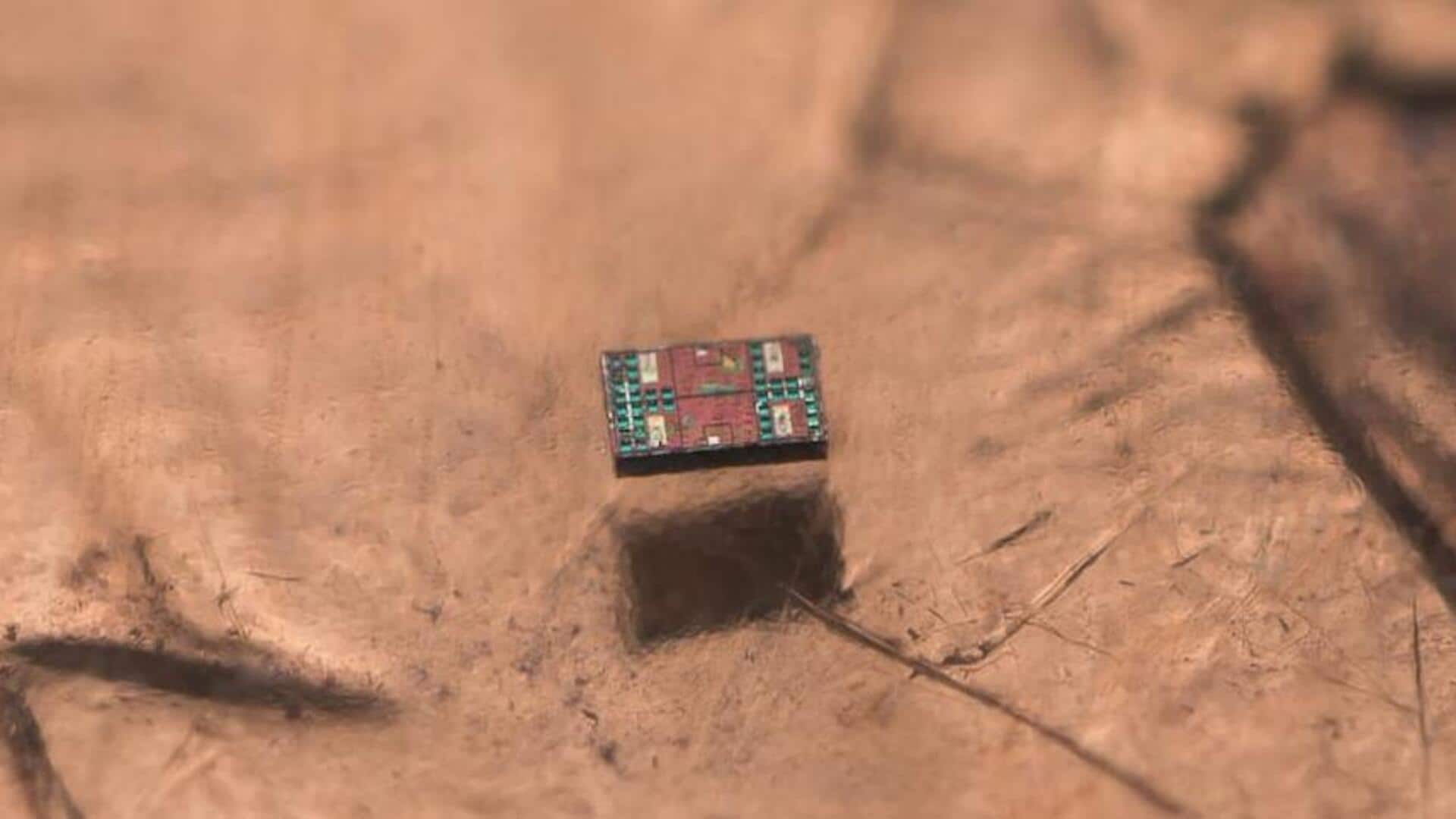
Researchers from the University of Pennsylvania and the University of Michigan have developed an ultra-tiny robot, smaller than a grain of salt. The sub-millimeter-sized microrobot is packed with a computer, motor, and sensors. This groundbreaking research, published in the journal Science Robotics, could pave the way for creating microscopic robots capable of performing complex medical tasks inside the human body.
Future applications
Microrobot: A potential tool for medical miracles
The microrobot could one day be used to repair tissues or deliver treatment to hard-to-reach areas in the human body.
"It's the first tiny robot to be able to sense, think and act," co-author Marc Miskin, an assistant professor of electrical and systems engineering at UPenn, told The Washington Post.
However, the device is still highly experimental and not yet ready for use inside a human body.
Technical hurdles
Microrobots: A challenge for scientists
Creating a microrobot that can move, sense its environment, and think on its own has been a challenge for decades.
The team explained that roboticists have usually controlled the microrobots externally to make them work at smaller scales, but this compromises their ability to process information.
This limits these robots' interactions with their environment and reduces their real-world applicability.
Biological significance
Microrobots: A glimpse into biological systems
Miskin said having a robot on the scale of microns, or one millionth of a meter, would give us access to what corresponds to the smallest units of our biology.
He added that "every living thing is basically a giant composite of 100-micron robots," which is quite profound considering nature has singled out this one size as being how it wanted to organize life.
Design details
Microrobot's design and functionality
The researchers' robot looks like a microchip and is made of silicon, platinum, and titanium. It is encased in a layer of glass-like material to protect it from fluids.
The robot uses solar cells to convert energy that powers its onboard computer and propulsion system.
This system uses two electrodes to create a flow in the surrounding water particles, allowing the robot to swim.
Communication potential
Microrobot's communication capabilities and future prospects
The microrobot can communicate with its human operators, sending and receiving messages about its actions and observations.
However, the next step in this research is to enable inter-microrobot communication.
"So the next holy grail really is for them to communicate with each other," co-author David Blaauw from U-M told The Washington Post.
This advancement could significantly enhance the real-world applicability of these tiny machines in medical settings.