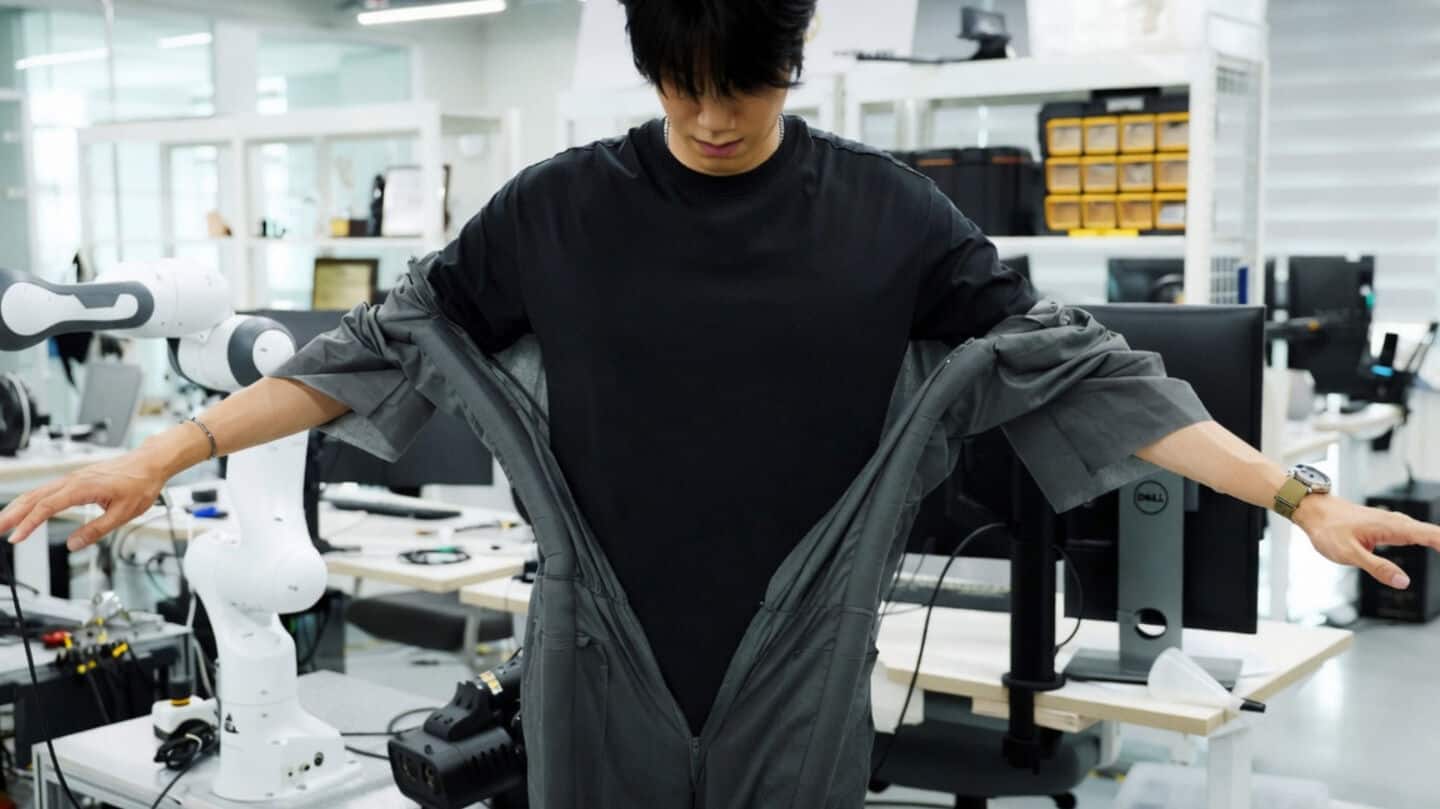
This robot can dress you without any manual assistance
What's the story
A joint research team from South Korea's KAIST and Stanford University has developed a revolutionary robotic technology. The system can dress a person without any manual assistance or the need for them to remain still. The innovation is powered by soft and flexible "vines" embedded in clothing, which use air pressure to function. When pressurized, these vines move the fabric close to the wearer's body, much like an ivy plant climbing on a structure.
Versatility
Potential applications in cleanrooms and emergency services
The robotic technology has a wide range of potential applications, including in semiconductor cleanrooms and by emergency workers requiring personal protective equipment.
The system can dress a full suit in about 10 seconds, without the need for complex control algorithms.
This makes it particularly useful for situations where quick dressing is essential, such as in emergencies or hazardous environments.
Inspiration
Design and functionality of the self-dressing system
The design of this robotic technology was inspired by climbing ivy.
The robot moves by growing at its tip instead of moving its whole body, which allows it to move stably along curved surfaces.
It can also pass through narrow gaps and adapt to the shape of its surrounding environment.
This adaptability makes it a promising solution for a variety of applications, including those requiring quick dressing without manual assistance.
Assistance
Research team envisions help for elderly, disabled people
The researchers believe their robotic technology could be a game-changer for elderly or disabled people who need help getting dressed.
The study was published in IEEE Robotics and Automation Letters, a peer-reviewed journal.
Lead author Kim Nam Gyun said the idea of an automatic raincoat inspired their work, while Ryu Jee-Hwan highlighted how mechanical engineering can complement software in creating innovative solutions like this self-dressing robot.