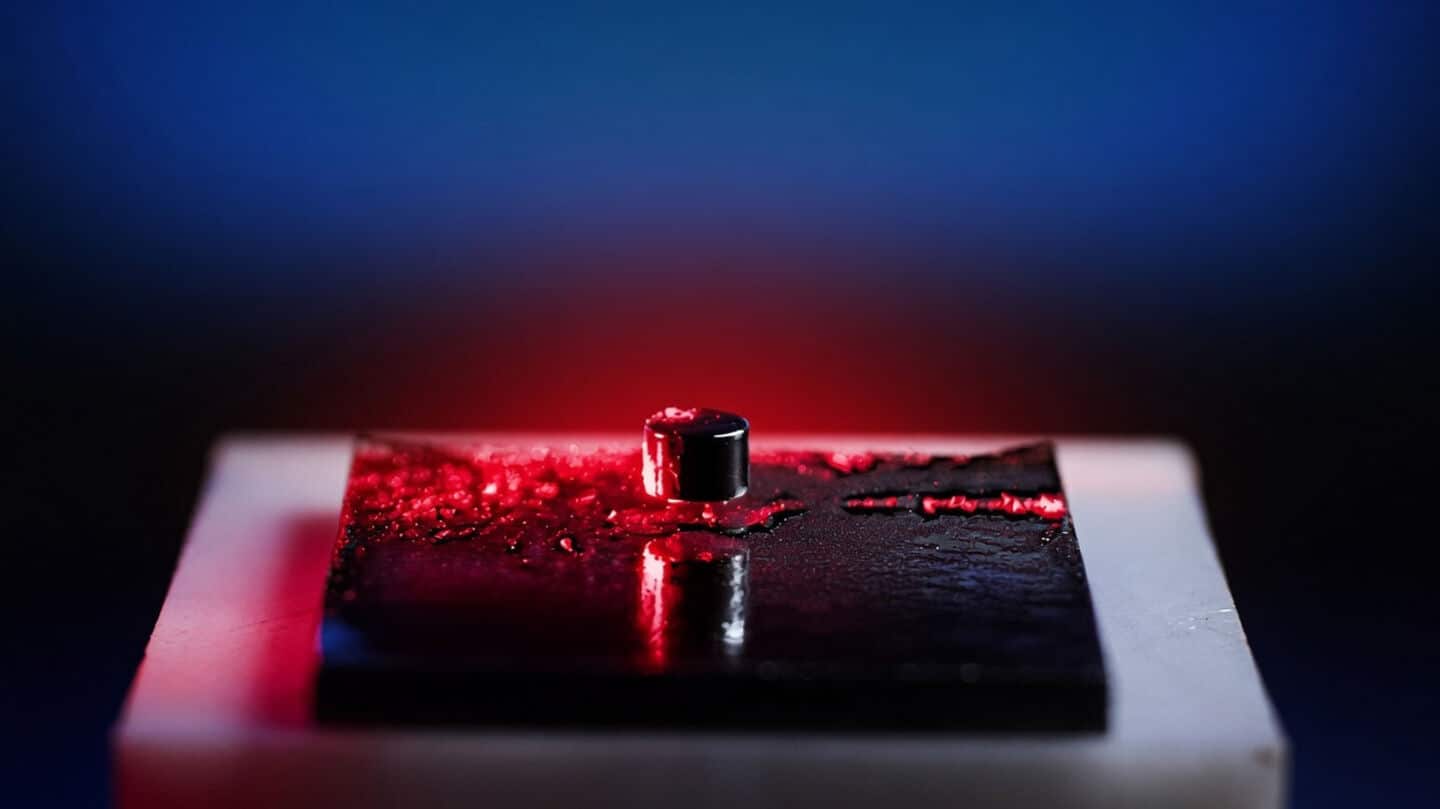
This ultra-sensitive 'floating compass' can help search for dark matter
What's the story
A team of Chinese scientists has developed a tabletop magnetic sensor, the Levitated Magnet Magnetometer (LeMaMa). The device can detect magnetic signals a billion times weaker than Earth's own field. It works like a compass with a needle that floats in mid-air with virtually no friction. By tracking the needle's tiny deflections, researchers can measure magnetic fields down to the femtotesla level.
Future applications
The device could help in the search for dark matter
Ji Wei, an assistant professor at Peking University's School of Physics and corresponding author of the study, told Guangming Daily that "the combination of room-temperature operation, tiny components and high sensitivity makes LeMaMa promising for fundamental physics experiments."
The development could expand the search for elusive dark matter particles or even monitor brain signals.
Measurement difficulties
Research team and publication
Magnetic fields are ubiquitous, from the 1.5 tesla of a hospital MRI machine to the femtotesla generated by human brain activity.
However, measuring these minuscule magnetic fields has always been a challenge.
Now, scientists from China's Peking University and Germany's Johannes Gutenberg University Mainz have developed the world's first room-temperature ultraprecise magnetometer based on a levitated magnet.
Their work was published in the journal Science.
Measurement techniques
SQUID magnetometer has to work at cryogenic temperatures
Femtotesla-level measurements have mainly relied on two approaches. The first is the superconducting quantum interference device (SQUID) magnetometer, which offers excellent sensitivity but has to work at cryogenic temperatures near absolute zero. This requires bulky and expensive liquid-helium cooling systems.