Singapore's new data center runs on living human brain cells
What's the story
Singapore has unveiled a revolutionary biological data center prototype, the first of its kind in the world. The groundbreaking facility integrates living human neurons into a server-rack environment, paving the way for more efficient and adaptive computing systems. The project is a joint effort between the National University of Singapore (NUS) Medicine's Yong Loo Lin School of Medicine, data-center operator DayOne, and biological computing company Cortical Labs.
System details
The prototype is made up of 20 biological computing units
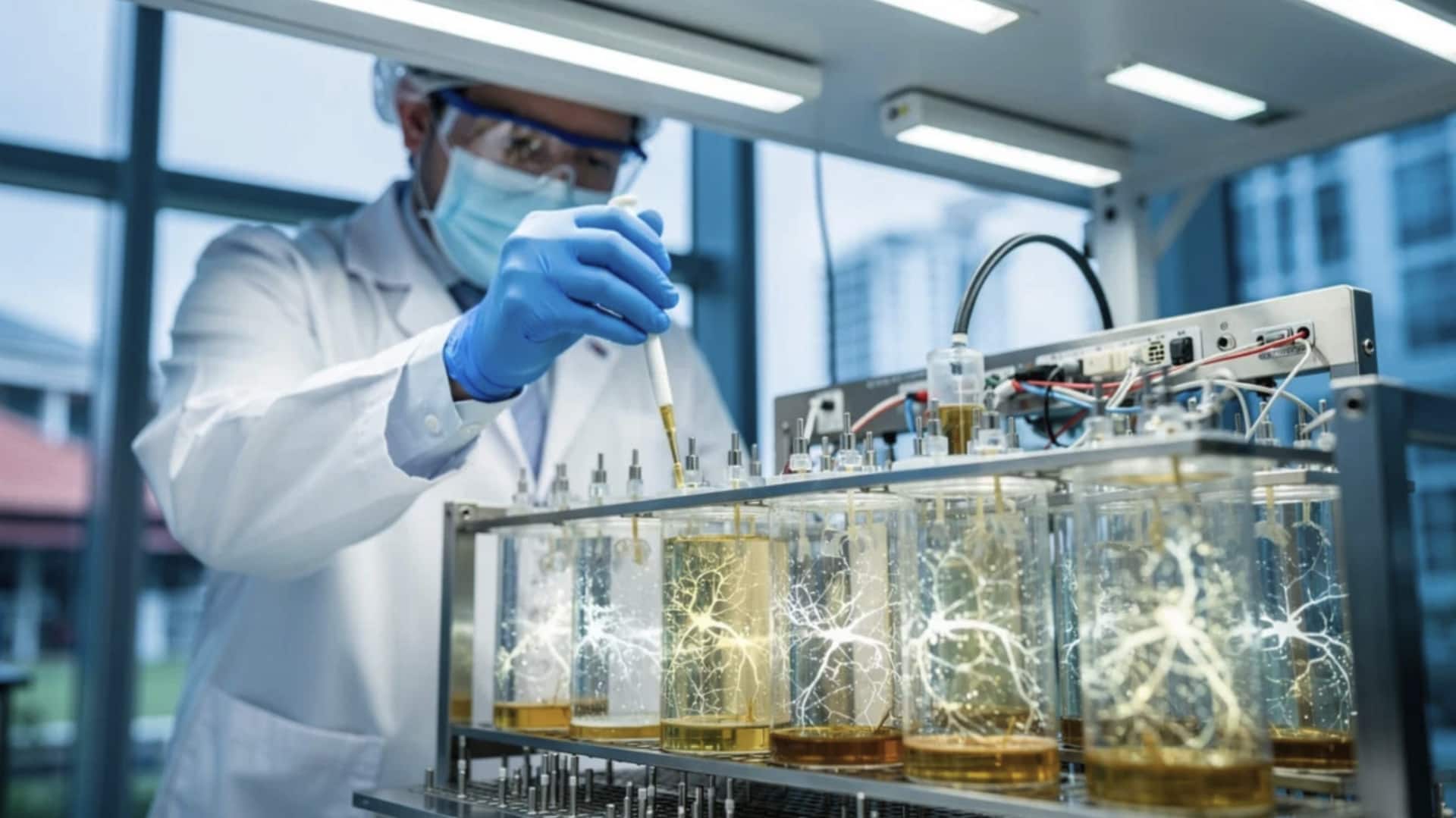
The prototype of the biological data center comprises 20 CL1 biological computing units. Each unit is a network of lab-grown human neurons integrated with silicon hardware.
This means that the entire 20-unit system likely consists of some 16 million neurons, considering each unit has about 800,000 neurons.
The system was unveiled at NUS on August 6 and is being touted as a potential new approach to AI and computing.
Project collaboration
Each partner brings unique skills to the project
The Biological Data Centre prototype has been set up at the NUS Life Sciences Institute, as part of a larger effort to transition biological computing from lab experiments into practical computing infrastructure.
Each partner in this project brings a unique skill set: NUS offers neurobiology expertise and will manage the culturing and maintenance of living cells; DayOne brings data-center infrastructure experience; while Cortical Labs provides CL1 biological computing technology.
Infrastructure innovation
A new category of computing infrastructure
The project aims to create a new category of computing infrastructure where biological systems work alongside conventional electronics, instead of relying solely on silicon processors.
The technology behind this system is different from a conventional server, but it still relies heavily on silicon hardware.
Cortical Labs grows neurons from human stem cells and places them on a silicon-based platform with microelectrode arrays that can stimulate the neural network and record its electrical activity.
AI advancement
Researchers believe biological computing could complement AI
The researchers behind this project believe biological computing could one day provide an edge in cases where traditional AI systems require massive amounts of training data and compute power.
Living neural networks can adapt to changing conditions and learn from interactions with their environment.
This is why researchers are looking at ways to complement, rather than replace, traditional AI systems with biological computing.