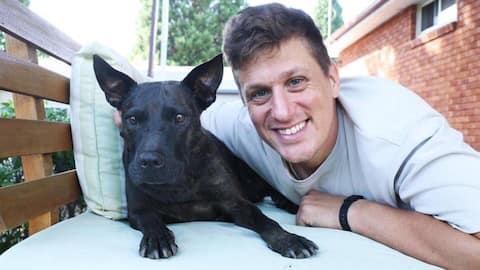
How AI helped techie develop cancer vaccine for his dog
What's the story
In a groundbreaking case, an Australian man has leveraged artificial intelligence (AI) tools to develop an experimental vaccine that could potentially treat cancer in his pet dog. The techie, Paul Conyngham, used several AI platforms including OpenAI's ChatGPT and Google's DeepMind's AlphaFold to create a personalized treatment after his dog was diagnosed with cancer.
Journey
Conyngham's dog was diagnosed with cancer in 2021
Speaking on the Australian news program 'Today,' Conyngham opened up about his emotional journey. He said that when she was handed the sentence, he felt he had to do his part for her.
His dog Rosie, a Staffy-Shar Pei cross adopted from an animal shelter in 2019, was diagnosed with cancer five years later.
Despite spending money on conventional treatments like chemotherapy, the tumor did not respond to therapy.
Treatment
The techie used ChatGPT to devise a plan
Faced with the challenge, Conyngham turned to AI for help. He used ChatGPT to devise a plan for the process and contacted the University of New South Wales's Ramaciotti Centre for Genomics for genomic data.
The center sequenced Rosie's DNA at a cost of about $3,000 (around ₹2 lakh). After receiving the results, Conyngham compared healthy DNA with tumor DNA to pinpoint genetic mutations responsible for cancer.
Vaccine
Conyngham then used AlphaFold to study protein structures
Conyngham then used AlphaFold to study protein structures associated with the identified mutations. This helped him determine which drugs or treatments could potentially target the tumor.
He then contacted researchers at UNSW to create a customized mRNA vaccine for Rosie.
The treatment was developed amid regulatory hurdles, with Conyngham spending months getting ethical approval for a drug trial on his dog.
Results
Rosie's tumor has shrunk significantly
Rosie received her first shot in December, followed by booster doses. Since starting the treatment, her tumor has shrunk significantly, even though the cancer was already at an advanced stage.
However, Conyngham is cautious about calling it a cure. "I'm under no illusion that this is a cure," he said. "But I do believe this treatment has bought Rosie significantly more time and quality of life."