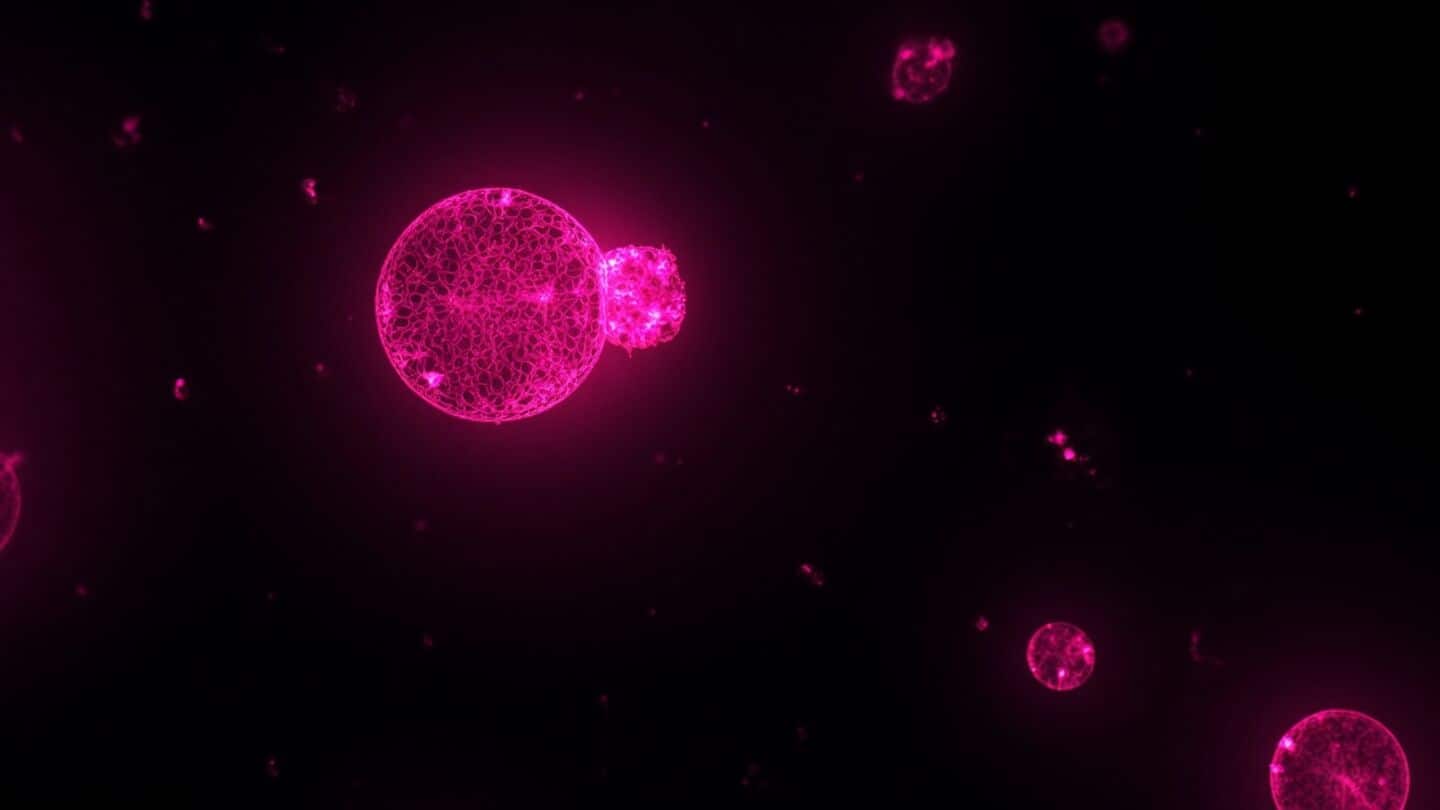
This world's first synthetic cell can grow and reproduce
What's the story
In a groundbreaking achievement, scientists have successfully created a synthetic cell from non-living chemical components. The team, led by Kate Adamala, a synthetic biologist at the University of Minnesota, built the cell piece by piece. This revolutionary development in synthetic biology could pave the way for custom-made organisms that work like living machines.
Research implications
Synthetic cell could unlock secrets of life's origins
The synthetic cell, which is neither a plant nor an animal but resembles a simple bacterium, could help scientists better understand the origins of life.
Adamala said, "I know the full ingredient list of the cell, I know exactly what chemicals, what molecules at what concentrations. It is fully defined, which means we can engineer it."
Future possibilities
Synthetic cells seen as next frontier in bioengineering
For decades, scientists have bioengineered natural cells to solve human problems.
A famous example is inserting human insulin genes into E. coli bacterial cells to manufacture insulin and treat diabetes.
Now, synthetic cells are being seen as the next frontier. They could lead to new cancer treatments and innovative methods for carbon capture or chemical manufacturing.
Research significance
Programming synthetic cells could lead to breakthroughs
The synthetic cell created by Adamala and her colleagues is not "life created in the lab" but a major step toward that goal.
Yuval Elani, an associate professor at Imperial College London, said building a cell from scratch removes the constraints of natural biology.
He added, "It opens up the possibility of designing systems and programming them to do things that living cells may not do easily, or may not do at all."
Technological advancement
Adamala has named her creation 'SpudCell'
Adamala has named her creation "SpudCell," a nod to Sputnik, the Russian satellite that launched the space age.
The synthetic cell is made up of 150 to 200 molecules and can feed, grow, and replicate for about five generations.
Each generation requires feeding and takes roughly 12 hours to replicate at a temperature of 30 degrees Celsius.
Cellular characteristics
How SpudCell replicates and feeds
The genome of the synthetic cell is much smaller than that of a natural cell, with 90,000 base pairs.
While it can replicate like a natural cell, it uses a different mechanism.
Instead of using a cytoskeleton, which SpudCell lacks, the synthetic cell produces proteins that crowd at the membrane and force it to split.
However, it can't make its own ribosomes and relies on E. coli ribosomes supplied through feeding.
Future prospects
Safety concerns around synthetic cells raised
Despite its limitations, Adamala sees SpudCell as a starting point for future bioengineering advancements.
She said, "It's just the beginning. It's a chassis that we're hoping to build on."
Drew Endy, an associate professor of bioengineering at Stanford University, emphasized that SpudCell doesn't pose any biosafety risks in its current form.
However, he acknowledged potential safety and security concerns around broader access to synthetic cell technology in the future.