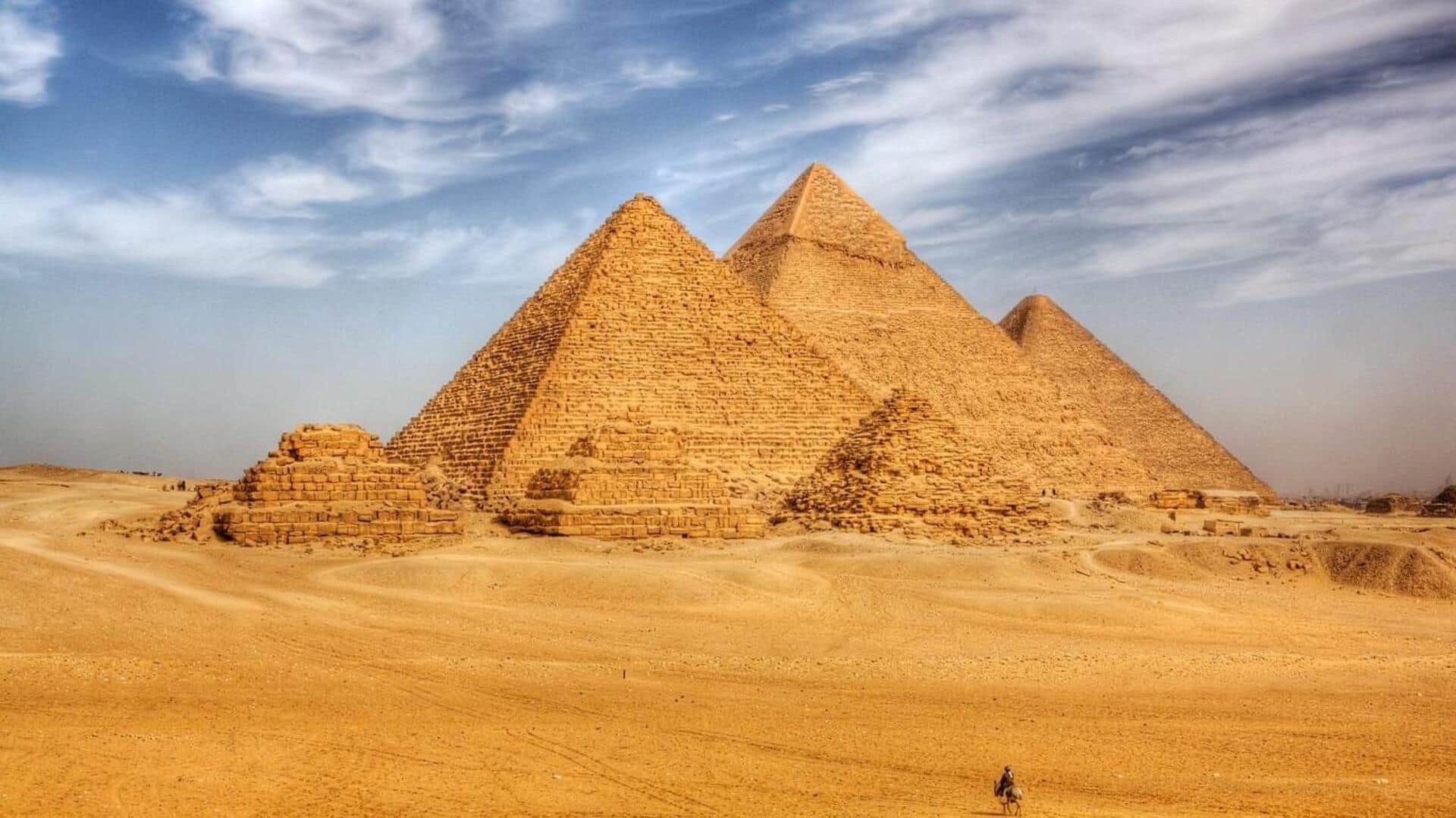
We might finally know how Pyramid of Giza was built
What's the story
The construction of the Great Pyramid of Giza, which comprises 2.3 million massive stone blocks, has long puzzled researchers. Mainstream archeology believes that these pyramids were built using natural limestone or granite blocks that were precisely cut and transported. However, an alternative theory suggests that an early form of concrete may have been used to cast the blocks. But this idea raises a key question: how could such an artificial material last for over 4,500 years?
Study findings
Study shows ancient Roman concrete becomes stronger over time
A recent study, published in the peer-reviewed journal Science Advances, could provide an answer.
The research shows that ancient Roman concrete not only withstands decay but also becomes stronger over time.
This is due to a self-healing process where calcite crystals slowly form and fill pores and microcracks in the material.
The study was led by Zhu Xiaohong of Beijing University of Technology with collaborators from several institutions, including UC Berkeley and the University of Michigan.
Construction theories
Insights into Great Pyramid's construction
The durability of Roman concrete could provide insights into how the ancient Egyptians built the Great Pyramid.
If they used a similar self-healing material, it could explain how these structures have survived for millennia.
The study's findings highlight the potential of ancient materials science in understanding historical construction techniques and preserving modern architecture against decay.