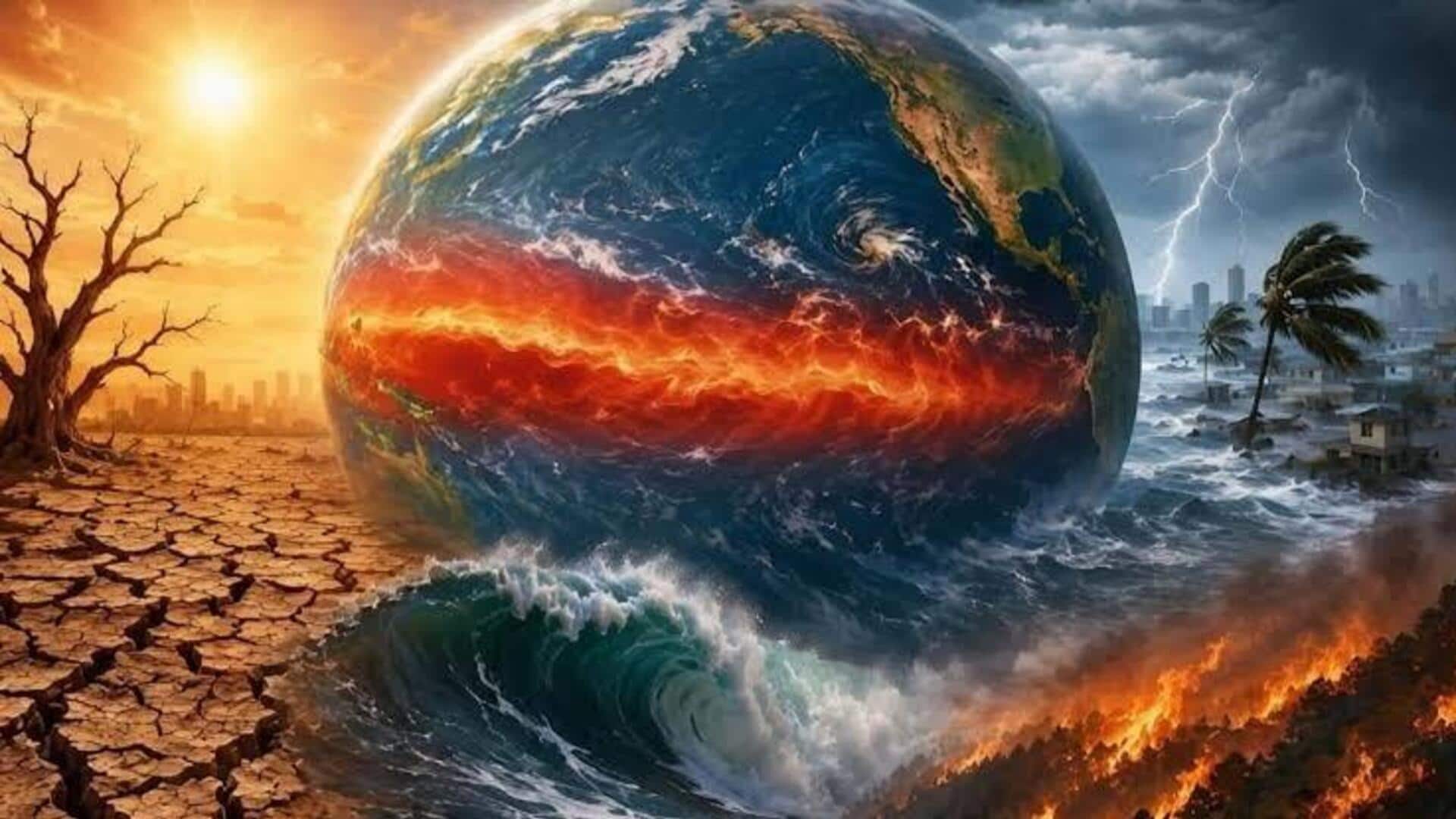
Earth set to breach 1.5°C warming limit, UN warns
What's the story
The United Nations has confirmed that the world is on track to exceed its target of limiting global warming to 1.5 degrees Celsius above pre-industrial levels. The grim assessment comes from a new report released by the UN, which also outlines a revised strategy for combating climate change. The report emphasizes the need to focus on ways to limit "overshoot" and eventually bring global temperatures back down, rather than simply aiming for a specific temperature target.
Current status
Global average temperatures have already risen by 1.4 degrees Celsius
The UN report highlights that global average temperatures have already risen by about 1.4 degrees Celsius, largely due to greenhouse gas emissions from fossil fuels such as oil, gas, and coal.
These gasses trap heat in the atmosphere and contribute to climate change.
"This summer's scorching heat, raging wildfires and deadly floods are a warning of what lies ahead. We must make the overshoot above 1.5 degrees as small and short as possible," UN Secretary-General Antonio Guterres said.
Concerns
National climate pledges remain critically inadequate
National climate pledges remain critically inadequate, according to the UN report. An analysis of mitigation targets submitted under the Paris Agreement reveals a persistent emissions gap.
Even with the full execution of the latest third-round Nationally Determined Contributions (NDCs) finalized by September 2025, which would yield only a marginal decline from record-high 2024 emissions, the shortfall required to stabilize the climate remains vast.
Concerns
Glaciers could lose over 25% of their mass by 2100
Even with full execution of all national climate pledges and net-zero goals, global temperatures are projected to peak 1.8°C above pre-industrial levels.
This trajectory would trigger severe disruption, drastically altering ice sheets, permafrost, and glaciers.
Glaciers could shed over a quarter of their mass by 2100, adding 9 to 12.5 cm to sea levels and permanently disrupting downstream freshwater supplies.
The warning follows the catastrophic glacier collapse across Nepal and Tibet, which unleashed flash floods killing over 1,000 people.
Challenge ahead
Proposed methods for reversing climate change
The UN report proposes a daunting task of reversing climate change by removing carbon dioxide from the atmosphere on an unprecedented scale.
This could involve covering large parts of the world with forests or using innovative technologies to extract carbon from the air.
However, even if these measures are implemented, global temperatures would continue to rise for the foreseeable future and wouldn't return to temperatures like today's for decades or even centuries.