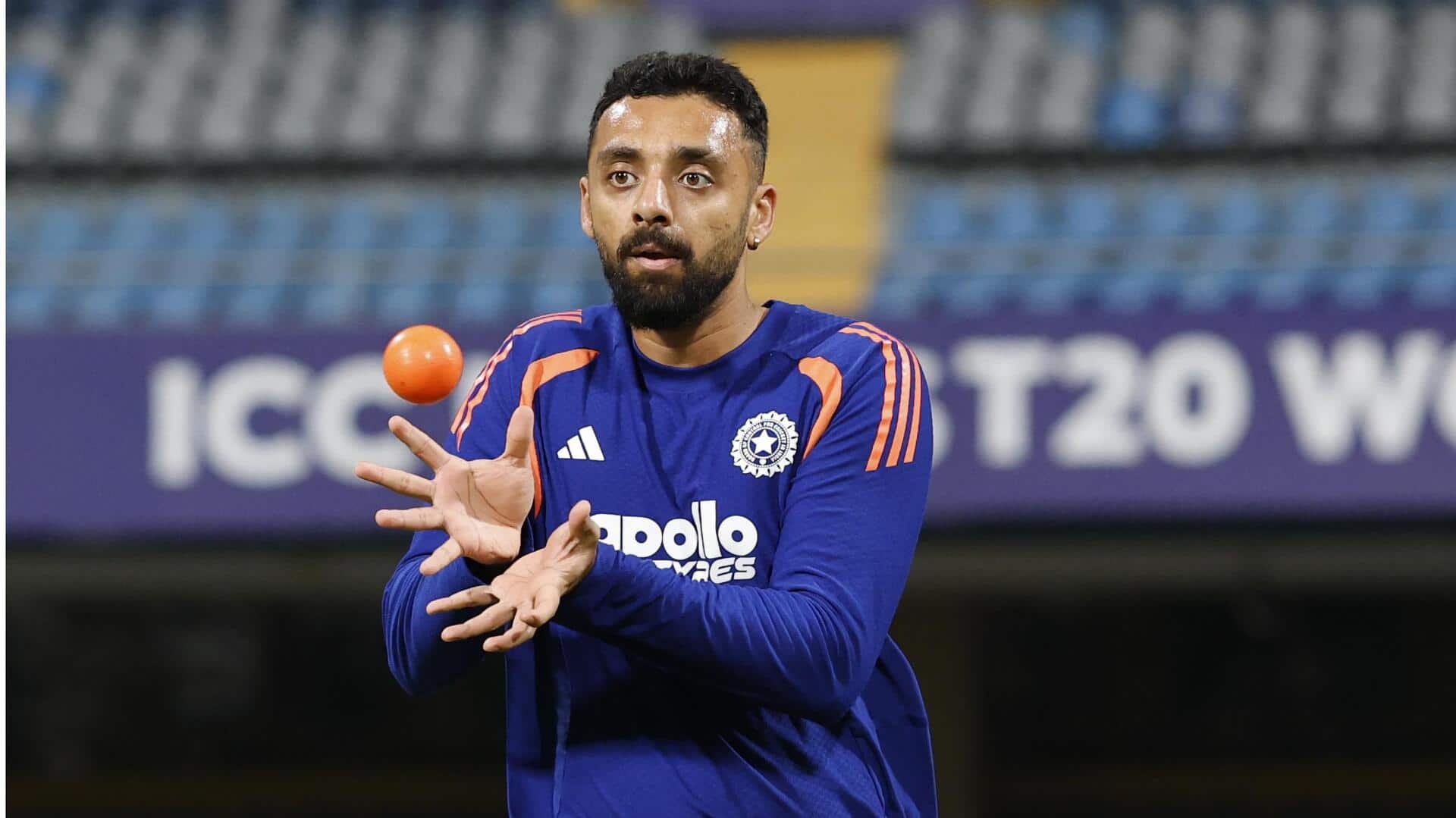
Varun Chakravarthy: Dissecting his T20 WC campaign in two halves
What's the story
The ICC T20 World Cup 2026 witnessed some incredible performances by bowlers, defying the common notion that T20 cricket is a batsman's game. India's Varun Chakravarthy, the top-ranked T20I bowler, ended the tourney as the joint-highest wicket-taker with 14 scalps. Though India went on to lift the title, it was a campaign of two halves for the spinner. Here we decode the same.
Tally
Nine wickets in the group stage
Chakravarthy, who made it to India's XI ahead of Kuldeep Yadav, enjoyed a dream campaign in the group stage.
The mystery spinner claimed nine wickets across four games in this round at a brilliant economy of 6.88, as per ESPNcricinfo.
He claimed two three-fers in the group stage as Team India entered the Super 8s unbeaten.
Super 8s and knock-outs
Start of struggles from Super 8s
Notably, three of India's four matches in the group stage were against associate nations.
However, the challenge became stiffer in the Super 8s and knock-outs.
India's opponents in these games were South Africa, Zimbabwe, West Indies, England (semi-final), and New Zealand (final).
Chakravarthy claimed one wicket in each of these five games.
However, he recorded economy rates of 10 or more in four of these matches, excluding Zimbabwe (8.75).
Information
Worst economy rate in this stage
Chakravarthy's economy rate of 11.84 was the worst among bowlers who delivered at least 10 overs since the start of the Super 8 round. In the semi-final against England, the spinner conceded a whopping 64 runs while taking just one wicket in four overs. The performance is now tied for the second-most expensive bowling spell in T20 World Cup history.
Stats
Chakravarthy finishes at par with Bumrah
Chakravarthy overall finished the tourney with 14 wickets at an economy rate of 9.26. His average read 20.50.
His best performance was 3/7 against Namibia in Delhi.
The spinner's fellow Indian teammate Jasprit Bumrah also ended as the joint-highest wicket-taker with 14 scalps at an average of 12.42.
However, the pacer's wickets came at a stunning economy rate of 6.21.