Canada welcomes EU chief's proposal to become 1st 'associate member'
What's the story
Canadian Prime Minister Mark Carney has welcomed the European Union's proposal for Canada to become its first "associate member." The idea was proposed by European Commission President Ursula von der Leyen, who suggested closer cooperation in areas like manufacturing, technology, defense, energy, critical minerals, and economic security. The status of "associate member" does not currently exist within the EU framework and could take years to implement.
Proposal details
Carney proposes Canada-EU alliance as a 'beacon for other democracies'
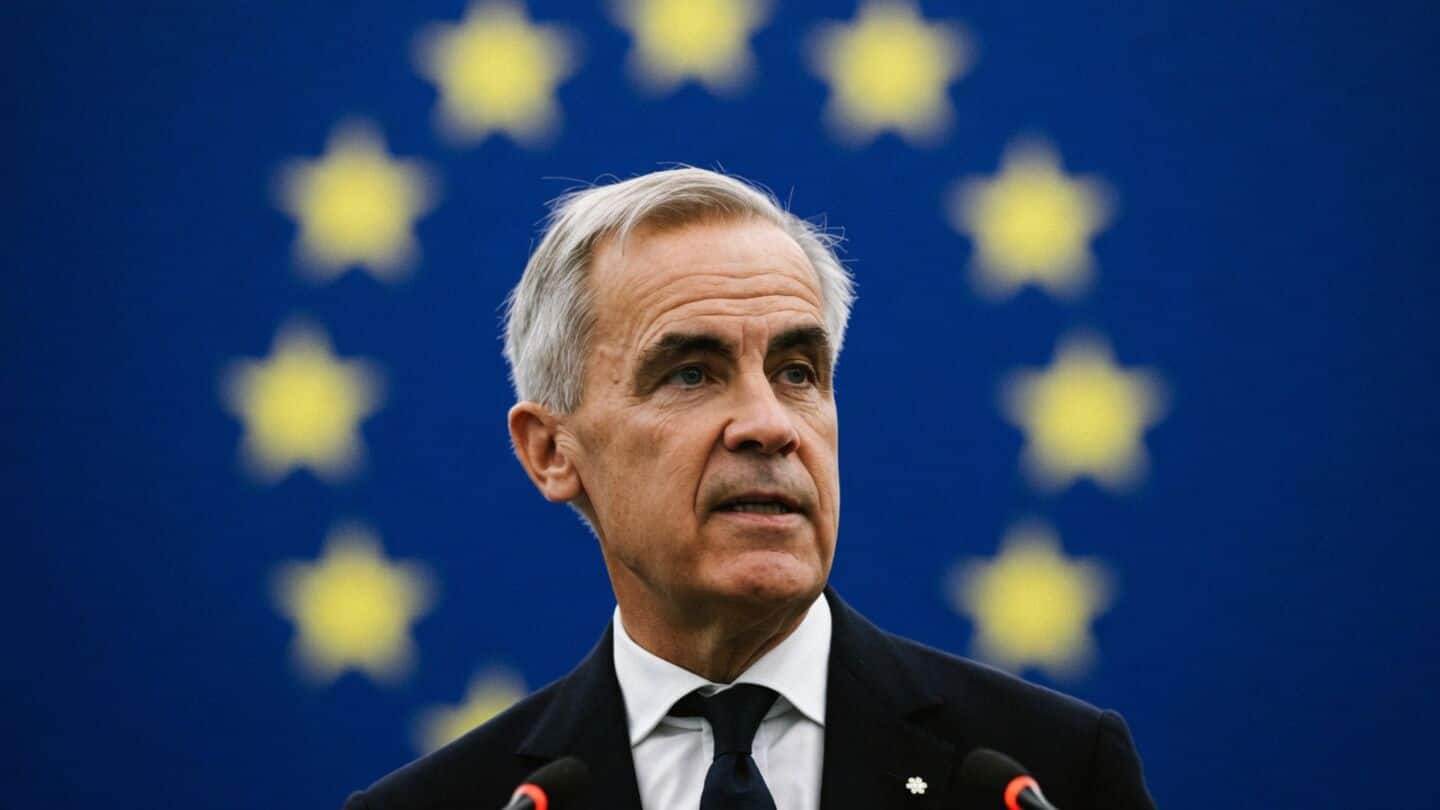
During his address to European Parliament, Carney emphasized that Canada and Europe are "stronger together" amid global challenges like climate change and trade weaponization.
"This is about sovereignty, our ability to live as we wish."
He said a Canada-EU alliance could serve as a "beacon for other democracies," but clarified it wouldn't be to create a new power bloc.
He highlighted potential benefits of such cooperation, including Canada's role in supplying liquefied natural gas and hydrogen for European energy security.
Trade tensions
US President Trump's reaction
US President Donald Trump had reacted skeptically to the proposal, calling it "laughable" and warning of "very serious tariffs" if he perceives it as a hostile act.
Canada and the US are embroiled in a growing trade war, with both sides imposing tit-for-tat tariffs after bilateral talks collapsed last month.
Responding to Trump, Carney said, "This alliance is a positive process, that's my response to the American president."
Trump
Current status of Canada-EU relations
"Canadians are united that nobody is going to tell us what language we speak...dictate our culture, or with whom we can strike agreements internationally," Carney added.
Currently, Canada and the EU have a free-trade agreement and cooperate on trade, defense, and research.
Carney suggested deepening this cooperation by pooling technological resources and allowing people-to-people ties through programs like Erasmus+.
He described the proposed relationship as "a unique, positive approach that we will define together."
Existing agreements
Granting Canada 'associate membership' could take years
It is unknown what that relationship would be like because the "associate member" status does not yet exist in the EU.
Any new arrangement would require the approval of all 27 EU member states and take years.
Earlier this year, German Chancellor Friedrich Merz had suggested a similar status for Ukraine, which received mixed reactions.
Some Western Balkan countries are already on their way to full EU membership, while Georgia and Moldova are also applying in Eastern Europe.