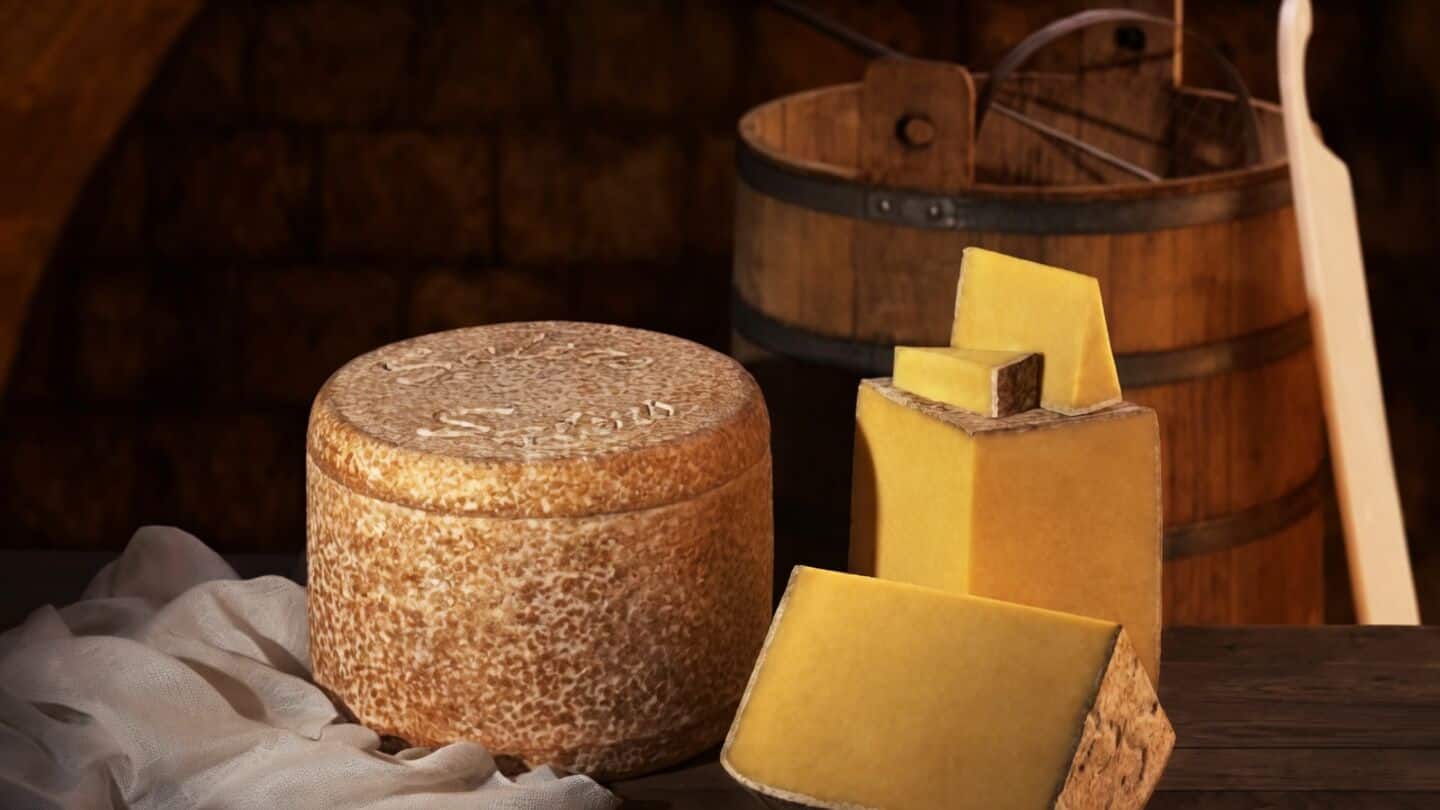
France's beloved Salers cheese production threatened due to climate change
What's the story
The production of some of France's most popular artisanal cheeses is under threat due to climate change. Historic heat waves and droughts are stressing dairy cows, resulting in reduced milk production and weaker calves. Laurent Lours, a veteran dairy farmer, said these issues now occur "every other year" instead of every 15-20 years. This summer, over three-quarters of Salers cheese producers had to stop production due to extreme weather conditions.
Production pause
Salers cheese under threat
Salers cheese, a semi-hard raw cow's milk cheese with a protected designation of origin (AOP), has been particularly impacted by climate change.
The AOP certification ensures that all stages of production occur in a specific geographic area.
Salers is mainly made in Cantal, the Auvergne-Rhône-Alpes region, where cows graze on nutrient-rich wild grasses at high altitudes.
However, this year's drought forced Lours to stop making Salers and switch to producing Cantal cheese instead.
Regulation changes
AOP regulations modified for some cheesemakers
In light of the "historic drought," the Institut national de l'origine et de la qualite (INAO) has temporarily modified AOP regulations for some cheesemakers.
Producers of Beaufort, Comte, and Abondance cheeses can now increase fodder share or source supplementary feed from outside their AOP zones.
However, Lours said they didn't seek exemptions for Salers, as anything less than 50% pasture-grown grass wouldn't "deserve the designation" of Salers cheese.
Diet impact
Changes to AOP regulations affect cheese quality
Research from France's National Research Institute for Agriculture, Food and Environment (INRAE) shows that diet affects cheese quality.
Cheeses made with grass-based milk are richer in omega-3 fatty acids and superior in taste.
Christian Janier, a Lyon-based cheesemonger, believes any changes to AOP regulations will have subtle effects on cheese quality.
However, he admits that while the end result may be imperceptible for consumers, it could still affect the final product's texture and flavor profile.
Economic impact
Farmers face strain
Climate change is also affecting the livelihoods of French dairy farmers.
Cows suffering from heat stress produce 10% less milk, leading to a decline in supply.
Salers production has dropped from an average of 1,500 tons a year in the early 2010s to around 1,000 tons today.
Farmers are forced to use winter hay supplies for summer grazing due to grass shortages.
Financial strain
Producers switch to less profitable cheeses
Producers like Stephanie Gardes have been forced to switch from Salers to less profitable cheeses like Cantal due to drought conditions.
Gardes lost €20,000 in revenue last year and is facing her worst financial year yet.
Emilie Jacquot, who produces Abondance cheese, has also noticed climate change's impact on their operation, with wild temperature swings affecting production quality.