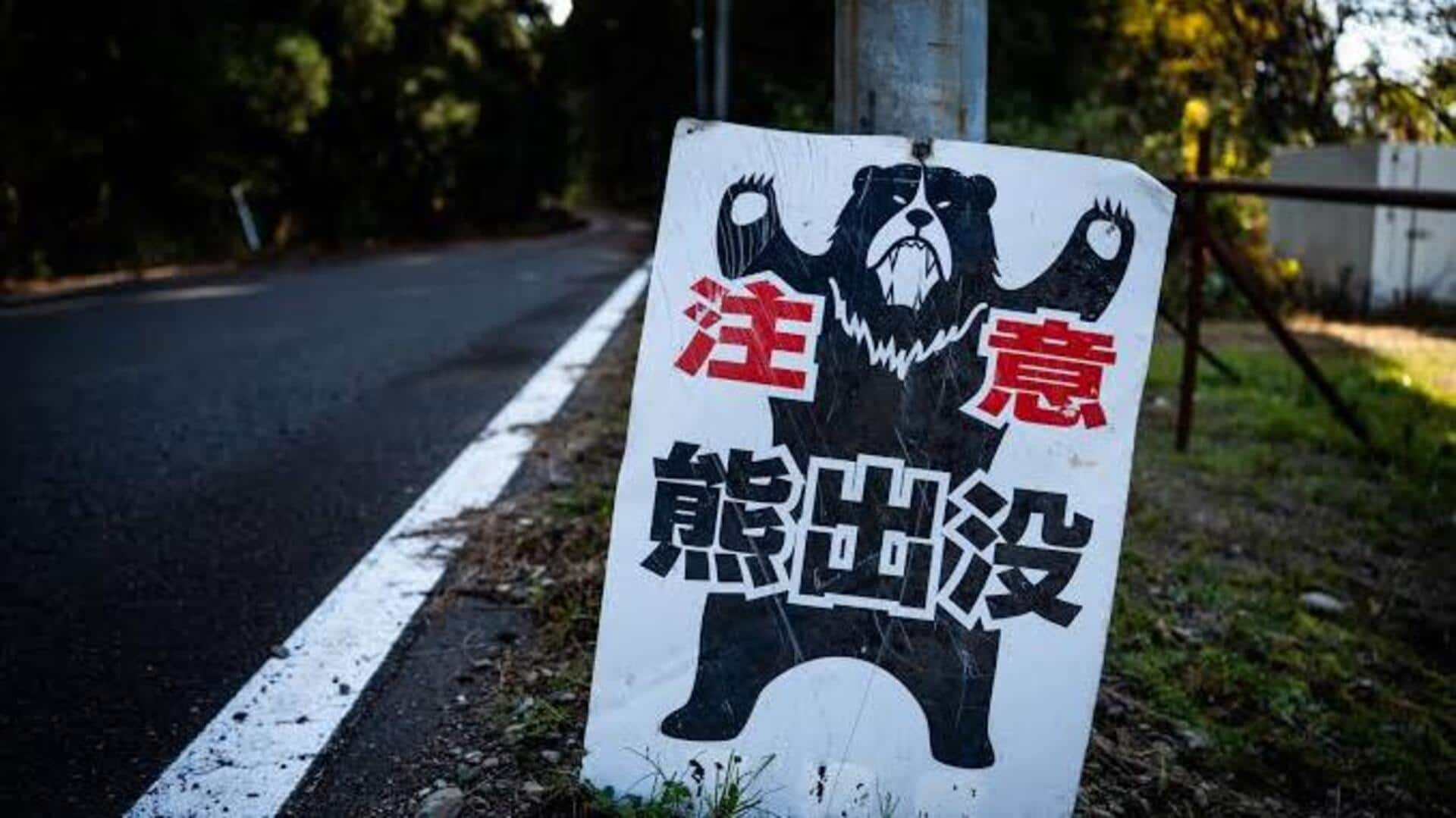
Japan's bear crisis; here's how it's tackling it
What's the story
Japan is grappling with a bear crisis as the number of human-bear encounters has skyrocketed. Between April 2025 and March 2026, the country witnessed 13 fatalities and over 220 injuries due to bear attacks. This is a sharp rise from the previous year when three people were killed and 82 injured in similar incidents. The situation has prompted authorities to take drastic measures as fall approaches, which is when bears typically forage for food in preparation for winter hibernation.
Rural decline
Bears's natural habitat has shrunk
The surge in human-bear encounters is largely due to shrinking rural communities since World War II.
As young people moved to cities, farmland that once separated settlements from bears was lost.
Wildlife researcher Liam Adcock of the Picchio Wildlife Research Center was quoted as explaining by CNN: "With the loss of farmland that once buffered settlements from bears, the boundary between towns and forests became more blurred for them."
Environmental impact
Climate change is also a factor
The problem is further compounded by climate change. Vegetables, berries, and acorns that bears depend on are ripening later and becoming scarcer.
Adcock reportedly said, "But they know that one food source remains unchanged: human rubbish."
This has led hungry bears to venture closer to towns than ever before. Last year alone saw 50,000 bear sightings in Japan.
Official measures
The government has relaxed hunting rules
In a 2026 environment white paper, the Japanese government declared bears "a serious threat to public safety and peace."
The government has relaxed bear hunting rules and introduced a population control roadmap.
The plan aims to reduce the bear population to between 62% and 67% of current levels across several prefectures through culling by 2030.
Innovative solutions
AI and drones to the rescue
While there is still a general cultural preference for coexistence, the priority has shifted to ensuring immediate public safety and responding efficiently to threats.
Adcock was quoted as saying, "We want to show that coexistence through nonlethal management, including technology, is perfectly achievable."
Regions prone to bear encounters have started using AI-powered cameras in forests to detect bears and alert local officials.
In Hokkaido, drones are deployed within minutes of a sighting to track bears until help arrives.
Cost concerns
Kumamap app tracks bear sightings
However, these technologies are not practical for individual use.
Tokyo-based engineer Danyel Koca created Kumamap, a bear incident tracker app, after noticing the lack of centralized information on bear encounters.
The app has nearly six million users and tracks over 156,000 public bear incident records.
Adcock acknowledges technology's potential in bear conservation but emphasizes that human intervention is often necessary to effectively manage these situations.