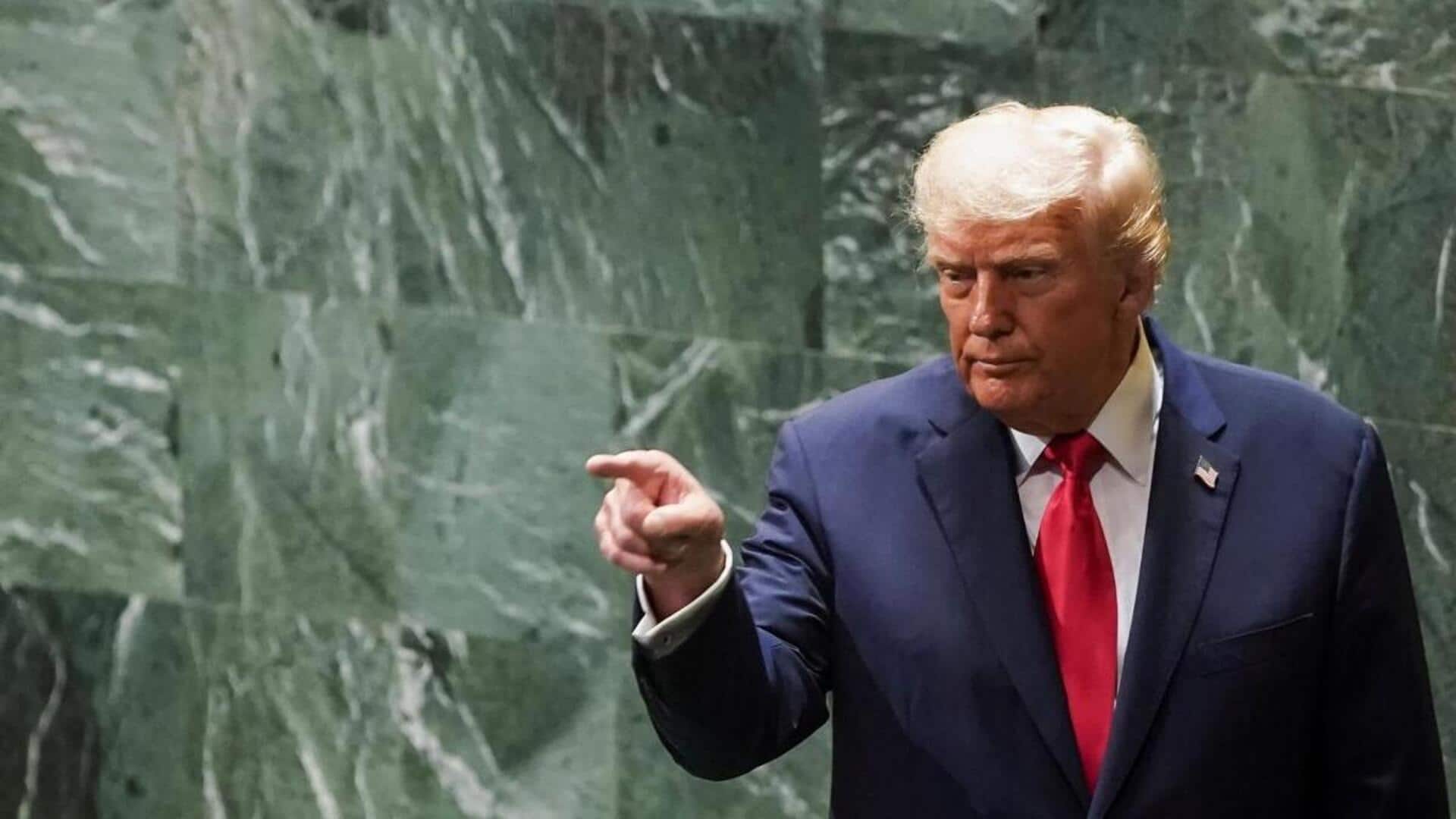
'Make deal or annihilate Iran?' Trump at UNGA
What's the story
US President Donald Trump opened his speech at the 81st session of the United Nations General Assembly with a storm of condemnation directed at Iran. Calling the nation the "number one sponsor of terror," Trump said for 51 years, the "fanatical" Iranian regime has ruled by bloodshed and mass murder, spreading death and carnage and chaos across the entire Middle East and beyond. "They were the bully of the Middle East," but not anymore, he said.
Trump
'We must be equally united in maintaining pressure'
Trump thanked the UN Security Council "for voting overwhelmingly to pass a resolution condemning Iran's despicable terrorist attacks on commercial shipping," adding, "Now we must be equally united in maintaining pressure."
According to Trump, "the United States Navy has recently escorted more than 1 billion barrels of oil out of the Strait of Hormuz, and more oil is flowing than at any point since the start of the war."
"We're taking 22, 25, 30, 32 and 37 ships out....every night."
Speech
'I have a big decision to make'
Yet, the president said, "I have a big decision to make."
He asked, "Will a deal be made with Iran that lets them rebuild and create a far greater country than it ever was before, maybe one of the greatest in the Middle East or....world? Or do I annihilate the Republic....never giving them a chance to kill and destroy people and countries again? Do I drive them into hell with no chance of survival and no hope of future greatness?"
Deal
Believe we'll make a deal: Trump
That being said, Trump said he believed Washington and Tehran could reach a deal after the midterm elections.
"I believe we'll make a deal...after the election because it doesn't make sense for them not to. They're waiting to see how I do in the midterm election," he said.
It remains unclear whether Trump and Iranian President Masoud Pezeshkian will meet. But should an encounter take place, it would be the first meeting between sitting presidents of the US and Iran.
Escalating tensions
Regional and global conflicts escalate
The meeting comes amid two escalating wars in Europe and the Middle East, a volatile global economy, and a changing world order.
The past year has seen major upheavals, including a daring US military operation that ousted Venezuelan leader Nicolas Maduro.
This was followed by a brutal crackdown in Iran after pro-government protests.
A joint US-Israel attack on Tehran has since spiraled into a regional conflict, effectively shutting down a key waterway.
Environmental crises
Climate change and pandemic preparedness at forefront
Meanwhile, the Russia-Ukraine war continues unabated, with both sides intensifying military actions.
The Democratic Republic of the Congo and Uganda witnessed an Ebola outbreak in May, raising concerns over global pandemic preparedness.
Deadly earthquakes in Venezuela and Colombia, along with flash floods in Nepal and Tibet, further underscored the impact of climate change on communities worldwide.
These events have intensified discussions among diplomats about international preparedness for future crises.