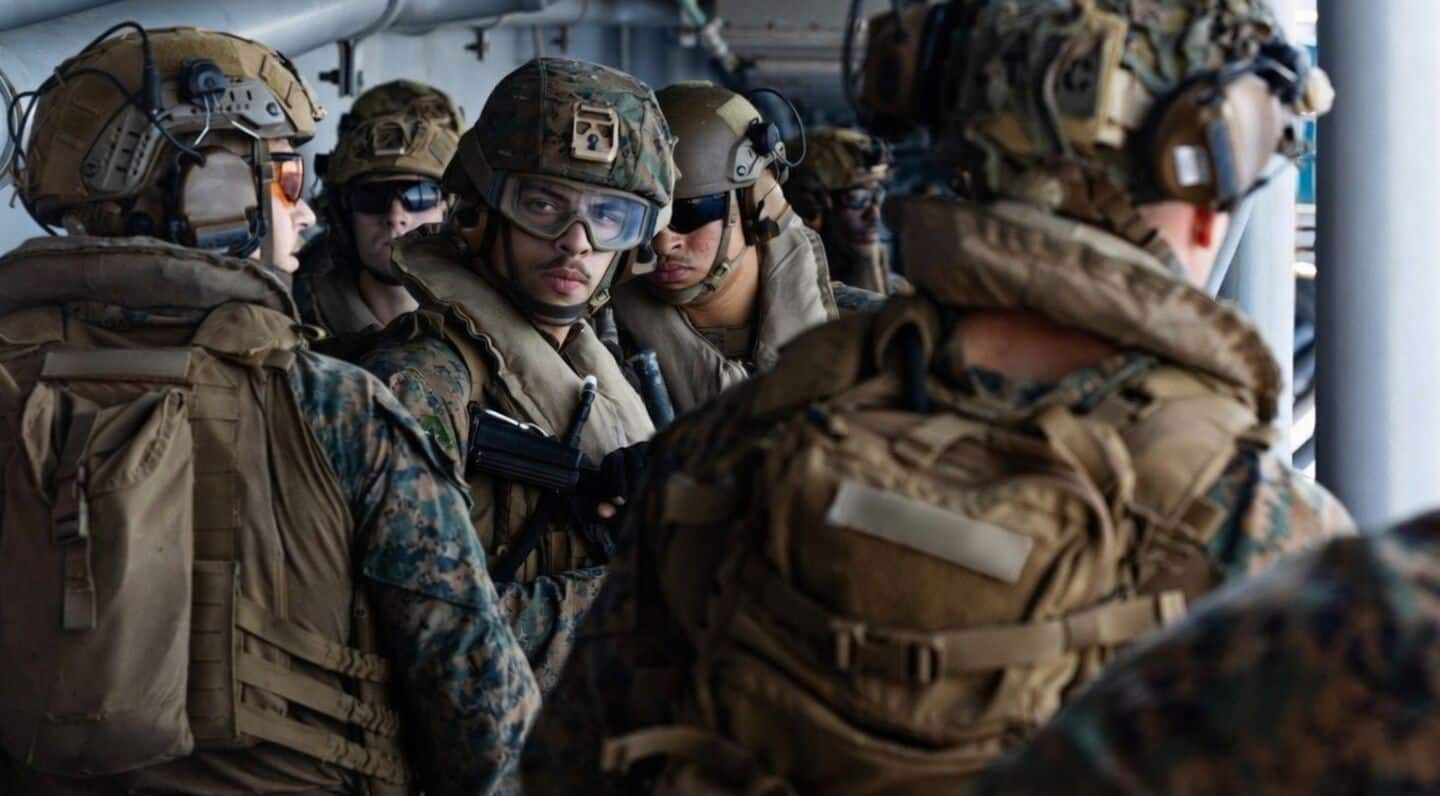
US deploys over 3,500 Marines and sailors aboard USS Tripoli
What's the story
The United States has deployed over 3,500 Marines and sailors to the Middle East as tensions with Iran escalate. The troops arrived aboard the USS Tripoli, an amphibious assault ship that can launch advanced aircraft like F-35s, according to the US Central Command. This marks the largest US military buildup in the region in two decades. The deployment is part of a larger force of around 50,000 US personnel already stationed across the Middle East.
Ship features
USS Tripoli can launch F-35s
The USS Tripoli is a modern "big deck" amphibious assault ship, capable of launching advanced aircraft such as F-35 stealth fighter jets and Ospreys.
Previously stationed in Japan, it received deployment orders nearly two weeks ago.
The ship's arrival in the operational zone is a significant boost to America's military posture in the region.
Other naval units from San Diego, including the USS Boxer, are also being sent to reinforce US forces.
Military operations
Operation Epic Fury exceeds 11,000 targets
Since the launch of "Operation Epic Fury" on February 28, over 11,000 targets have been struck. This highlights the scale of ongoing military operations in the region.
The conflict began with US-Israeli strikes on Iran and has since spread rapidly across the region, involving multiple actors and opening new fronts.
However, according to The Washington Post, which cited officials, it remains unclear whether US President Donald Trump will approve deploying ground troops.
Escalating conflict
Iran strike injures US personnel
On the other hand, Iran has launched ballistic missiles and drones at Saudi Arabia's Prince Sultan Air Base, injuring at least 10 US personnel.
The Houthis, backed by Iran in Yemen, have also fired missiles toward Israel, putting key maritime routes, such as the Bab el-Mandeb Strait, on target.
The conflict has severely disrupted global energy flows through the Strait of Hormuz, a critical chokepoint for oil and liquefied natural gas supplies.
Unresolved tensions
Trump threatens strikes on Iranian energy
Diplomatic efforts to prevent further escalation are underway, with Iranian President Masoud Pezeshkian holding talks with Pakistan's Prime Minister Shehbaz Sharif.
Meanwhile, Trump has threatened further strikes on Iranian energy infrastructure if Tehran does not reopen the Strait of Hormuz.
Despite these diplomatic efforts, the situation remains tense as US forces continue to build up in the region and Iran issues warnings against potential ground operations inside its territory.