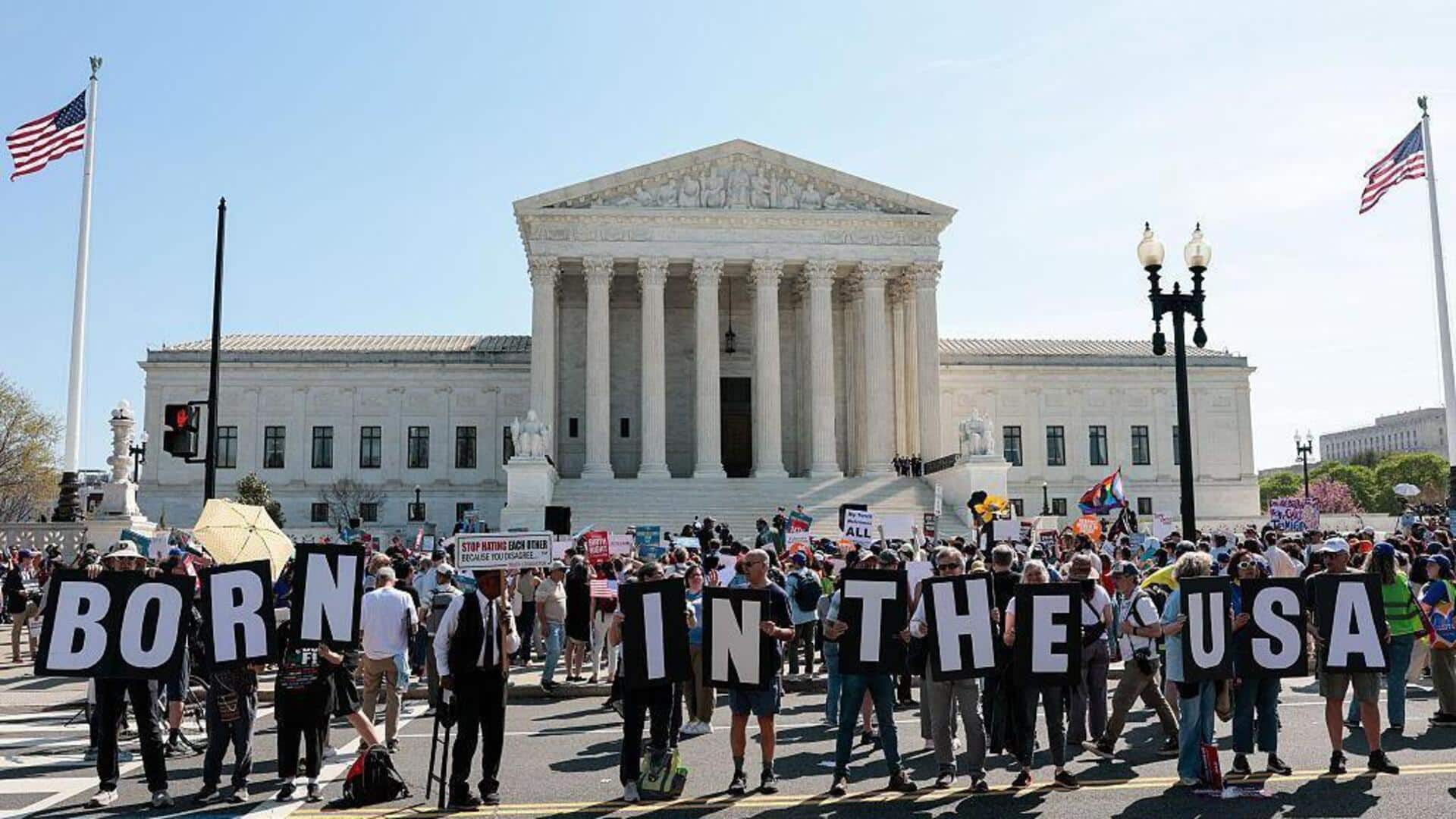
US SC upholds birthright citizenship, rejects Trump's proposed limits
What's the story
The US Supreme Court has upheld the principle of birthright citizenship, rejecting President Donald Trump's executive order, which declared that children born to people who are in the US illegally or temporarily are not American citizens. The court's decision was based on the 14th Amendment, which was passed in the wake of the Civil War, and recent federal laws, which broadly confer citizenship on anyone born in the country with few exceptions. Justices voted 6-3 in favor of birthright citizenship.
Judges
What judges said
"Children born in the United States to parents unlawfully or temporarily present are 'subject to the jurisdiction' of the United States and are citizens at birth under the Fourteenth Amendment's Citizenship Clause," the majority decision written by Chief Justice John Roberts said.
According to Trump's order, 30 days after its effective date, babies born in the US would not be eligible for citizenship documents if their parents had immigrated illegally or were undocumented workers.
Legal hurdles
Legal challenges to Trump's order
Trump's order, which he signed on the first day of his second term, was immediately challenged in court, including by Democratic state attorneys general and the American Civil Liberties Union (ACLU).
Cecillia Wang of the ACLU told justices that Americans' understanding of the citizenship rule is that everyone born in the country is a US citizen.
"The 14th amendment's fixed bright line rule has contributed to the growth and thriving of our nation," Wang said.
Reaffirmation
Amendment ensures that Black people had citizenship
Trump's order would have upended generally held views that the 14th Amendment grants citizenship to anyone born in the US, with the exception of children of foreign diplomats and those born to a foreign occupying force.
The amendment was designed to ensure that Black people, including former slaves, received citizenship, albeit the Citizenship Clause is more widely worded.
"All persons born or naturalized in the US, and subject to the jurisdiction thereof, are citizens...and of the State wherein they reside."
Domicile debate
Arguments and skepticism from justices
The Trump administration argued that the phrase "subject to the jurisdiction thereof" indicates that children born in the US to persons who are not legally in the nation are not citizens.
It argued that "domicile" was a key part of the citizenship definition, saying those unlawfully or temporarily present don't have "domicile" in the US.
However, Chief Justice John Roberts and liberal Justice Elena Kagan were skeptical of this interpretation during arguments, with Roberts calling part of it "very quirky."
Constitutional foundation
Trump administration's broader immigration policy crackdown
The birthright citizenship order is part of the Trump administration's broader immigration policy crackdown.
Birthright citizenship was the first Trump immigration-related policy to reach the court for a final decision.
Courts had earlier overturned Trump's global tariffs imposed under an emergency powers legislation that had never been applied in that fashion.
Trump responded angrily to the late-February tariff ruling, claiming he was ashamed of the justices who decided against him and called them unpatriotic.
Impact
Over one-quarter of million babies born in US each year
According to research conducted by the Migration Policy Institute and Pennsylvania State University's Population data Institute, the executive order would have affected more than a quarter of a million babies born in the US each year.
While Trump's rhetoric and actions have been focused on illegal immigration, birthright citizenship limits would have extended to persons who are lawfully present in the US, such as students and applicants for green cards or permanent resident status.