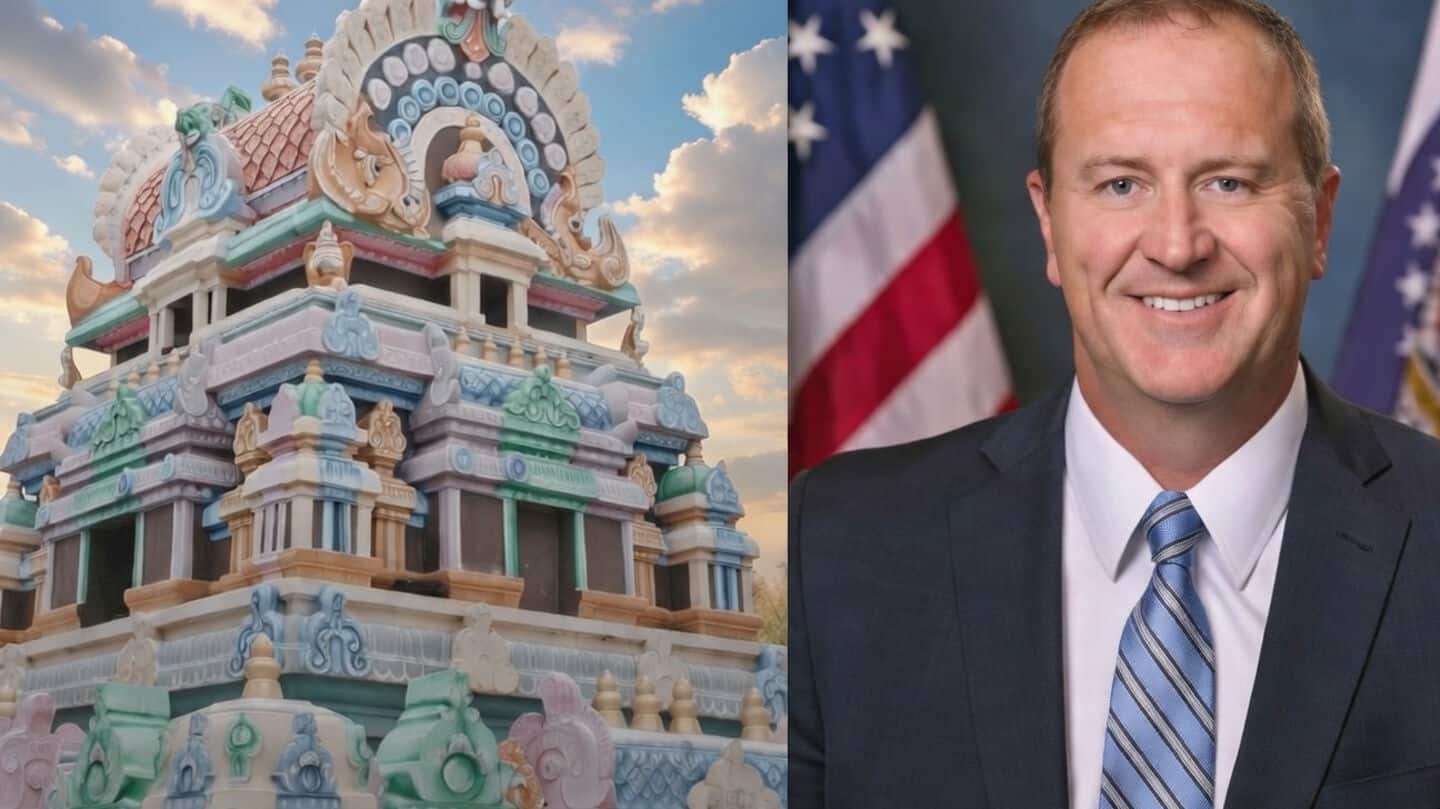
'Visa cartel has own visa temple': US Senator targets Indians
What's the story
United States Senator Eric Schmitt has sparked a controversy by targeting Hyderabad's Chilkur Balaji Temple, also known as the "Visa Temple." The Republican senator from Missouri took to the social media platform X to criticize the US employment-based visa system. He alleged that the system suppresses local wages and forms a global "Visa Cartel" with its own "Visa Temple" which displaces American workers.
Visa impact
Schmitt's claims on foreign students
Schmitt claimed that programs like H-1B, L-1, F-1, and Optional Practical Training (OPT) are "hollowing" the American middle class.
He alleged that foreign students, nearly half of whom are Indians, receive taxpayer-subsidized work permits without payroll taxes or wage rules for corporations.
"They flow into H-1B, then green cards, while US grads with debt compete against cheaper labor," he wrote on X.
Interview leaks
Schmitt alleges ethnic favoritism in visa process
Taking his argument further, Schmitt alleged that Indian visa holders share confidential interview questions with other applicants from India.
He wrote, "Big Tech quietly locks out Americans by routing jobs through these pipelines. Merit is now replaced by ethnic favoritism."
Hyderabad is home to several temples associated with US visa approval dreams, especially among students and IT professionals.
Twitter Post
Senator Schmitt's post on X
The "Visa Cartel" has its own “Visa Temple” in Hyderabad, which sees thousands of Indians circling altars and getting passports blessed for U.S. work visas.
— Senator Eric Schmitt (@SenEricSchmitt) May 13, 2026
American workers shouldn’t have to compete against a system this gamed. pic.twitter.com/k7wSlECTJ6
Visa prayers
India accounts for about 70-80% of all H-1B visa approvals
The Chilkur Balaji Temple is the most famous of these, where devotees seek blessings for their US visa applications.
India accounts for about 70-80% of all H-1B visa approvals, much higher than China's 12%.
Schmitt's comments have sparked a debate over the impact of these programs on American workers and the role of religious institutions in visa application processes.