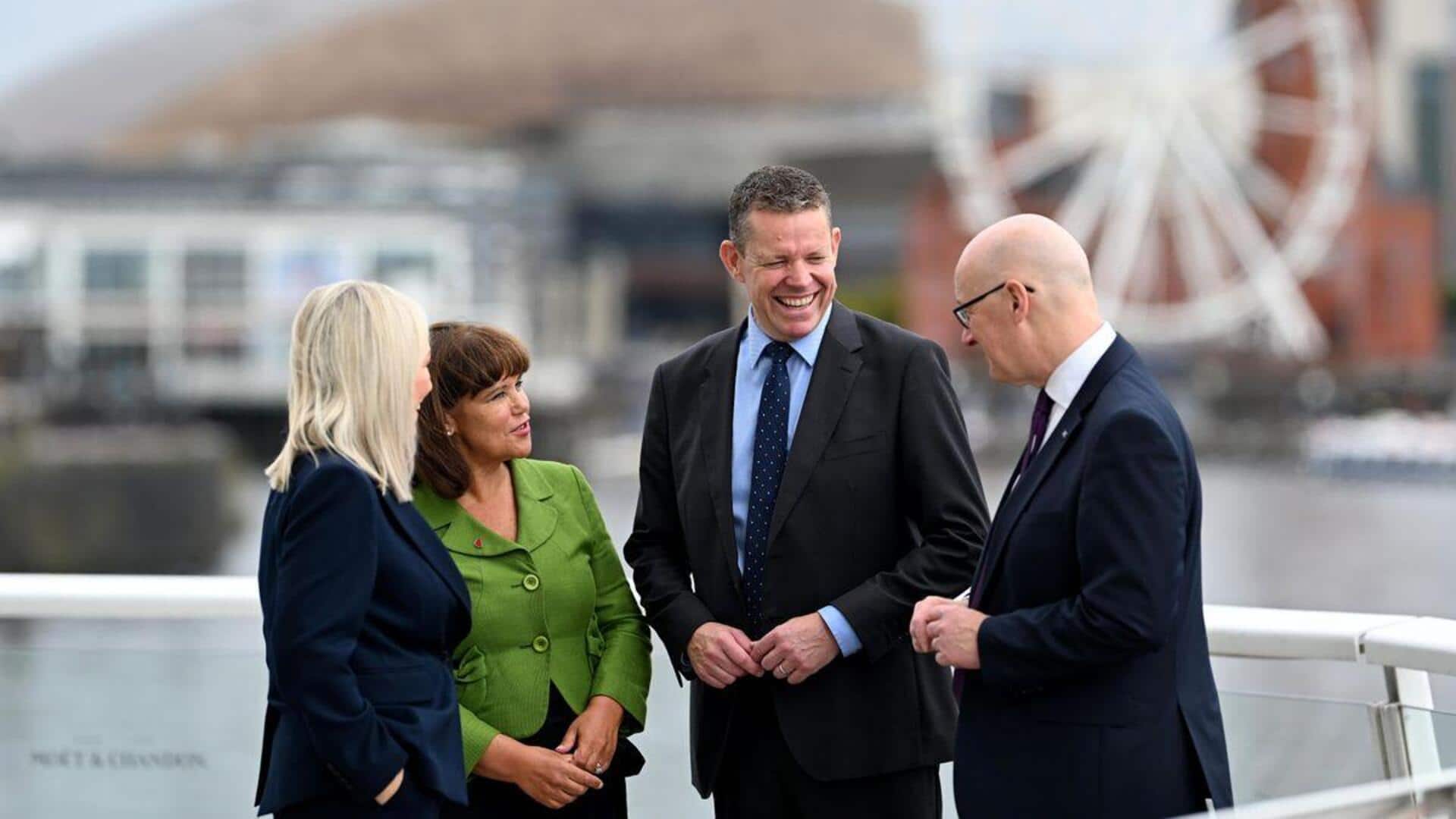
Wales, Scotland, Northern Ireland leaders sign pact to exit UK
What's the story
The First Ministers of Scotland, Wales, and Northern Ireland have signed a memorandum of understanding (MoU) that threatens to lead to the breakup of the United Kingdom. The agreement was signed at a summit in Cardiff by John Swinney (Scotland), Rhun ap Iorwerth (Wales), and Michelle O'Neill (Northern Ireland), who told Prime Minister Andy Burnham and his government to prepare for constitutional change and that their future lies with the European Union.
MOU
What MOU said
"For people watching across these islands—for people watching around the world—there could be no clearer sign that Westminster's time is coming to an end," they said in the MOU.
"Momentum is behind our movements; we believe that constitutional change is coming...No Westminster government has the right to block democracy or undermine the principle that our people will decide their own future. "We call for the British government to prepare for, plan and facilitate constitutional change in each jurisdiction."
Political implications
MoU urges UK government to prepare for constitutional change
Burnham's spokesperson dismissed the threat, saying the prime minister fully supports the union and is more concerned with cutting the cost of living than with constitutional debates.
"The United Kingdom is at its best when people come together around our shared values and problem-solving, rather than division," Tom Wells said.
The agreement does not have any legal force but indicates increasing cooperation among pro-independence and pro-unification leaders.
Future prospects
Latest poll
Swinney and O'Neill have called for independence referendums in their regions. However, Iorwerth did not specify a timetable for Wales.
According to the latest polling, 47% of Scottish voters would vote for independence were a referendum held tomorrow, along with 36% in Northern Ireland and 32% in Wales.
Since the 2014 referendum, support for independence in Scotland has remained between 45% and 50%, but data suggests it is increasing in Wales and Northern Ireland.
Devolution debate
Good Friday Agreement requires a vote on unification
In the late 1990s, the UK passed legislative acts that decentralized government through the devolution process, granting each country, except England, some measure of policy independence and self-governance through their respective parliaments.
However, tensions have lingered with the UK-wide government in London, which retains control over national issues and those concerning England.
The Good Friday Agreement requires a vote on unification if polls indicate it would likely pass, a threshold the UK government says has not been met.
Independence support
Support for Scottish independence has grown since Brexit
Scotland attempted unsuccessfully to break away in 2014, with voters rejecting a referendum 55% to 45%.
But support for Scottish independence has grown since Brexit, which saw the UK leave the European Union in January 2020.
Swinney now believes voters would approve independence if a referendum were held.
Burnham had earlier said he would allow a vote if there was a "clear consensus" in Scotland but later said it was "off limits."