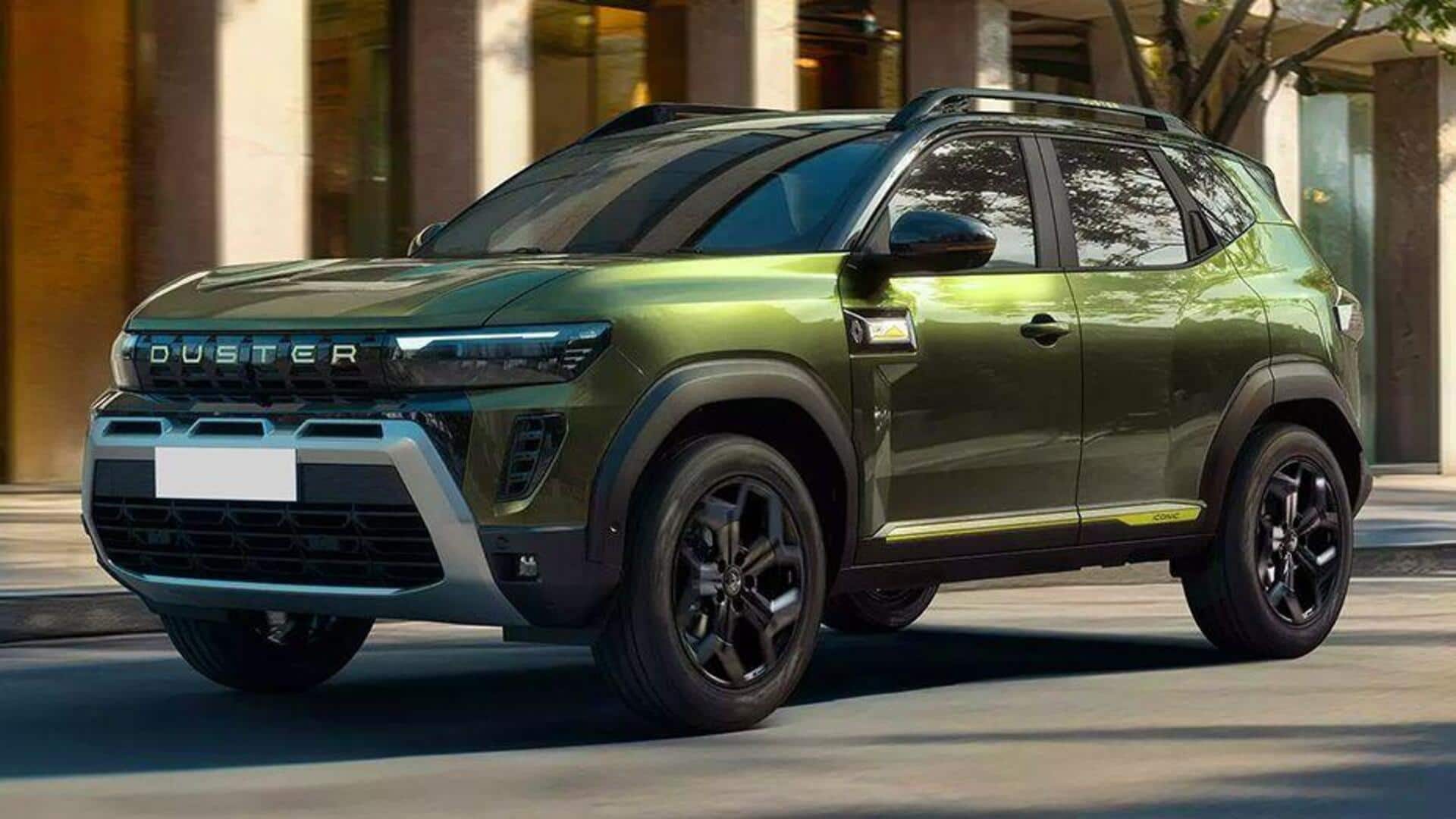
How IIT Kanpur helped Renault develop the new Duster
What's the story
The Indian Institute of Technology (IIT) Kanpur has played a major role in the design and development of the new second-generation Duster for Renault. The French automaker collaborated with IIT Kanpur's National Wind Tunnel Facility (NWTF) to test and validate the aerodynamics of its mid-size SUV. The collaboration focused on fine-tuning wind noise performance through extensive tests at this state-of-the-art facility.
Performance
Segment-best Articulation Index (AI) of 73%
Renault India has claimed a segment-best Articulation Index (AI) of 73% for its new mid-size SUV.
The AI is a metric that determines the quality of conversation between passengers inside a vehicle cabin.
A lower AI score indicates higher levels of roughness, loudness, and sharpness of outside noise (engine, road, wind) inside the cabin.
Design improvements
Drag coefficient reduced by 13%
Renault has also used several computer-aided engineering (CAE) tools to digitally engineer the aerodynamics of the new Duster.
This has led to a 13% reduction in the drag coefficient of the upcoming SUV, compared to its predecessor.
The Indian version of Duster is built on a heavily-localized Renault Global Modular Platform (R-GMP) and is almost 50mm taller than its global counterpart.
Technical specifications
The SUV features McPherson strut front suspension
The new Duster features a fully-independent McPherson strut front suspension and a semi-independent rear twist beam suspension.
This differentiates it from competitors such as Hyundai Creta, Maruti Suzuki Grand Vitara, Kia Seltos, Volkswagen Taigun, and Honda Elevate.
The firm's Multi-Tuned Valve Technology with Concentric Land (MTV-CL) is also used in the new model for optimized response to primary (yaw, pitch and roll) and secondary (wheel movement) motions while driving.