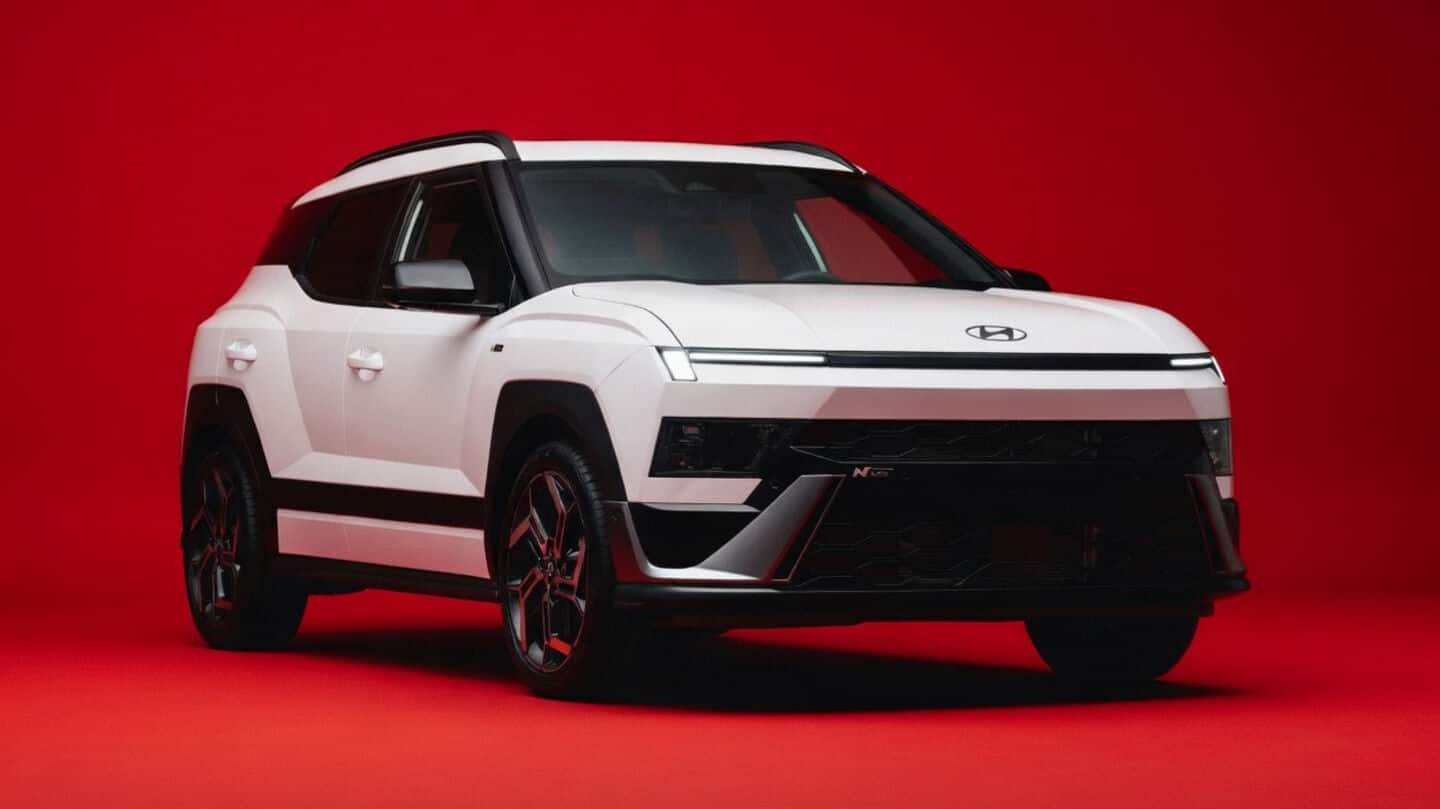
Hyundai unveils sportier Bayon N Line
What's the story
Hyundai has unveiled the Bayon N Line at the Paris Motor Show 2026. The new model is a sportier version of the standard India-spec Bayon SUV. While it shares some design elements with its standard counterpart, the N Line stands out with more aggressive styling and different engine options. Let's take a closer look at what this new addition to Hyundai's lineup has to offer.
Design details
The SUV looks more aggressive than the standard model
The Bayon N Line retains the India-spec model's design elements such as L-shaped front and rear lights, squared-off headlamp units, boxy wheel-arch cladding, flared fenders, a wordmark on the boot lid, and a heavily kinked window line.
However, it also gets sportier touches like a new bumper with an open design and a honeycomb pattern for the grille.
An 'N Line' badge can also be seen on the left side of the bumper.
Exterior enhancements
It gets a bigger roof spoiler and dual exhaust tips
The Bayon N Line also gets gloss-black finishes for the cladding and outside rearview mirrors, larger 18-inch alloy wheels, and N Line badging on the front fenders.
The roof rails are slimmer than those on the India-spec Bayon.
At the back, it sports a bigger twin-ridge roof spoiler, dual exhaust tips, a fully black bumper with black finishes for Hyundai emblem and Bayon wordmark on boot lid.
Interior insights
It features an N Line-specific steering wheel and gear lever
The interior layout of the Bayon N Line is similar to that of the India-spec model.
It features a curved pair of 12.3-inch displays, a vertical center console, vertically oriented air vents, and an open storage space on the co-driver side of the dashboard.
However, it also gets sportier touches such as a black interior color scheme with red accents and contrast stitching, Alcantara-esque seat upholstery, and an N Line-specific steering wheel and gear lever.
Tech specs
The SUV offers Level 2 ADAS and connected car tech
The Bayon N Line also comes with wireless Apple CarPlay and Android Auto, ambient lighting, a panoramic sunroof, heated and ventilated front seats, reclining rear seats, a digital key, an 8-speaker Bose sound system.
It also packs Level 2 ADAS (Advanced Driver Assistance Systems), connected car tech, a wireless charging pad, dual-zone climate control, among others.
Hyundai claims 440-liter of boot space for non-hybrid versions of the Europe-spec Bayon.
Powertrain details
The SUV packs a turbo-petrol engine with multiple outputs
The India-spec Bayon will get a 115hp 1.5-liter naturally aspirated four-cylinder petrol engine with a 6-speed manual or CVT automatic.
The N Line, however, will be offered with Hyundai's 1.0-liter three-pot direct-injection turbo-petrol motor in two states of tune - 90hp and 115hp - along with six-speed manual and seven-speed dual-clutch automatic gearbox options.
Performance metrics
A strong-hybrid version will be offered later
Hyundai claims a 0-100km/h time of as low as 10.8 seconds for the Bayon N Line, likely the 115hp DCT version.
A strong-hybrid version will join the Europe-spec Bayon line-up later, comprising a 1.6-liter direct-injection petrol engine, an electric motor, and a six-speed DCT for a combined output of 138hp.
It will also get adaptive regenerative braking that can be controlled by steering-mounted paddleshifters.