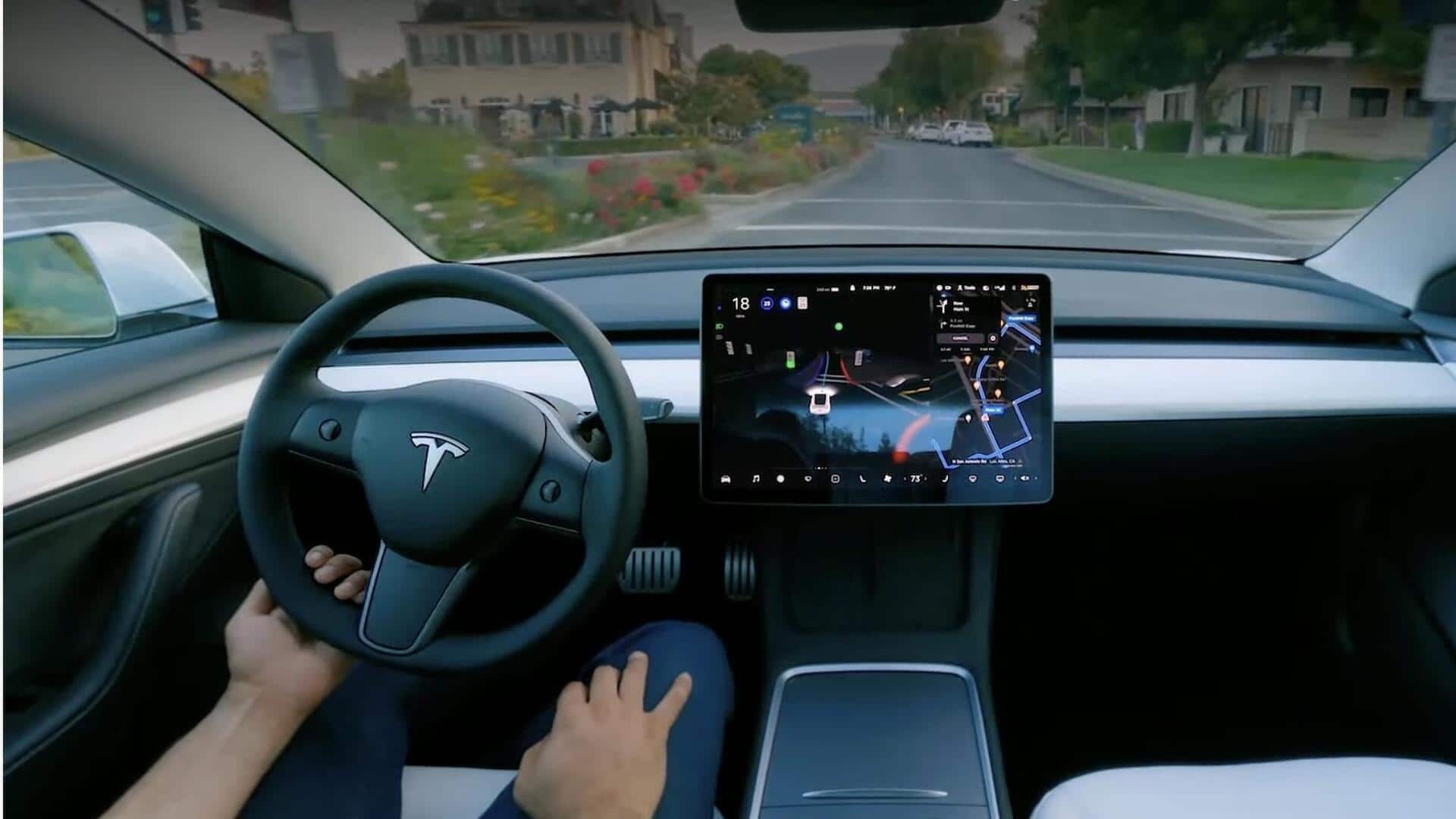
Tesla, running on Full Self-Driving, crashes during livestream
What's the story
A Tesla vehicle crashed head-on while a driver was livestreaming a demonstration of the company's "Full Self-Driving" (FSD) system. The incident occurred in China. The car began driving in the wrong direction and collided with another vehicle. The FSD is a Level 2 driver-assist system that requires constant supervision from the driver despite its name.
Incident details
Livestream crash raises questions about FSD's capabilities
During a recent livestream, a Douyin user identified as Qie An Hao was demonstrating the Tesla FSD in his Model 3.
However, the vehicle unexpectedly veered into the oncoming lane and crashed head-on with another car.
While the livestream itself didn't go viral, video captures of the aftermath were shared by the Tesla owner and quickly went viral.
Fortunately, no one was seriously injured in this incident.
Accountability
Questions arise over FSD's role in the crash
The incident has raised questions about whether FSD was active during the crash.
The driver had initially withheld the footage, claiming he was seeking direct compensation from Tesla.
However, he later released the footage which clearly showed that FSD was indeed active during the crash and even initiated a lane change in the wrong direction.
This incident highlights concerns over reliance on Tesla's autonomous driving features.
Criticism
Tesla's FSD system faces criticism and scrutiny
The incident has drawn criticism from many, including a Tesla Model Y owner who shared an experience where his car stopped on trolley tracks while using FSD.
He had to take control manually to avoid a potential accident with an incoming train.
The owner said there was no warning message or indicator from the system during this incident, highlighting potential shortcomings in Tesla's autonomous driving technology.
Rebranding
Tesla's FSD system rebranded in China
Unlike the US, where the system is known as 'Full Self-Driving,' China quickly asked Tesla to change its name.
The rebranding was done as it was deemed not representative of what the system could actually do.
Many Chinese Tesla owners have been livestreaming their FSD-enabled drives on platforms like Douyin (TikTok), comparing it with similar systems from other automakers in the country.