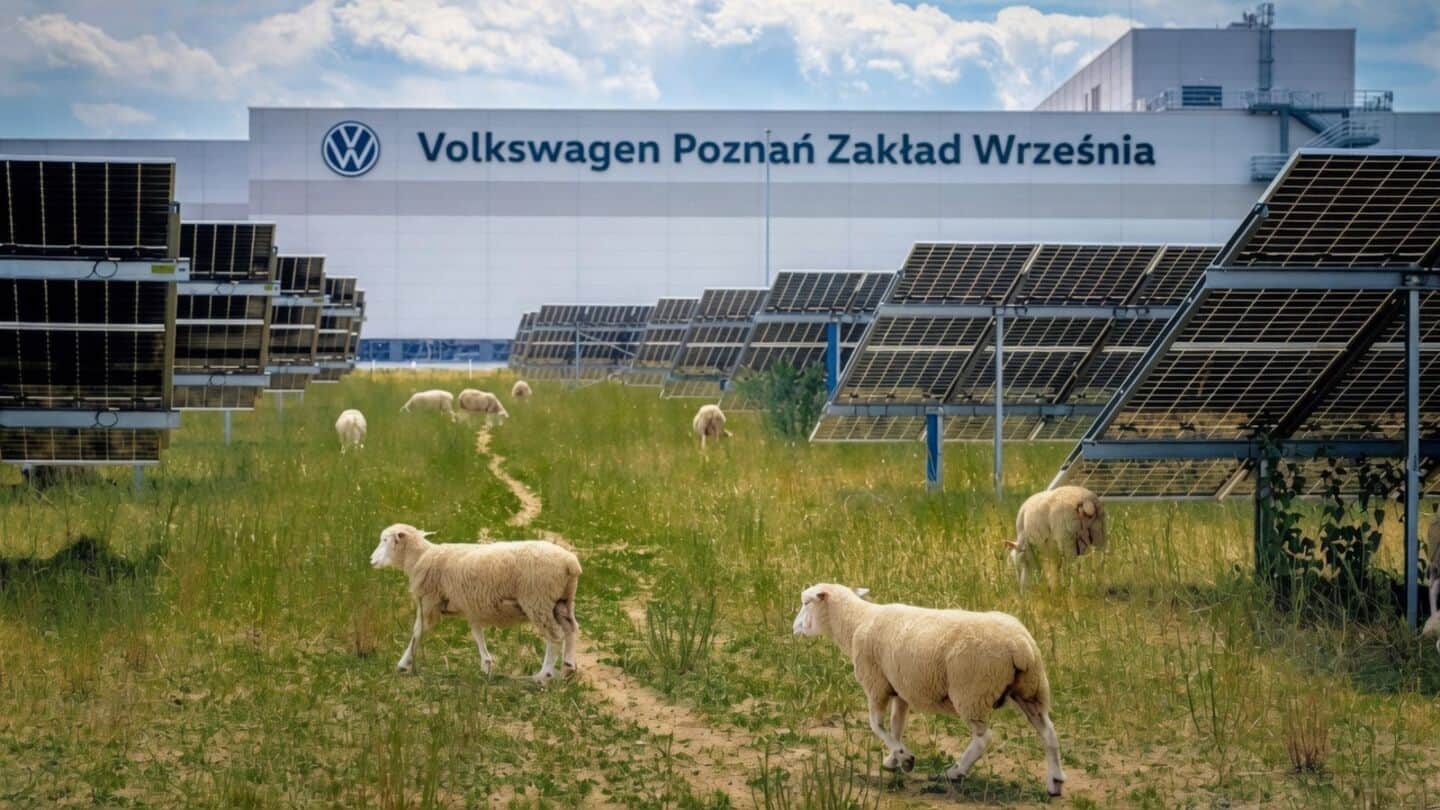
Why Volkswagen brought 100 sheep to its solar-powered factory
What's the story
Volkswagen has employed a flock of 100 sheep to graze beneath the solar panels of its manufacturing plant in Poznan, Poland. The initiative is part of an agrivoltaics project aimed at studying the coexistence of agriculture and renewable energy on the same land. The move also replaces traditional lawnmowers with a more sustainable alternative.
Research partnership
Collaboration with Poznan University of Life Sciences
The project is being conducted in collaboration with the Poznan University of Life Sciences.
Their researchers are studying the effects of sheep grazing on animal welfare, biodiversity, soil quality, vegetation growth, and microclimate at the site.
Agrivoltaics has become a popular strategy in renewable energy, allowing land to be used for both farming and solar power generation.
Sustainable solution
Replacing mechanical mowing
Volkswagen has replaced mechanical mowing with the flock to maintain vegetation under its Poznan facility's 31,000-plus solar panels.
The move not only provides an eco-friendly way of landscape maintenance but also seeks to understand how large-scale solar generation and agriculture can coexist successfully.
The 18.3MW solar farm was built and is operated by Berlin-based Quanta Energy.
Energy generation
Solar farm's contribution to Volkswagen factory
On sunny days, the solar farm can generate enough electricity to meet the entire power demand of Volkswagen's factory. Over a year, it supplies roughly 25% of the factory's electricity needs.
"The photovoltaic farm delivers much more than green electricity. It has also become a place that supports biodiversity, local agriculture and scientific research," said Marzena Pillich-Gronska, Director of Volkswagen Poznan.
Environmental benefits
Benefits of sheep grazing
The sheep will stay at the solar farm until autumn under the care of experienced breeders.
By replacing mechanical mowing, grazing is expected to cut down on maintenance costs and emissions while creating a more hospitable environment for insects and other wildlife.
This innovative approach not only benefits Volkswagen but also contributes to biodiversity and supports scientific research.