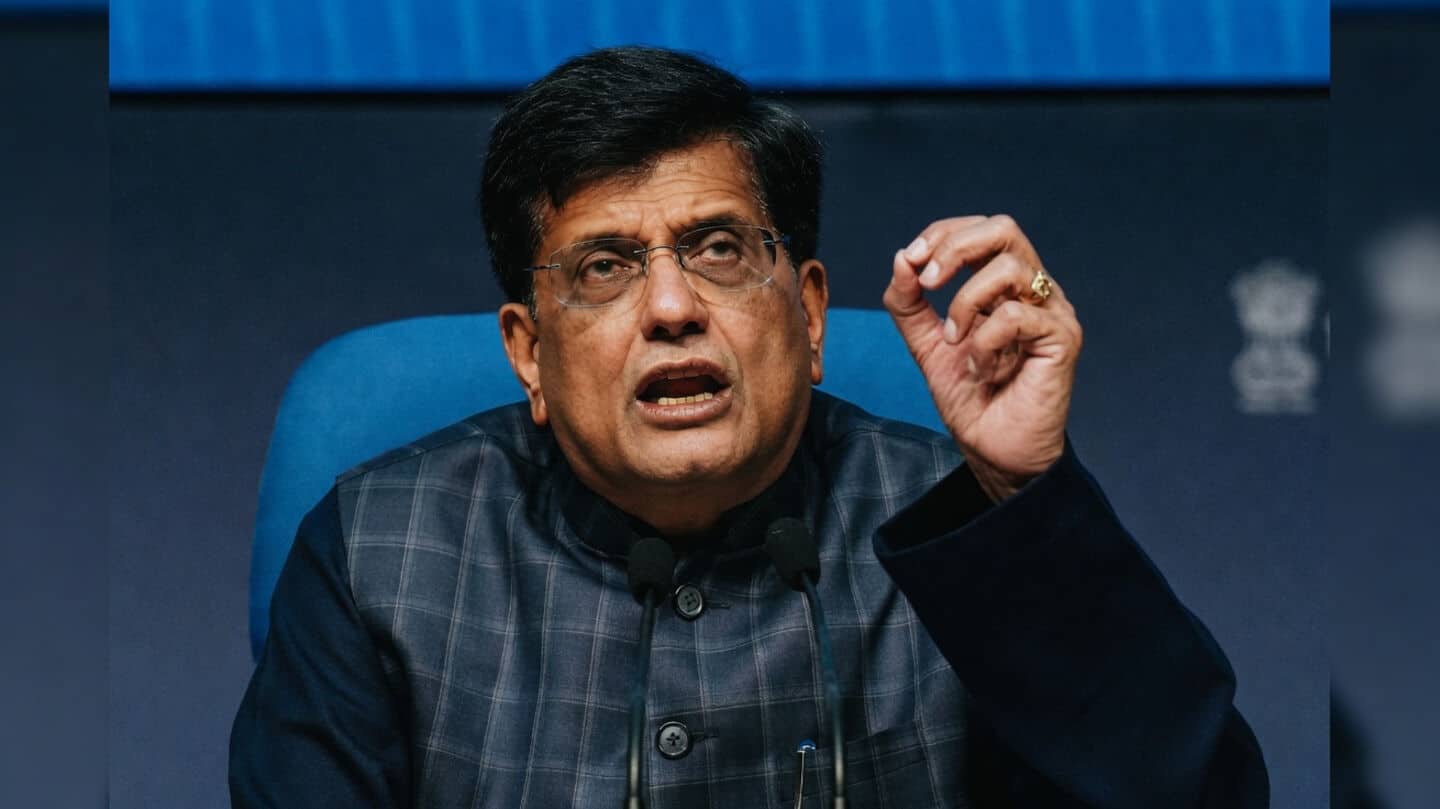
Trade measures against forced labor must be evidence-based: Piyush Goyal
What's the story
India has called for trade measures against goods produced using forced labor to be backed by specific and verifiable evidence. The call was made by Commerce and Industry Minister Piyush Goyal at the G20 Trade Ministers's Meeting in Milwaukee, US. He stressed that "Measures at the border must be based on specific and verifiable evidence rather than presumptions about entire countries, regions or sectors."
Commitment reaffirmed
Follow due process, comply with WTO rules: Goyal
Goyal reaffirmed India's "absolute and unconditional" commitment to eliminate forced labor.
However, he stressed that any trade measures should follow due process and comply with World Trade Organization (WTO) rules.
He also highlighted India's support for voluntary exchanges of good practices among G20 members to tackle forced labor in global supply chains, but clarified such cooperation shouldn't involve monitoring member countries or creating new obligations.
Trade position
India has ratified ILO Conventions 29 and 105
Goyal highlighted Article 23 of the Indian Constitution, which prohibits forced labor as a fundamental right enforceable by the Supreme Court.
He also noted that India has ratified International Labour Organization Conventions 29 and 105.
On structural excess capacity and production, Goyal said India doesn't have structural excess capacity in sectors identified by the G20 presidency.
He emphasized India's domestic-demand-driven economy with manufacturing capacity serving both domestic and global markets.
Trade concerns
Address trade distortions through WTO-consistent measures: Goyal
Goyal acknowledged that trade-distorting support in some economies can lead to dumping and predatory pricing.
He said such concerns should be addressed through WTO-consistent measures, including anti-dumping and countervailing duties based on evidence and subject to judicial review.
Goyal also stressed diversification of production and supply chains was a legitimate objective but warned against using it as a reason to introduce measures outside WTO rules.
Trade principles
Most-favored-nation principle key to transparent, non-discriminatory trading system
On the most-favored-nation (MFN) principle, Goyal said India's trade with G20 members depended on a "transparent, non-discriminatory and rules-based trading system."
He described MFN treatment as an important guarantee of that system because it ensures the same terms apply to both small and large traders.
The minister also stressed consensus remains central to the WTO and called for preserving special differential treatment for developing countries to help them catch up with developed economies.
System advocacy
Goyal meets US trade representative on sidelines of G20 meeting
Reiterating India's support for a rules-based, fair, equitable, transparent, open and inclusive multilateral trading system with the WTO at its core, Goyal said developing countries need enough policy space to grow and meet their populations' needs.
He also extended India's support to the United Kingdom for its G20 presidency in 2027.
On the sidelines of the meeting, he held discussions with US Trade Representative Jamieson Greer on the India-US trade deal.