Indian solar exports face 15% US tariff under Trump order
What's the story
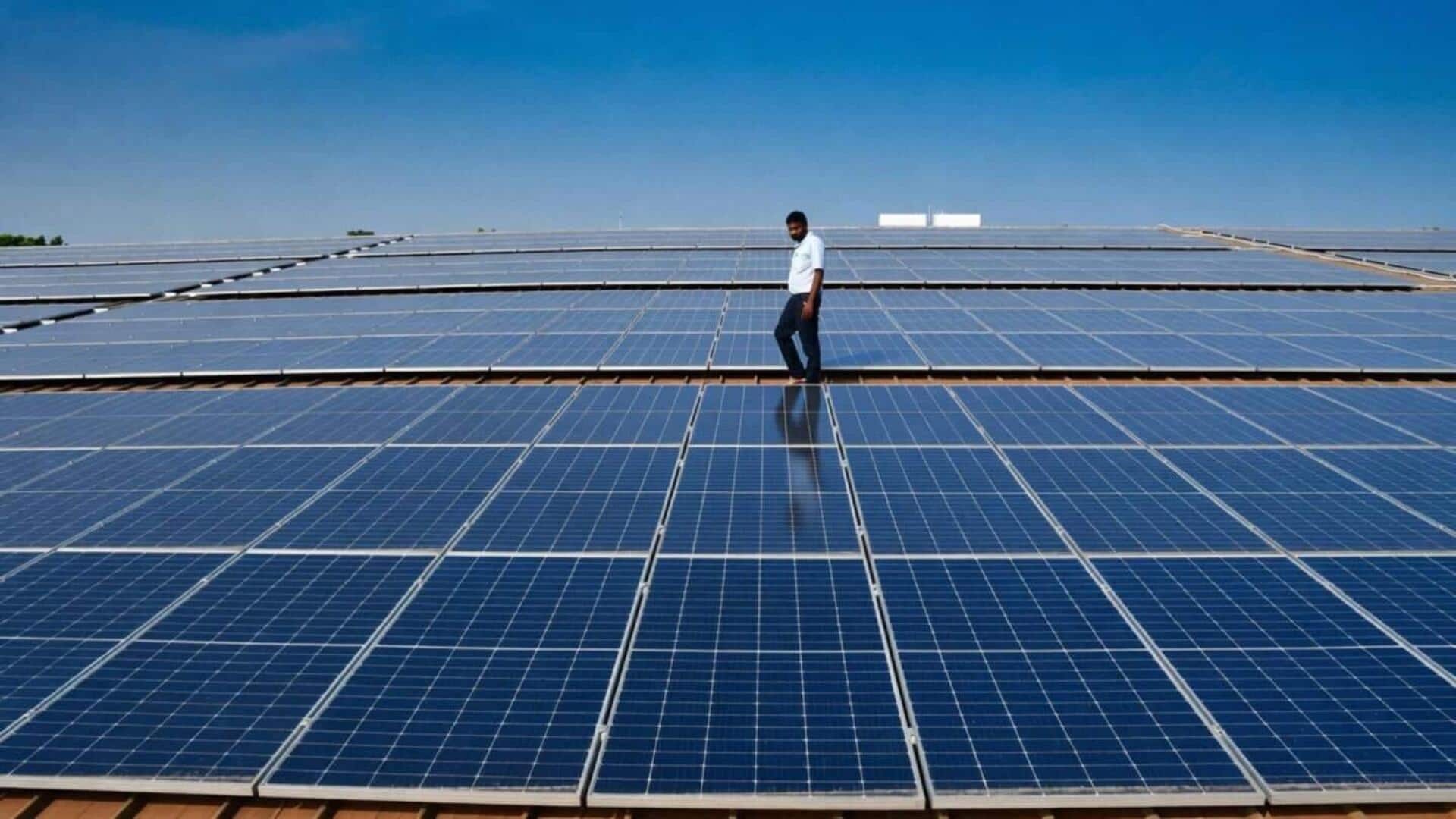
The United States has announced a 15% tariff on solar cells and modules imported from India and other countries. The new trade measure, signed by President Donald Trump, will come into effect from December 4. It covers polysilicon, the raw material used in manufacturing solar cells and modules. The move is part of a broader strategy to extend US import protection across the polysilicon supply chain.
Manufacturing impact
New tariff to provide relief to US solar manufacturers
The new tariff is aimed at providing relief to US solar manufacturers. It combines tariffs on downstream products with minimum prices for raw polysilicon, wafers, solar cells, and modules.
For Japan, South Korea, Taiwan, Switzerland, Liechtenstein, and EU members, the combined Section 232 tariff and ordinary customs duty will be 15%.
UK products will attract an additional 10% duty.
Tariff details
Importers failing to provide necessary documentation may face a duty
The new tariffs will be effective from 12:01am US Eastern Time on December 4.
Importers must prove that the first arm's-length sale in the US will occur at or above the minimum price.
If the declared value is below this floor, a specific duty equal to the difference will be imposed by US Customs and Border Protection.
Importers failing to provide necessary documentation may face a duty equal to applicable price floor.
Export impact
India exported $792.65 million worth of solar products to US
According to the US Commerce Department, India exported 2.3 gigawatts of crystalline-silicon solar cells and modules to the country in 2024, worth some $792.65 million.
This is a significant increase from 232.4 megawatts worth $83.87 million in 2022.
The figures include products under the same solar-cell and module tariff categories covered by Trump's latest proclamation.
Notably, Indian solar exports are also facing a separate US antidumping and countervailing-duty investigation.
Production link
US share of global polysilicon production capacity has dropped significantly
Polysilicon is a key raw material for both semiconductor wafers and crystalline-silicon solar products.
The Trump administration said the US share of global polysilicon production capacity has dropped from 50% in 2005 to less than 2% in 2024.
It also noted that global polysilicon production has increased by over 270% since 2020, with inventories reaching some 400,000 tons by the end of 2024.