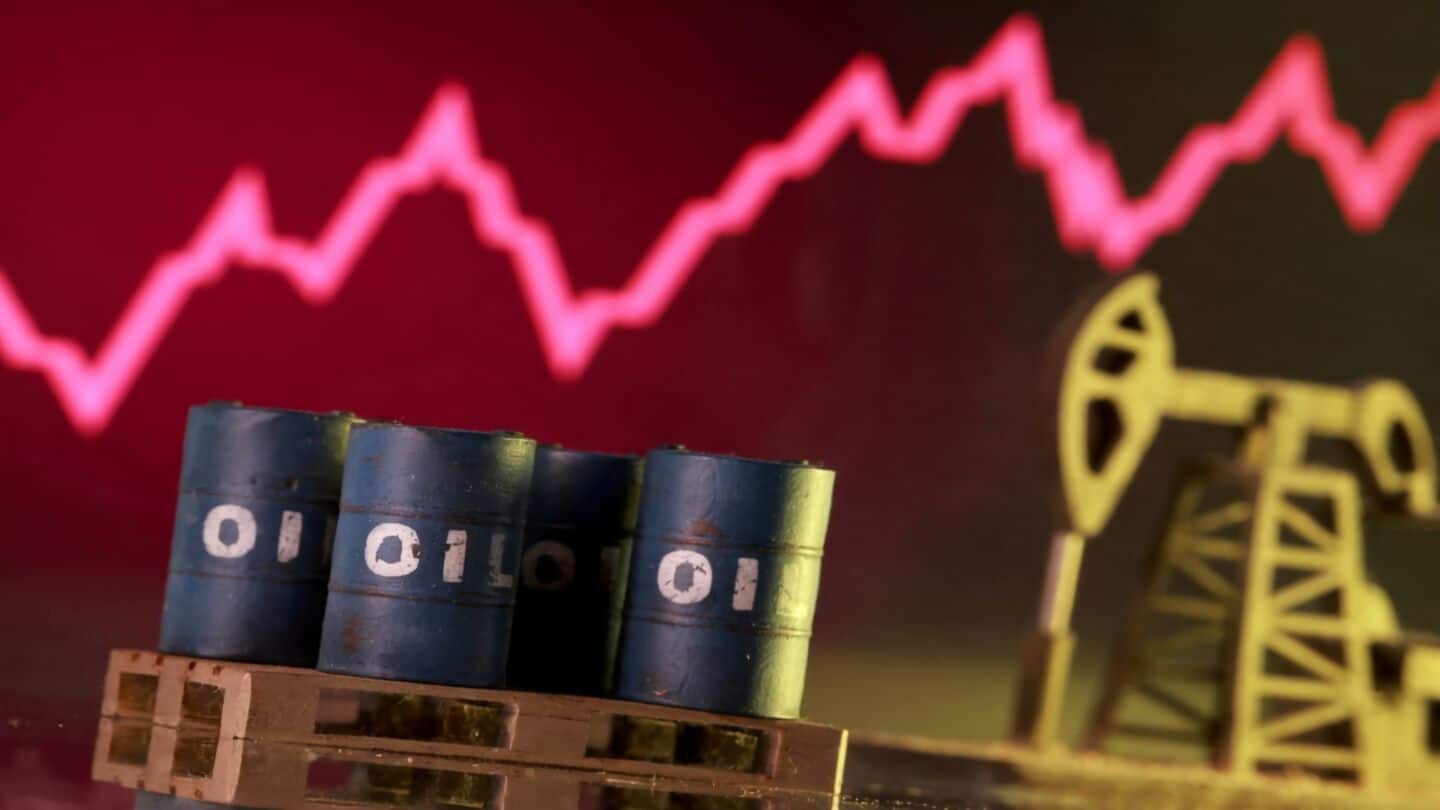
Oil prices cross $91 as US-Iran ceasefire ends
What's the story
Oil prices rose on Tuesday after the end of a fragile US-Iran truce. The temporary ceasefire expired after diplomatic efforts between Washington and Tehran failed to yield results. Iran announced it would adopt a "fully offensive" military stance if diplomacy fails, raising fears of renewed conflict and further disruption to shipping through the Strait of Hormuz.
Market response
Prices up on US-Iran tensions
Brent crude futures rose 0.3% to $91.14 per barrel, while US West Texas Intermediate crude futures were up 42 cents to $85.04 a barrel.
The gains were driven by fears of disruptions to global oil supplies due to the lack of progress in US-Iran talks and heightened military tensions in the region.
Shipping concerns
Strait of Hormuz at center of market concerns
The Strait of Hormuz, a key route for global energy shipments, is at the center of market concerns.
Shipping activity has slowed sharply amid the conflict, with only five tankers passing through on Saturday and none on Sunday.
Any prolonged disruption could tighten global oil supplies and push prices higher.
Market performance
Asian markets resilient amid geopolitical tensions
Despite the geopolitical tensions, Asian markets remained relatively resilient.
MSCI's broadest index of Asia-Pacific shares outside Japan rose 0.8%, buoyed by a more than 3% surge in South Korea's KOSPI after the market reopened from a holiday.
However, Japan's Nikkei 225 fell 0.3% while S&P 500 futures were largely flat as investors reacted to weaker US economic data, including an unexpected fall in retail sales.
Yield impact
Long-term bond yields rise, raising concerns for markets
The rise in long-term bond yields is a bigger concern for markets.
The yield on the benchmark US 10-year Treasury rose by 0.8 basis points to 4.728%, while the 30-year Treasury yield climbed by 0.6 basis points to its highest level in over two decades.
Higher yields increase borrowing costs across the economy and can pressure equity valuations, especially high-growth technology companies.