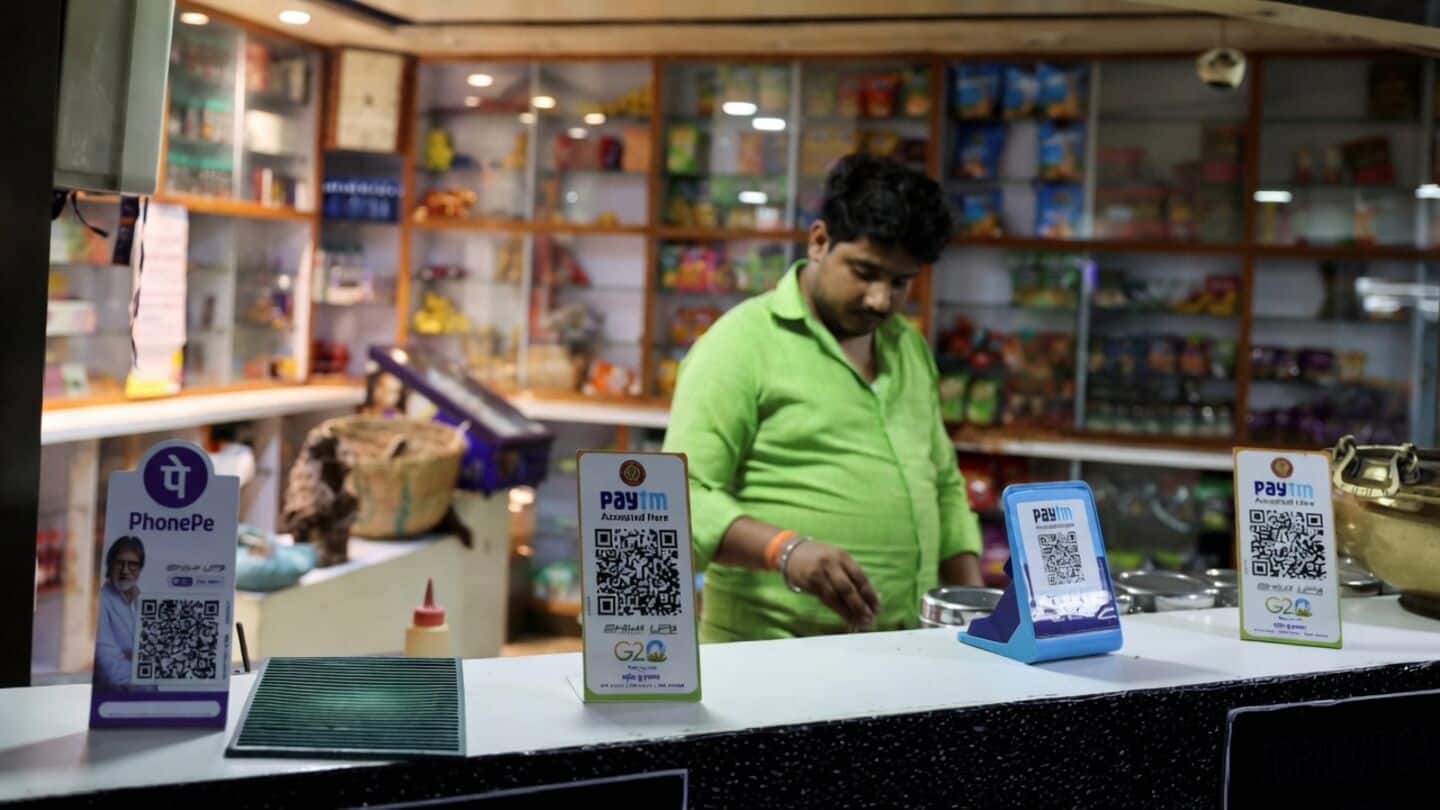
Paytm, Pine Labs, MobiKwik fall as UPI-MDR rollout is delayed
What's the story
Paytm's stock price plummeted by as much as 6.5% after the National Payments Corporation of India (NPCI) announced a delay in the implementation of Merchant Discount Rate (MDR) for select Person-to-Merchant (P2M) Unified Payments Interface (UPI) transactions. Other fintech companies, including Pine Labs and One Mobikwik, also witnessed a decline of around 4% in their share prices.
Delay details
Delay in MDR implementation
The NPCI announced the delay in a statement, saying, "UPI and Services Steering Committee today decided that, keeping in mind the festive season, Merchant Discount Rate (MDR) on select Person-to-Merchant (P2M) UPI transactions, shall be implemented immediately post Diwali at a date to be notified separately."
This decision has directly affected the stock market performance of companies like Paytm.
Rate details
MDR charges under the NPCI circular
The NPCI circular issued last month stated that a 0.4% MDR will be levied on P2M UPI transactions above ₹2,000.
The charge will be borne by merchants and capped at ₹300 for transactions worth ₹75,000 or more.
However, payments between individuals and most day-to-day merchant payments will continue to remain free of charge.
Service charges
Essential services will attract ₹5 fee per transaction above ₹2,000
Essential services such as railways, telecom, fuel, and insurance will attract a flat ₹5 fee per transaction above ₹2,000.
Capital markets transactions (mutual funds, stockbroking) will be charged at a lower rate of 0.02%, also capped at ₹300.
The NPCI had issued the circular on September 15 to create a sustainable revenue framework for the digital payments ecosystem.
Charge concerns
96% of transaction volume is not expected to attract charges
NPCI chief Dilip Asbe had said last month that only 10% of the overall value of UPI transactions could see charges being passed on to consumers under the MDR.
He added that large corporates, which already accept credit cards, would bear most of the proposed costs.
Currently, about 96% of transaction volume and 75% of overall value are not expected to attract charges.