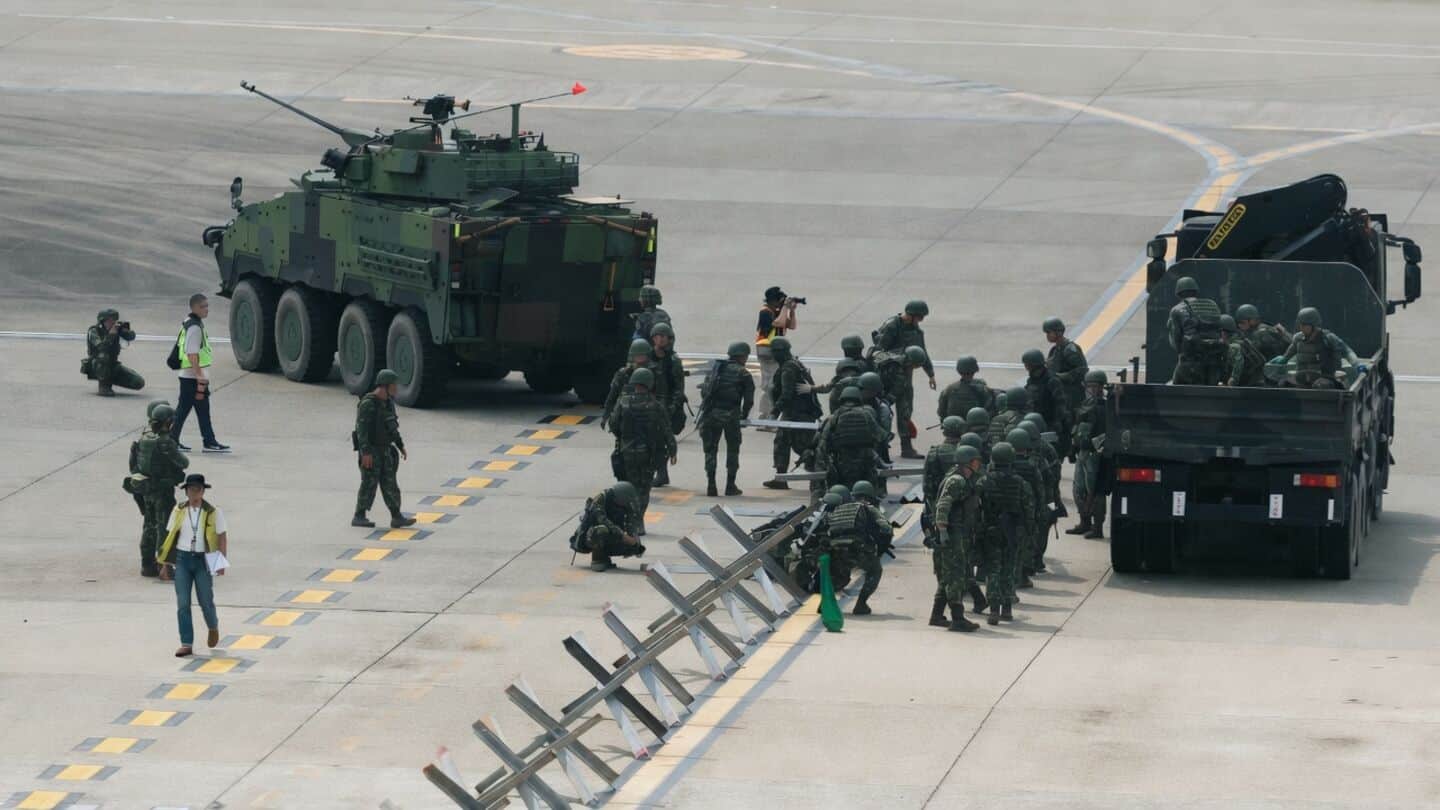
Taiwan to boost defense spending amid rising Chinese military threats
What's the story
Taiwan is gearing up to increase its defense budget by 16% next year, taking the total expenditure above T$1.1 trillion (around $31 billion). The proposal will be presented on August 20, but the final figure will be determined through the budget process. The move comes as China intensifies military activity around Taiwan and the US urges Taipei to take more responsibility for its own defense.
Strategic shift
Shift in Taiwan's defense strategy
Taiwan's defense strategy is evolving from traditional military assets to more asymmetric systems like drones, unmanned vessels, and mobile missiles.
This change is driven by the island's inability to match China's massive military might in terms of personnel and equipment.
Instead of a confrontation, Taiwan hopes these new technologies will make any potential invasion difficult and costly for China.
Budget disparity
Comparison with China's defense budget
China's official defense budget for 2026 has been increased by 7% to about $283 billion, nearly nine times Taiwan's proposed T$1.1 trillion-plus budget.
The People's Liberation Army is also rapidly modernizing with new aircraft carriers, advanced fighter jets, missiles, drones, and other weapon systems.
This massive disparity in military budgets further emphasizes Taiwan's need for an asymmetric defense strategy.
Industrial growth
Focus on drone production and procurement
Taiwan is looking to ramp up its monthly drone production capacity from 15,000 units to over 100,000 by 2030.
The government has also proposed spending billions over several years to boost drone production and procurement.
This strategy not only meets defense requirements but also aims at creating a new technology manufacturing sector in Taiwan.
Defense reorganization
Reorganizing coastal defenses
Taiwan is also reorganizing its coastal defenses around mobile weapons and distributed forces.
The new Littoral Combat Command integrates mobile radar units, missile vehicle units, and unmanned aerial vehicle forces.
It will heavily rely on Taiwan's domestically produced Hsiung Feng anti-ship missiles and US-made Harpoon systems to create multiple layers of defense along the country's coastline against any potential Chinese amphibious assault.
International support
US's role in Taiwan's defense strategy
The US has been pushing its allies and partners to take more responsibility for their own security.
Higher Taiwanese defense spending not only strengthens the island's self-defense capabilities but also shows that Taipei is ready to shoulder a bigger share of its own defense costs, rather than relying solely on American support.
This move is politically and militarily significant for Taiwan's future defense strategy.