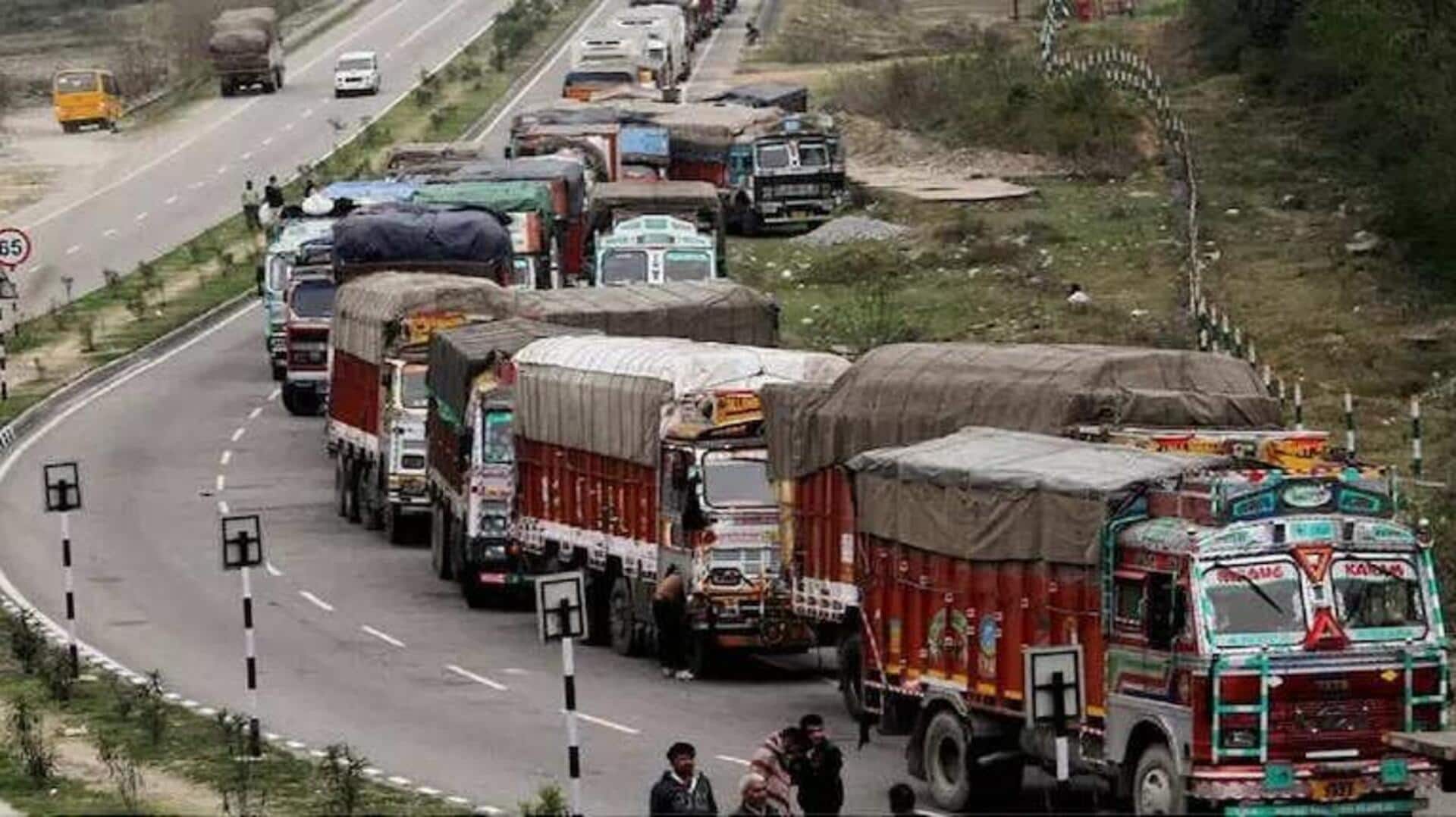
Why trucking in India is slow despite faster expressways
What's the story
India's huge investment in highways and expressways has not resulted in a proportionate increase in freight movement speed. A year-long government study found that trucks spend too much time waiting at warehouses, factories, and logistics hubs. This is a major concern as nearly 70% of India's freight is transported by road, making the system heavily reliant on trucking efficiency.
Government response
MoRTH seeks measures to reduce delays
The findings of the study have prompted the Ministry of Road Transport and Highways (MoRTH) to seek measures from the Department for Promotion of Industry and Internal Trade (DPIIT).
The aim is to reduce loading and unloading delays that are hampering logistics efficiency gains from improved road infrastructure.
Despite access-controlled expressways and national highways designed for speeds of 100-120km/h, average commercial vehicle speeds remain low at just 37-38km/h on highways and 47-48km/h on expressways.
Operational challenges
Time-bound delivery commitments to be expanded
The study also found that truckers often spend up to a day each on loading and unloading cargo, which erodes the benefits of faster transit corridors.
With no strict requirement for time-bound deliveries across a large share of road freight, operators often drive at moderate speeds to conserve fuel.
This is because higher speeds significantly increase operating costs.
To address this issue, the government plans to expand time-bound delivery commitments across a broader range of commodities.
Strategic shift
Incentives for drivers, institutional interventions on the cards
The government also plans to push for time-based incentive schemes for drivers, replacing current cost-centric models that discourage faster transit.
MoRTH has urged DPIIT to examine institutional interventions that can lower turnaround times at industrial facilities.
A consultative process involving transporters, logistics firms, drivers and manufacturers is also being planned to address operational bottlenecks limiting the efficiency gains expected from upgraded highways.
Industry perspective
What do logistics executives say?
Logistics executives have warned that faster driving alone won't solve the problem.
Sameer Varma, Executive Director at ColdStar Logistics, said, "The push for time-dependent movement is the right instinct, but it will only work if we fix what happens at the loading dock."
He suggested formalizing shipper-transporter agreements via enforceable service level agreements (SLAs), mechanizing cargo handling and adopting relay driving as possible solutions.
Infrastructure evaluation
Infrastructure experts call for change
Industry experts have also suggested that India should measure transport infrastructure by freight movement outcomes rather than road construction alone.
Kuljit Singh, Partner and National Infrastructure Leader at EY India, said, "For decades, India has measured highway success by the kilometers of roads built. Instead, it should track, publicize and manage the average speed of traffic on these corridors annually."