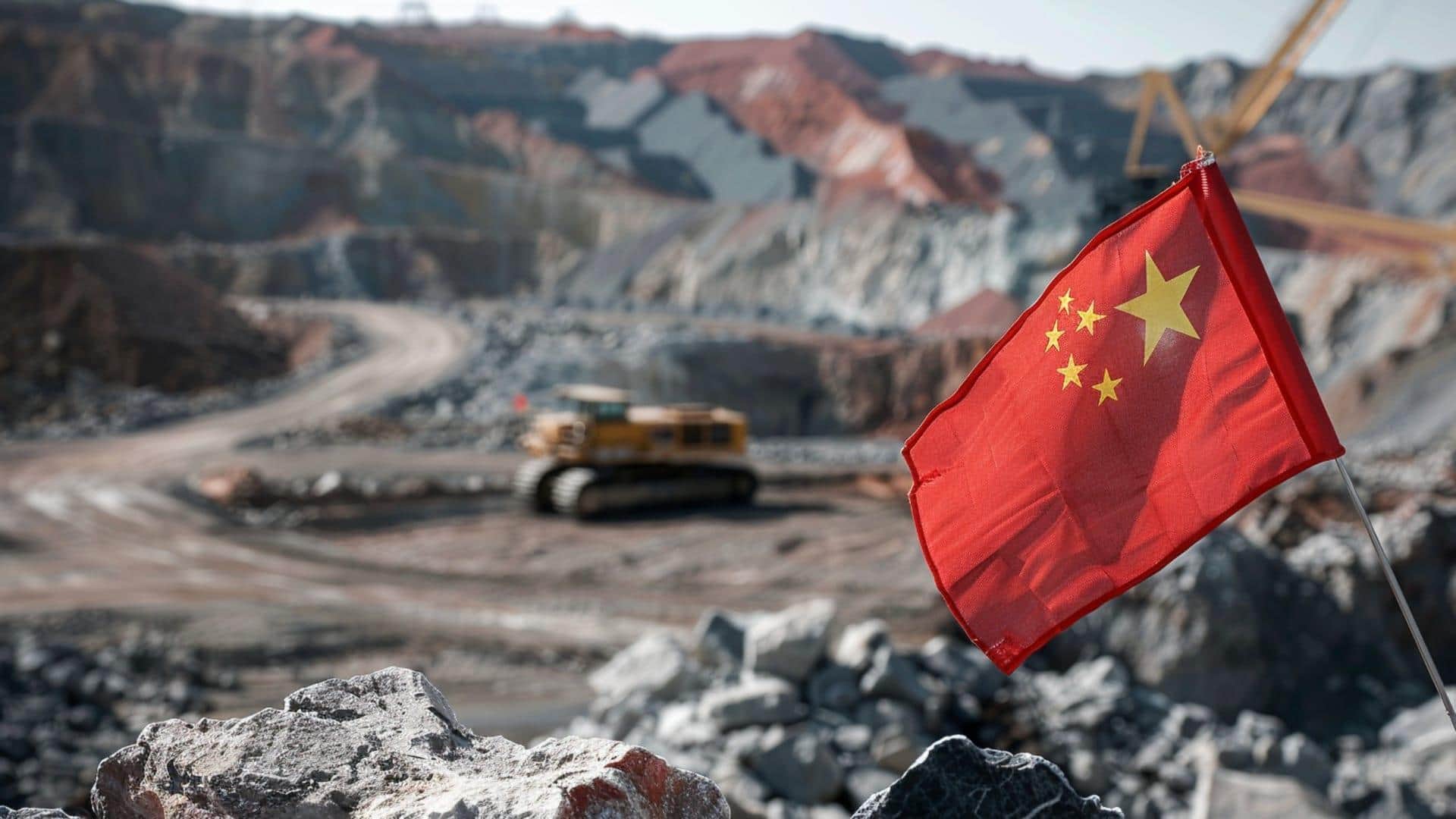
Why China's export curbs threaten $6.5 trillion supply chains
What's the story
China's recent export restrictions on critical minerals and rare earth elements could endanger an estimated $6.5 trillion worth of annual downstream production outside the country, the International Energy Agency (IEA) has warned. The IEA's Global Critical Minerals Outlook 2026 report highlights that industries such as automotive, defense, clean energy, and high-tech manufacturing are particularly vulnerable due to their reliance on concentrated supply chains.
Economic impact
Rare earth restrictions disrupt industries
In April 2025, China imposed export controls on seven heavy rare earth elements, disrupting downstream industries.
Companies relying on rare earth magnets were particularly affected, with some automakers having to cut utilization rates or even shut down temporarily.
The IEA report notes that these restrictions highlight the world's reliance on China's processing capabilities for critical minerals.
Market control
Efforts to diversify supply chains
Despite many countries having mineral reserves, China remains the dominant player in refining and processing several key materials needed for electric vehicles, renewable energy equipment, semiconductors, and defense applications.
This disruption from China's rare earth restrictions has prompted governments and companies worldwide to speed up efforts to diversify supply chains, develop alternative processing capacity, and secure long-term mineral supplies.
Market fluctuations
Price volatility across critical mineral markets
The IEA report also highlights that price volatility is not limited to rare earths. Critical mineral markets across battery materials, base metals, and strategic minerals have also witnessed sharp price movements amid rising demand and supply constraints.
For instance, prices of base metals such as copper, aluminum, and tin rose by about one-third between January 2025 and April 2026 due to tighter market conditions.
Refining dominance
Concentration of refining capacity
The IEA report warns that global refining capacity remains heavily concentrated, with top refining nations accounting for more than 75% of total growth in refined mineral supply over the past two years.
China dominates several key energy minerals while Indonesia has emerged as a dominant player in nickel processing.
Excluding rare earths, the average market share of the largest refining country stood at 72% in 2025, highlighting continued dependence on a small number of suppliers.
Investment hurdles
Investment challenges in diversifying supply chains
The push to diversify supply chains is also facing investment challenges. Global critical mineral investment fell by 9% in 2025, while capital spending in battery metals declined by over 20%.
The IEA report suggests that diversification would involve additional costs but could have a limited impact on consumers as critical minerals usually account for only a small share of the final cost of products.