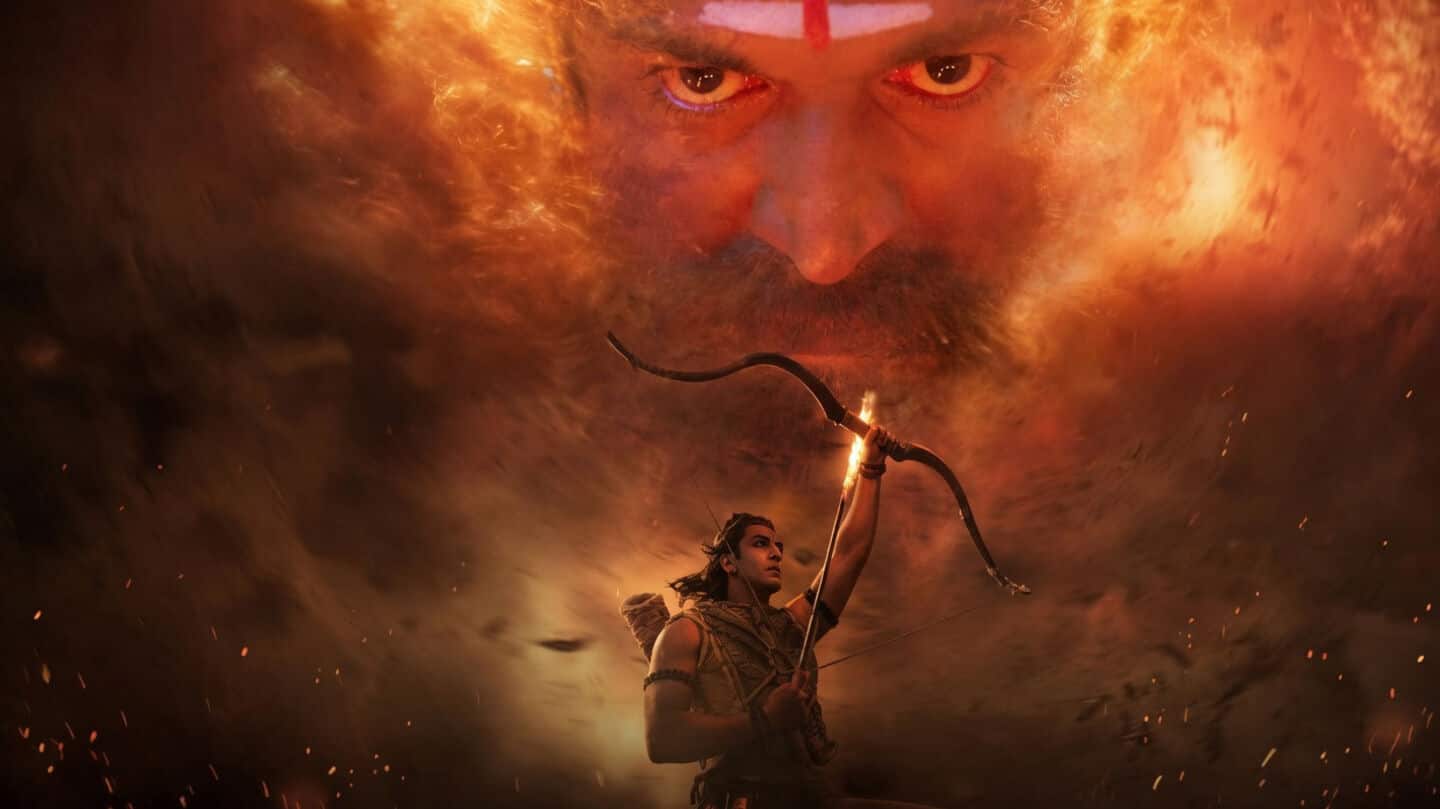
'Ramayana' to release in ScreenX, 4DX globally
What's the story
The first part of Nitesh Tiwari's two-part Ramayana adaptation will be released in ScreenX and 4DX globally on Diwali 2026, as per Prime Focus Studios, via Variety India. The deal with CJ 4DPLEX will see the film being screened in nearly 1,300 ScreenX and 4DX theaters worldwide. This marks a historic first for an Indian film to be released in ScreenX.
Cast details
Meet the star cast and crew of 'Ramayana'
The film features a star-studded cast with Ranbir Kapoor as Rama, Sai Pallavi as Sita, Yash as Ravana, Sunny Deol as Hanuman, and Ravie Dubey as Lakshmana.
Namit Malhotra is producing through Prime Focus Studios in association with DNEG and Yash's Monster Mind Creations.
Shridhar Raghavan has adapted the screenplay, while Hans Zimmer and AR Rahman are composing the music.
ScreenX explained
What is ScreenX?
ScreenX is a premium cinema format that expands select portions of a film from the main screen to the walls on either side of the auditorium.
This creates a 270-degree viewing field, allowing certain sequences to occupy the audience's peripheral vision.
For Ramayana, specially formatted sequences will use the side walls during selected action and dramatic moments.
4DX details
And, what is 4DX?
While ScreenX enhances the visual experience, 4DX adds physical immersion.
This format combines motion-enabled seats with environmental effects that are synchronized to scenes in the film.
Depending on the sequence, 4DX auditoriums can use effects such as movement, vibration, wind, water, snow, scents, and lighting effects.
Ramayana will contain sequences specifically formatted for this presentation.
Sequel details
'Ramayana' will be released in 2 parts
The film is the first of a two-part live-action adaptation based on Valmiki's Ramayana. The second part is currently in production and will be released worldwide during Diwali 2027.
The ScreenX and 4DX deal gives Ramayana more premium-format options as it gears up for its global Diwali 2026 release, with the two formats offering different ways to present the film's large-scale visual and action sequences.