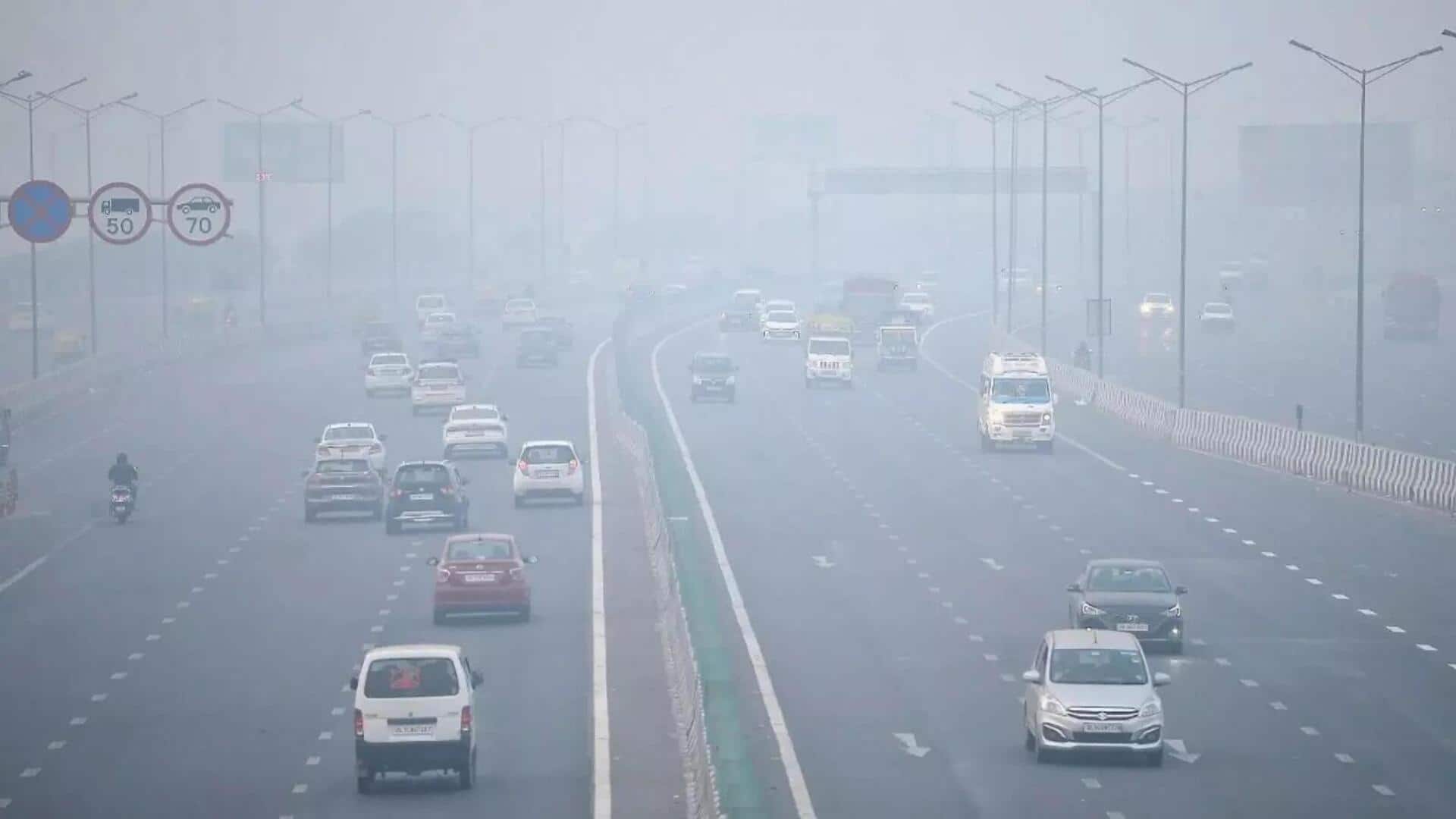
GRAP-4 enforced in Delhi-NCR as AQI nears 450
What's the story
The Graded Response Action Plan (GRAP-4) has been reimposed in Delhi and the National Capital Region (NCR) after the Air Quality Index (AQI) approached 450 on Saturday. The Commission for Air Quality Management (CAQM) reported that the AQI in Delhi rose from 400 at 4:00pm to 428 four hours later due to "western disturbance, highly unfavorable weather/meteorological conditions, and lack of dispersal of pollutants."
Action measures
GRAP-4's Stage IV measures activated amid worsening air quality
In light of the deteriorating air quality, the CAQM Sub-Committee on GRAP has decided to implement all actions under Stage-IV of GRAP, which is 'Severe+' Air Quality (DELHI AQI > 450). Under this stage, a number of restrictions come into effect. These include a ban on vehicles that are not BS-VI compliant (including petrol vehicles), while also not bearing a Delhi registration from entering the capital.
Vehicle ban
Restrictions on vehicles and construction activities
Moreover, the entry of non-essential trucks into Delhi is banned, barring those carrying essential goods or those that use cleaner fuels, such as LNG, CNG, electric, or BS-VI diesel. All construction and demolition activities are also completely halted under GRAP-4. This includes public projects such as highways, roads, flyovers, overbridges, power transmission lines, and pipelines. In a new restriction introduced in December 2025, under GRAP-4, non-BS-VI compliant vehicles are banned from entering Delhi unless they bear a Delhi registration.
Work-from-home
Schools and offices advised to shift online and remote
To protect vulnerable groups, such as children, state governments in NCR and the Government of the National Capital Territory of Delhi (GNCTD) may shift physical classes for students in classes VI to IX and XI to online mode. Public, municipal, and private offices are also advised to operate with at least 50% staff working from home. Staggered timings may also be introduced to reduce peak-hour traffic.
Additional measures
Discretionary measures and potential work-from-home policies
State governments can consider further steps such as closing colleges and educational institutions, suspending non-emergency commercial activities, or implementing odd-even vehicle rationing schemes. The central government may also decide on work-from-home policies for its employees. The measures implemented by CAQM come into effect after air quality deteriorates over an index of 450, and are aimed at preventing further deterioration of air quality in the region