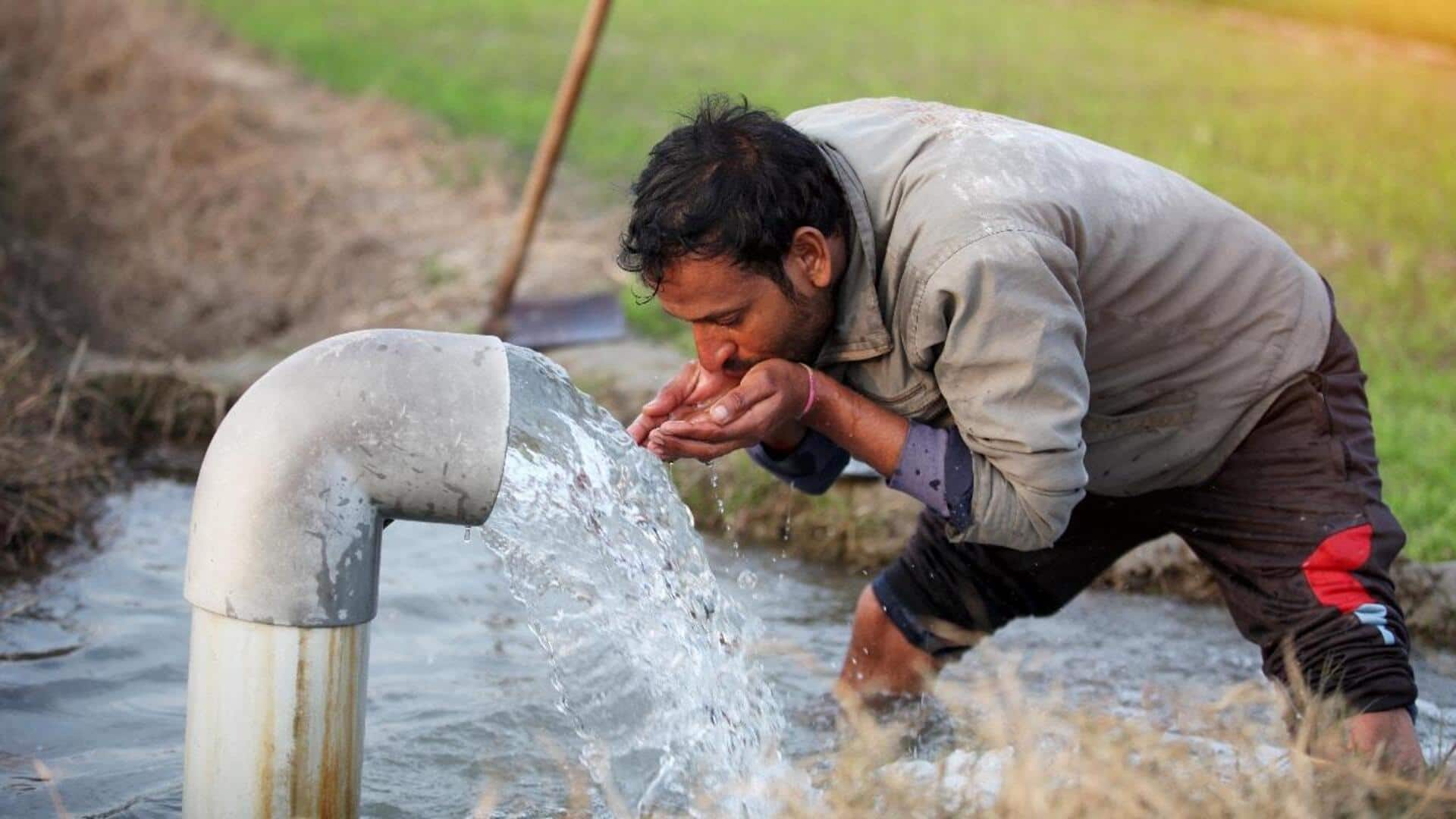
India is running out of groundwater, says report
What's the story
India's freshwater reserves are under severe stress, according to a new report by the World Meteorological Organization (WMO). The WMO's "State of Global Water Resources 2025" report, released on September 17, highlights persistent groundwater deficits across northwestern India from 2022 to 2025. The study indicates a multi-year drying trend and cumulative depletion of these vital resources.
Water storage
Terrestrial water storage below normal in northern India
The WMO report also notes that terrestrial water storage was below normal in northern India in 2025.
This includes freshwater stored underground, in soil, rivers, lakes, reservoirs, vegetation as well as snow and ice.
The findings highlight the growing challenge of managing India's water resources amid changing climate conditions.
Dependence
Groundwater's critical role in India's agriculture
Groundwater is a major contributor to irrigation in northwestern India's agricultural belt.
The Central Ground Water Board (CGWB) estimates that groundwater accounts for nearly 62% of India's irrigation and is also a key source of rural and urban water supply.
This dependence makes the persistent groundwater deficit more concerning than a temporary drop in water levels, as it could have long-term implications for food security and access to drinking water.
Over-exploitation
Over-exploitation of groundwater resources
The CGWB's latest national assessment also highlights the pressure on groundwater resources.
Its 2023 report classified 736 out of 6,553 groundwater assessment units as over-exploited, with another 199 categorized as critical and 698 as semi-critical.
Together, these findings paint a picture of a water system where extraction and replenishment are becoming increasingly important to agricultural resilience in India.
Global
Broader change in global water cycle
The WMO report puts India's groundwater situation in the context of a broader change in the global water cycle.
It says terrestrial water storage has been on a downward trend since 2014-16, with an increasing area experiencing below-normal conditions.
In 2025, below-normal storage was recorded across several regions including northern India.
Climate
Diminished river flows complicate water management challenges
The WMO report also raises questions about how much protection groundwater can continue to provide if successive years of climatic stress coincide with continued extraction.
In 2025, it was one of the driest years for global river discharge in 35 years, with below-normal flows covering 36% of the world's river-basin area.
This trend further complicates India's water management challenges as it navigates between periods of drought and excess rainfall.
Glacial impact
Glacier mass loss and implications for river systems
The report also highlights the loss of mass from global glaciers, which could have long-term implications for river systems in India.
Glaciers are slow components of the water cycle, and their retreat can initially increase runoff but lower the longer-term reserve available to downstream rivers.
This trend further complicates India's water management challenges.